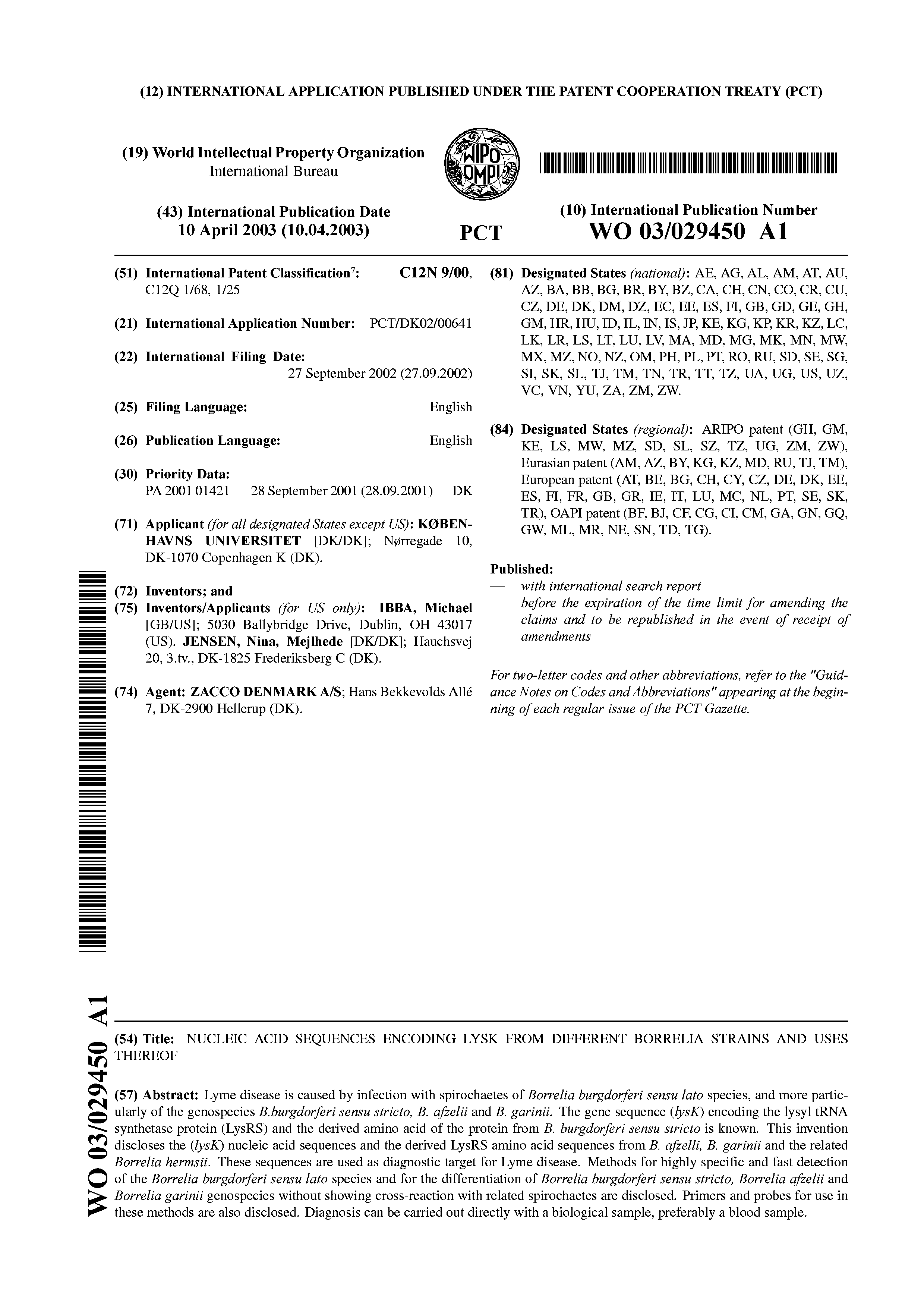
[0001]NUCLEIC ACID SEQUENCES ENCODING LYSK FROM DIFFERENT BORRELIA STRAINS AND USES
[0003]5 FIELD OF THE INVENTION
[0004]The present invention concerns the use of the class l-type lysyl-tRNA synthetase (LysRS) as diagnostic target for Lyme disease. For this purpose the corresponding gene (lysK) was cloned and sequenced from several genospecies of Borrelia burgdorferi sensu lato. lysK specific primers designed to 10 detect and/or genotype the different Lyme disease-causing Borrelia in one single polymerase chain (PCR) reaction are disclosed in the invention. The methods of the invention are so sensitive and specific that no cross-reactivity with examples of other Borrelia or spirochaetes species is observed.
[0005]BACKGROUND OF THE INVENTION
[0006]15 The etiological agent of Lyme borreiiosis, several genospecies of the spiro- chaete Borrelia burgdorferi sensu lato, is transmitted to mammals by the bite of an infected Ixodes tick (1 , 2). The initial manifestation of infection in humans is mild constitutional symptoms, often associated with erythema mi- grans, a red rash expanding from the site of the tick bite. The spirochaetes
[0007]20 then spread hematogenously to additional body tissues and the disease can progress to chronic neurologic, cardiac, cutaneous, and arthritic manifestations if it is left untreated (7). The late manifestations of the disease seem to be associated with the three distinct genospecies of B. burgdorferi sensu lato: B. burgdorferi sensu stricto is associated with arthritis, B. afze/// with cu-
[0008]25 taneous symptoms and S. garinii with neuroborreliosis (8).
[0009]Routine laboratory diagnosis of Lyme borreiiosis depends on serological detection of B.
 antibodies. However, the sensitivity of this method during early infection is low and antibody concentrations decrease only slowly after therapy (4). Present diagnostic techniques, such as ELISA 30 and Western blotting, furthermore often test false positive when applied to
patients who are not infected with Lyme disease but have relapsing fever (S hermsii infections), Rocky Mountain spotted fever, mononucleosis, syphilis {Treponema pallidum) and rheumatoid arthritis PCR has proven its diagnostic value for detection of Borrelia in patient samples (9, 10, 11 , 12, 13), but the genetic variation of 8 burgdorfeπ makes it difficult to design primer sets that can detect and genotype all pathogenic genospecies (5, 6)
antibodies. However, the sensitivity of this method during early infection is low and antibody concentrations decrease only slowly after therapy (4). Present diagnostic techniques, such as ELISA 30 and Western blotting, furthermore often test false positive when applied to
patients who are not infected with Lyme disease but have relapsing fever (S hermsii infections), Rocky Mountain spotted fever, mononucleosis, syphilis {Treponema pallidum) and rheumatoid arthritis PCR has proven its diagnostic value for detection of Borrelia in patient samples (9, 10, 11 , 12, 13), but the genetic variation of 8 burgdorfeπ makes it difficult to design primer sets that can detect and genotype all pathogenic genospecies (5, 6)
[0010]The enzyme that adds lysine to its corresponding tRNAs, lysyl-tRNA synthetase (LysRS) is an essential component of gene expression and might therefore be considered as a "house keeping gene" LysRS is unusual among the aminoacyl-tRNA synthetases because the enzyme, dependent on the organism, is found as one of two structurally distinct protein classes In eukaryotes and most bacteria, LysRS is found as a class II aminoacyl-tRNA synthetase, whereas in archea and certain bacteria, including the human pathogens 8 burgdorferi, Treponema pallidum (the spirochaete that causes syphilis) and Rickettsia prowazecku, the enzyme belongs to class I (17, 18)
[0011]The genome of 8 burgdorferi sensu stricto strain B31 has been fully se- quenced (14) and the gene encoding LysRS, lysK, has been identified (3)
[0012]OBJECT OF THE INVENTION
[0013]The object of the present invention is to provide the nucleic acid sequences of lysK from 8 afzelu and 8 garinii, two other genospecies of 8 burgdorferi known to cause Lyme borreiiosis, as well as lysK of 8 hermsii, a related Borrelia that causes relapsing fever A further object is to provide fast and specific diagnostic methods These methods are primarily based on primers derived from Borrelia lysK sequences, but other methods are disclosed as well A PCR reaction allows for direct and rapid molecular typing of 8 burgdorfeπ- containing samples, at the same time detecting and genotypmg the different pathogenic genospecies, and thereby facilitate studies of the relationship between type of Borrelia infection and clinical manifestations
SUMMARY OF THE INVENTION
[0014]Fundamental structural differences between the LysRS enzymes of pathogen and host in Borrelia infections, makes LysRS protein and/or the lysK gene a desirable target for diagnosis of Lyme disease. These structural differences are well known in the art but it is novel to combine this with methods of diagnosing Lyme disease. It is also novel that sufficient differences exist between lysK sequences of the various genospecies of Borrelia burgdorferi sensu lato, to permit genotyping of the infection in a fast and easy one-step process.
[0015]The following nucleic acid sequences are disclosed in the invention:
[0016]• an isolated nucleic acid molecule comprising the lysK coding sequence of Borrelia afzelii which is shown in SEQ ID NO:1 and is the subject-matter of claim 1 ;
[0017]• an isolated nucleic acid molecule comprising the lysK coding sequence of Borrelia garinii which is shown in SEQ ID NO:3 and is the subject-matter of claim 2; and
[0018]• an isolated nucleic acid molecule comprising the lysK coding sequence of the more distantly related species Borrelia hermsii which is shown in SEQ ID NO:5 and is the subject-matter of claim 3.
[0019]Methods of highly specific and fast detection and/or differentiation of the Bor- relia strains Borrelia burgdorferi sensu stricto, Borrelia afzelii, and Borrelia garinii, without showing cross-reaction with related species are disclosed. Diagnosis can be carried out directly with a biological sample, preferably a blood sample.
[0020]Thus, in a first aspect involving PCR, the invention provides a method of di- agnosing Lyme disease in a mammalian subject, using /ysK-encoding nucleic acid molecules of Borrelia burgdorfeπ, Borrelia afzelii (SEQ ID NO: 1 ), and Borrelia garinii (SEQ ID NO: 3) genospecies as diagnostic target, comprising:
[0021](i) designing primers that anneal under appropriate conditions with lysK from the known Lyme disease-causing Borrelia genospecies (8.
burgdorferi, B. afzelii, and 8. garinii) but not with lysK from other pathogenic spirochaetes such as the relapsing fever-causing Borrelia hermsii;
[0022](ii) using these primers together with a biological sample from the subject in a PCR and subsequently detecting amplified fragments to specifically diagnose presence of Lyme disease-causing Borrelia.
[0023]More specifically, this aspect of the invention provides a method of diagnosing Lyme disease in a mammalian subject and differentiating between Borrelia burgdorferi, Borrelia afzelii, and Borrelia garinii genospecies, using lysK- encoding nucleic acid molecules of Borrelia burgdorfeπ, Borrelia afzelii (SEQ ID NO: 1 ), and Borrelia garinii (SEQ ID NO: 3) genospecies as diagnostic target, comprising:
[0024](i) designing genospecies-specific primers that anneal under appropriate conditions with lysK from the known Lyme disease-causing Borrelia genospecies (8. afzelii, B. burgdorferi, and 8. garinii) but not with lysK from other pathogenic spirochaetes such as the relapsing fever- causing Borrelia hermsii
[0025](ii) using these primers together with a biological sample from the subject in a PCR and subsequently detecting amplified fragments to specifi- cally diagnose presence of Lyme disease-causing Borrelia and to genotype the infection based on PCR fragment sizes.
[0026]The PCR used to amplify relevant fragments may be a traditional PCR using DNA as template or it may e.g. be a RT-PCR using RNA as template. It may also be conducted as a real time PCR or a real time RT-PCR. The detection of the amplified fragments may be carried out by separation of the fragments by gel electrophoresis or by measuring Tm of the fragments. However, it may also be made by means of microarray techniques.
[0027]In a second aspect involving Southern blot, the invention provides a method of diagnosing Lyme disease in a mammalian subject, using /ysK-encoding nucleic acid molecules or LysRS protein of Borrelia burgdorferi, Borrelia afze-
//'/' (SEQ ID NO: 1 ), and Borrelia garinii (SEQ ID NO: 3) genospecies as diagnostic target, and/or to quantify the amount of Lyme disease-associated lysK nucleic acid or LysRS protein, comprising:
[0028](i) providing a labelled single-stranded /ys -specific probe; and
[0029](ii) hybridizing said probe with immobilized DNA of a biological sample from the subject in a Southern blot-based reaction.
[0030]In a third aspect involving antibodies, the invention provides a method of diagnosing Lyme disease in a mammalian subject, using /ysK-encoding nucleic acid molecules or LysRS protein of Borrelia burgdorferi, Borrelia afzelii (SEQ ID NO: 1 ), and Borrelia garinii (SEQ ID NO: 3) genospecies as diagnostic target, and/or to quantify the amount of Lyme disease-associated lysK nucleic acid or LysRS protein, comprising:
[0031](i) raising polyclonal or monoclonal antibodies against lysK nucleic acid, or against native or denatured or recombinant LysRS protein, or frag- ments thereof, and selecting antibodies that specifically detect Lyme disease-associated Borrelia without cross-reacting with lysK or LysRS from other pathogenic spirochaetes such as the relapsing fever- causing Borrelia hermsii] and
[0032](ii) using these antibodies in antibody-based detection methods such as ELISA, Western blot, RIA, etc. to specifically diagnose presence of
[0033]Lyme disease-causing Borrelia, and/or to quantify the amount of lysK nucleic acids or LysRS protein in a biological sample from the subject.
[0034]More specifically, this third aspect of the invention provides a method of diagnosing Lyme disease and differentiating between Borrelia burgdorferi, Bor- relia afzelii, and Borrelia garinii genospecies in a mammalian subject, using /ysK-encoding nucleic acid molecules or LysRS protein of Borrelia burgdorferi, Borrelia afzelii (SEQ ID NO: 1 ), and Borrelia garinii (SEQ ID NO: 3) genospecies as diagnostic target, and/or to quantify the amount of Lyme disease-associated lysK nucleic acid or LysRS protein, comprising:
(i) raising polyclonal or monoclonal antibodies against lysK nucleic acid, or against native, or denatured, or recombinant LysRS protein, or fragments thereof and selecting antibodies that can specifically detect Lyme disease and Lyme disease associated Borrelia genospecies without cross-reacting with /ys /LysRS from other pathogenic spirochaetes such as the relapsing fever causing Borrelia hermsii, and
[0035](n) using these antibodies in antibody-based detection methods such as ELISA, Western blot, RIA, etc to specifically diagnose presence of Lyme disease causing Borrelia, and to genotype the infection and/or to quantify the amount of lysK nucleic acids or LysRS protein in a biological sample from the subject
[0036]The diagnostic target for Lyme disease in these methods of the invention may also be a variant of any one of the lysK sequence of the Type strain of 8 burgdorferi, the lysK sequence of 8 afzelii according to claim 1 , the lysK sequence of 8 garinii according to claim 2, and the LysRS proteins expressed therefrom, said variant occurring in natural strains of the genospecies 8 burgdorferi, B afzelii, and 8 garinii
[0037]Further, it is conceivable that the nucleic acid molecules comprising the lysK coding sequences of Borrelia afzelu and Borrelia garinii, respectively, may be mutated by means of recombinant molecular biology methods, for example in order to remove mutually common epitopes or epitopes common with 8 burgdorferi sensu stricto thus making them better suited for raising antibodies specific for each genospecies
[0038]The invention also provides expression vectors having the above mentioned nucleic acids inserted as well as host cells being transformed with the vectors and a method of producing LysRS protein by culture of the host cells
[0039]Further, the invention provides a method of designing a primer set for use in specific diagnosis of Lyme disease, whereby two primers are designed, based on lysK sequence alignment, to anneal specifically to lysK from 8 burgdorferi, B afzelu, and 8 garinii, but not to lysK from other pathogenic spirochaetes such as the relapsing fever-causing 8 hermsii, in such a way
that use of the said two primers in a PCR with template DNA from a Lyme disease-associated Borrelia genospecies will result in the amplification of fragments of a previously determined size thereby allowing diagnosis of Lyme disease
[0040]Primer sets to be used in both specific diagnosis and genotyping of Lyme disease can be designed by a method of the invention comprising, based on sequence alignment
[0041](i) designing three genospecies-specific lysK primers, wherein one primer is specific for B burgdorferi, another primer is specific for 8 afzelu, and the third primer is specific for 8 garinii, but none of the three primers cross-react with lysK from other pathogenic spirochaetes such as the relapsing fever-causing 8 hermsii, and
[0042](II) (1 ) designing one primer that is specific for lysK from 8 burgdorferi, B afzelu, and 8 garinii, but does not cross-react with lysK from other pathogenic spirochaetes such as the relapsing fever-causing 8 hermsii, or (2) designing two primers the first one being specific for one of the Lyme disease associated Borrelia genospecies and the other one being specific for two of the Lyme disease associated Borrelia genospecies, but none of them cross-reacting with lysK from other patho- genie spirochaetes such as the relapsing fever-causing 8 hermsii, or
[0043](3) designing another three primers as in (i), wherein the distance between each of the primers in (i) and each of the primers in (ιι)(1 ), (H)(2) and (H)(3) IS at least 10 bp, preferably at least 50 bp, and most preferably at least 80 bp, and
[0044]combining the primers in (i) with the primers in (ιι)(1 ), (H)(2) or (ιι)(3) to form a primer set which in a PCR with template DNA from 8 burgdorferi, B afzelu, or 8 garinii will result in the amplification of DNA fragments of three different sizes, thereby allowing diagnosis and genotyping of Lyme disease in one step
[0045]A primer selected to hybridise with 8 burgdorferi, B afzelu or 8 garinii should have a length of at least 10 bases, more preferably a length of 15-50
bases and most preferably a length of 18-30 bases. Specific primers according to the invention are disclosed in the following. Such primers can be used to detect and genotype Lyme disease by the above described methods involving PCR. However, they may also be used to prepare labelled single- stranded probes for use in the above described method involving Southern blot.
[0046]Further, the invention provides a PCR kit for use in diagnosis of Lyme disease, comprising a primer set designed as described in claim 19, a positive control containing DNA from Lyme disease-causing Borrelia, and preferably also a negative control containing either unrelated DNA or DNA from a closely related pathogenic spirochaete such as 8. hermsii.
[0047]The invention also provides a PCR kit for use in diagnosis of Lyme disease and genotyping of the 8. burgdorferi, B. afzelii, and 8. garinii genospecies, comprising a primer set designed as described in claim 20 or all the primers of claims 23-26, a positive control containing DNA from Lyme disease- causing Borrelia, and preferably also a negative control containing either unrelated DNA or DNA from a closely related pathogenic spirochaete such as 8. hermsii.
[0048]The PCR kits of the invention may also be adapted to RT-PCR in which case the primers work on lysK reverse transcribed from RNA expressed by the 8. burgdorferi, 8. afzelii, and 8. garinii genospecies. In such RT-PCR kits the positive and negative control should be the corresponding RNAs instead of DNAs. Further, both the PCR kits and the RT-PCR kits of the invention may be adapted to so-called real time PCR thus making it possible to quantify the amount of lysK DNA or lysK RNA, respectively, from the 8. burgdorferi, B. afzelii, and 8. garinii genospecies.
[0049]In addition, the invention provides a kit for use in diagnosis of Lyme disease and/or genotyping and/or quantifying the amount of Lyme disease-associated lysK nucleic acid or LysRS protein from 8. burgdorferi, 8. afzelii, and 8. garinii genospecies, comprising antibodies as described in claim 11 or 12, a positive control containing lysK or LysRS from Lyme disease-causing Sorre- lia, and preferably also a negative control containing either unrelated DNA or
protein or DNA or protein from a closely related pathogenic spirochaete such as 8 hermsii.
[0050]BRIEF DESCRIPTION OF THE DRAWINGS
[0051]Fig. 1. Alignment of Borrelia lysK nucleotide sequences. Start and stop codons are in italics. The sequences shown are from 8. burgdorferi {BblysK), available from the public database www.tiqr.org: 8. afzelii (Ba/ys ), SEQ ID NO:1 ; 8. garinii (BglysK) SEQ ID NO:3; and 8. hermsii (Bh/ysK), SEQ ID NO:5. Positions corresponding to specific primer sites are underlined. 8. burgdorfeπ specific primer: NM29, 8. afzelii specific primer: s5dk26, 8. garinii specific primer: s5dk6. The primer which is specific for all three genospecies: NM30.
[0052]Fig. 2. Alignment of Borrelia LysRS amino acid sequences. The sequences shown are from 8. burgdorferi (BbKRS), 8. afzelii (BaKRS), and 8. hermsii (BbKRS).
[0053]Fig. 3. Gel electrophoresis of PCR products on genomic DNA from different spirochaetes. The primer mixture used for the reaction consisted of the primers: NM29, s5dk26, s5dk6, and NM30. 20 μl of each reaction mixture was subjected to electrophoresis on a 1.5% agarose gel and stained with ethidium bromide. From left to right: 100 bp DNA ladder (lane 1 ), 8. afzelii (lane 2), B. burgdorferi (lane 3), B. garinii (lane 4), B. hermsii (lane 5) and Treponema pallidum (lane 6).
[0054]DETAILED DESCRIPTION OF THE INVENTION
[0055]Sequencing of the lysK gene
[0056]The lysK sequence of 8. burgdorfeπ sensu stricto B31 was available from the public database (www.tigr.org). In order to clone lysK sequences from 8. afzelii., B. garinii., and 8. hermsii, primers derived from the 8. burgdorferi lysK sequence were constructed and used in PCR reactions with genomic DNA from 8. afzelii, B. garinii and 8. hermsii as templates (Fig. 3). These primers (NM18, NM9, NM3, BBKRS2, SI5nt, SI3aa, and NM20; Table 1 ) did not work on the genospecies in a normal PCR (55 °C annealing tempera-
ture). However, in a PCR reaction with a very low annealing temperature (35 °C) the primers surprisingly annealed specifically to 8. afzelii, 8. garinii and 8. hermsii lysK. The PCR products were sequenced on both strands and contiguous sequences were made.
[0057]8. hermsii, the causative agent of relapsing fever, was added to the analysis in order to design Borrelia burgdorferi sensu lato specific primer sets, which would not cross react with other related Borrelias. Present techniques used in diagnosis of Lyme borreiiosis, such as ELISA and Western blotting, often test positive when applied to patients with relapsing fever (8. hermsii), Rocky Mountain spotted fever, mononucleosis, syphilis and rheumatoid arthritis.
[0058]DNA alignment of Borrelia lysK sequences
[0059]A sequence alignment of lysyl-tRNA synthetase encoding sequences from 8. burgdorferi sensu stricto, 8. afzelii, B. garinii and B. hermsii is shown in Fig. 1. A sequence alignment of the corresponding amino acid sequences is shown in Fig. 2. To further illustrate the degree of similarity between the sequences, a distance matrix was made using the amino acid and DNA sequence alignments, respectively (Table 2). Comparison of the lysK sequences revealed a high degree of homology (>90%) between the three strains 8. burgdorferi sensu stricto, 8. afzelii and 8. garinii. lysK from 8. hermsii on the other hand, showed a considerably lower degree of homology to 8. afzelii, B. burgdorferi and 8. garinii (75%) reflecting that 8. hermsii is more distantly related to these genospecies.
[0060]Table 1 : List of primers used to amplify and sequence lysK:
[0061]NM18: (GAAAAGAAATAAAATCAATAG) 208 bp upstream from start codon (SEQ ID NO 7)
[0062]NM9: (ATGGTGAAAACAGCACACTGGG) 19 bp upstream from start codon (SEQ ID NO 8)
[0063]NM3: (CAGTTCTTTTTTATGATCAAGTGC) 438 bp downstream from start codon (SEQ ID NO 9)
[0064]BBKRS2: (GATAAAGAT TTGGATCCCATTAAACATTAC) 140 bp downstream from stop codon (SEQ ID NO 10)
[0065]SI5nt: (GCATCGGGRATTACYCCMTC) 106 bp downstream from start codon (SEQ ID NO 11)
[0066]SI3aa: (CNTCNGGYTGRTANACYTCNARNACRTC) 876 bp downstream from start codon (SEQ ID NO 12)
[0067]NM20: (CCTCATYAGGAGATGTCATATC) 870 bp downstream from start codon (SEQ ID NO 13)
[0068]NM29: (CCACAAAACAAGTTATGCAAGG) specific for 8. burgdorferi sensu stricto (SEQ ID NO 14)
[0069]s5dk26: (CAAACAATATACCAACGGTGT) specific for 8. afzelii (SEQ ID NO 15)
[0070]s5dk6: (AGCTTTAAAAGACTCTGGATCGC) specific for 8. garinii (SEQ
[0072]NM30: (GTARATYCTCTCAAAYYTGTCG) specific for all three genospecies (SEQ ID NO 17)
Table 2. Distance matrix indicating similarity between Borrelia lysK DNA sequences (italics), and LysRS ammo acid sequences (bold)
[0074]Borrelia type1 b a g h
[0079]O g 93 94 100 74 c 'Z
[0082]CO ε h 76 77 76 100 o
[0083]1 abbreviations b, B burgdorfeπ, a, B afzelii g, B garinii, h, B hermsii
[0084]The similarity values were calculated from the ClustalW sequence alignments shown in Figs l and 2 (19)
[0085]Design of genospecies-specific primers
[0086]Numerous primers may be designed to differentiate between 8 afzelu, B burgdorferi and 8 garinii genospecies by PCR It is straightforward for a person skilled in the art to identify regions of high or low homology between these sequences, in order to design primers of the desired specificity Subsequently it is likewise straightforward for a person skilled in the art to optimize PCR conditions with the primers All primers exemplified in this invention are listed in Table 1
[0087]Primers to be used in carrying out this invention should have a length of at least 10 nucleotides in order to minimize the risk of the presence of a secondary hybridization site that is unrelated with the Borrelia lysK gene The length of the primers should more preferably be 15-50 nucleotides and most preferably be of a length of 18-30 nucleotides
[0088]Any primer designed for the purpose of practicing the present invention, should misprime with 8 hermsii lysK by at least one nucleotide and more
preferably by at least two nucleotides and most preferably by at least three nucleotides. This aspect is important in order to obtain the desired specificity and reliability of the diagnosis.
[0089]Upstream primers should be distanced appropriately from their correspond- ing downstream primers and vice versa. This distance might be of any length, as long as the primers anneal specifically. The distance between the primers can be 10-10,000 bases, more preferably 100-2000 bases and most preferably 300-1000 bases.
[0090]The primers of Example 2 were designed as follows: The 3' degenerate primer (NM30) is designed to anneal to any of the three 8. burgdorferi sensu lato genospecies and the three 5' primers (NM29, s5dk26, and s5dk6, Fig. 1 ) are designed to specifically anneal to 8. burgdorferi, B. afzelii, and 8. garinii, respectively.
[0091]As shown in Fig. 3, PCR with genomic DNA from 8. afzelii and the primers NM29, s5dk26, s5dk6, and NM30 gave rise to a band of 619 basepairs. PCR with 8. burgdorferi sensu stricto genomic DNA gave rise to a band of 709 basepairs, and 8. garinii genomic DNA gave rise to a band of 856 basepairs. PCR with genomic DNA from 8. hermsii and genomic DNA from Treponema pallidum respectively did not yield any bands. Such fragment sizes result in a good separation on an agarose gel, as well as being appropriate for a normal PCR reaction.
[0092]The primer that anneals to the three genospecies might as well be a 3' primer and the three corresponding genotype specific primers 5' primers.
[0093]Instead of using one primer specific for all three genospecies, two or three primers specific for two or three genospecies can also be used. However, it is a crucial point that at least one primer included in the PCR reaction is specific for one of the genospecies in order to obtain genotyping of the Borrelia infection. If genotyping is not desired, then the primer set can be designed on basis of the regions of highest homology among the three Borrelia lysK se- quences.
PCR reactions
[0094]The primers described in the previous section can be used in PCR reactions for diagnosis and/or genotyping of Lyme disease
[0095]A typical PCR thermal cycling programme normally comprises
[0096](i) An initial melting step
[0097](II) A "cycling step" where the DNA is melted, the primers are annealed to the single stranded DNA, and the primed DNA is then elongated by a polymerase enzyme This cycling step is repeated X number of times In some cases it is an advantage to run different cycles under different conditions
[0098](in) A final elongation step
[0099]Annealing temperature is chosen on basis of the theoretical melting temperatures of the primers, and the elongation time is chosen on basis of the size of the expected PCR-fragments However, optimal PCR conditions usually need to be determined empirically with respect to concentrations of the various components, temperatures, etc
[0100]In a preferred embodiment, a biological sample from an individual is used as "template DNA" in a PCR reaction The biological sample is typically a blood or serum sample Purified DNA from the individual can just as well be used A reaction should preferably be run along with positive and negative control reactions After the PCR reaction has been completed, the samples are separated on an agarose gel along with appropriate markers (21 ) If a band of one of the predicted sizes appears, preferably concomitantly with proper control reactions, the test is then positive and the patient is infected with Lyme disease If the primers are designed to differentiate between Borrelia genospecies, the size of the band(s) will then reveal which genospecies the patient is infected by
Other diagnostic methods
[0101]In one embodiment, quantitative "real-time PCR" can be used to quantify the amount of DNA from Borrelia or a Borrelia genospecies in a sample from an individual Borrelia quantification might be used e g as a guide to dose therapeutic antibiotics
[0102]In another embodiment, reverse transcπptase PCR (RT-PCR), a technique well known in the art, can be used to detect presence of actively transcribed lysK gene in a sample from an individual, as this gene can be considered as a "house keeping gene" Real-time RT-PCR can likewise be used to quantify amounts of lysK RNA Borrelia quantification is used for monitoring the effect of e g antibiotic therapy, or for monitoring progression of the disease in test animals, or as a guide to dose therapeutic antibiotics
[0103]In another embodiment, Southern blotting or DNA chip technology can be employed in order to detect and differentiate between Borrelia genospecies in an individual Southern blotting and DNA chip technology are both methods that are well known in the art Primers, designed as previously described, can be used as a probe DNA fragments of the lysK sequences obtained either by PCR or by restriction enzyme digestion can likewise function as a probe It is straightforward for a person skilled in the art to design appropriate probes and optimize reaction conditions, in order to obtain the desired specificity of the reactions
[0104]In yet another embodiment, poly- or monoclonal antibodies raised against the lysK gene or native/denatured/recombinant LysRS protein, or fragments thereof are used to diagnose and/or genotype the Borrelia infection It is well known to a person skilled in the art that these antibodies are subsequently used in methods like ELISA, Western blotting, RIA (radioimmuno assay), etc to detect presence of /ys /LysRS The reactions can be carried out either directly with a biological sample from an individual or with e g a DNA- containing or a protein-containing fraction
[0105]Variants of the lysK sequences from 8 afzelu, B garinii and 8 hermsii and the use of such variants are also a part of the invention These variants com-
prise naturally occurring lysK variants as well as mutants created by means of standard molecular biology methods (21 ).
[0106]In another embodiment, the lysK sequences disclosed in this invention are inserted in an expression vector. The expression vector is then transformed into an appropriate host cell and incubated in a suitable growth medium, whereby recombinant LysRS protein is synthesized. The recombinant protein is recovered and can for example be used to raise poly- and/or monoclonal antibodies against native/denatured LysRS.
[0108]The term "genospecies" refers to the phylogenetic definition of a species. A genospecies generally includes strains with at least 70% DNA-DNA related- ness at optimal conditions and with 5 °C or less D Tm [divergence (unpaired bases) within related nucleotide sequences is 5% or less]. Both values must be considered. It is possible to use the additional criterion that DNA related- ness of strains within a species is at least 55%, and more preferably at least 60% in reactions carried out under stringent incubation conditions with 5% or less divergence within related nucleotide sequences (5 °C or less D Tm).
[0109]The term "primer"' refers to a single stranded DNA molecule that is typically rather short. The terms "primer" and "oligonucleotide" are used interchangeably. Primers are usually synthesized synthetically and might be chemically or enzymatically modified (examples of such modifications can be viewed at www.hobolth.dk). One primer might also refer to several subpopu- lations of primers in the case of e.g. degenerate primers where the letters of the primer sequence that are different from "A, C, T, or G" refer to base degeneracy according to the IUPAC nomenclature system. Primers sometimes harbor an unspecific "tail" which accommodates for example restriction sites for use in cloning.
"PCR" (polymerase chain reaction) refers to a reaction that includes any polymerase enzyme capable of catalyzing DNA synthesis by addition of deoxy- ribonucleotide units to a DNA chain using DNA or RNA as template. Denatured or single stranded DNA molecules are primed by oligonucleotide prim- ers. The reaction furthermore includes nucleotides that might be labeled or unlabeled, DNA/RNA template and an appropriate buffer. The reaction is carried out in an instrument capable of performing "thermal cycling" resulting in specific DNA amplification. Amplified fragments can subsequently be detected by separation on an ethidiumbromide-stained agarose gel or by melt- ing point analysis of the fragment.
[0110]"Southern blot", "dot blot", "plaque screenings assays" etc. (21 ) are techniques where the principle is to detect the presence of specific immobilised DNA by means of a labeled single stranded probe that usually consists of a DNA molecule in the form of a restriction fragment, a PCR product or a primer. If the immobilized molecule is RNA, the technique is then usually referred to as "Northern blot". Other ways of detecting RNA include RNAse protection, RT-PCR, etc.
[0111]"RT-PCR" is a technique that is very similar to the PCR reaction. The fundamental difference is to provide RNA as the template instead of DNA. The first step of the process is the "reverse transcription" which is usually carried out by a viral reverse transcriptase enzyme in order to convert the primed RNA molecule to a complementary DNA molecule (=cDNA). The cDNA can subsequently be amplified in a PCR reaction.
[0112]"DNA-chip technology" or "micro-array" refer to a number of novel techniques which exploit the general principles of the above mentioned traditional molecular biology techniques. The reactions traditionally take place in minute volumes and the immobilized molecule (DNA, RNA, primers, protein, etc.) is usually attached to a small silicon or glass plate. Most reactions also require thermal cycling. In many cases sophisticated instruments and software are required to read and interpret the results.
[0113]"House keeping gene" refers to genes that are constitutively expressed.
"Spirochaetes" is a group of slender helically coiled bacteria with flexible body and no rigid cell walls.
[0114]"Biological sample" refers to a sample, or fractions thereof, taken from a part of the body that has been in contact with the blood circulation. In this inven- tion, a preferred biological sample refers to either a blood sample or a blood plasma sample.
[0115]"Subject" refers to the individual who is tested for Lyme disease. A subject can be any mammal but is preferably referring to a domestic animal such as a cat or a dog and is most preferably referring to a human being.
[0117]Amplification and sequencing of lysK from spirochaetes
[0118]Genomic DNA from 8. afzelii DK26, 8. garinii DK6 and 8. burgdorferi B31 were purified as previously described (15, 16). Genomic DNA from 8. hermsii and T. pallidum were kindly provided by Dr. P. A. Rosa (National Institute of Allergy and Infectious Diseases, Hamilton, Montana, U.S.A.) and Dr. S.J. Norris (University of Texas at Houston Medical School, Houston, Texas, U.S.A.), respectively.
[0119]The type strains of the four Borrelia species are publicly available from DSMZ - Deutche Sammlung von Mikroorganismen und Zellkulturen GmbH, Mascheroder Weg 16, D-38124 Braunschweig, Germany under the following accession numbers:
[0120]Borrelia burgdorferi B31 : DSM 4680
[0121]Borrelia afzelii: DSM 10534
[0122]Borrelia garinii: DSM 10508
[0123]Borrelia hermsii: DSM 4682
[0124]PCR amplification of lysK from 8. afzelii, B. garinii and 8. hermsii was performed using primers derived from the lysK sequence of 8. burgdorferi sensu
stricto strain B31. The full lysK sequences were deduced on basis of three overlapping PCR fragments. As no other Borrelia lysK sequences were available, the primers were not designed on basis of homology but were chosen by a trial-and-error process.
[0125]PCR was carried out at low annealing temperature (25 cycles; 95 °C 30 s, 35 °C 30 s, 72 °C 2 min), with a reaction mixture of 10 ng genomic DNA, 50 pmol of each of the primers (NM29, s5dk26, s5dk6, and NM30), 400 μM dNTP and 5 units Taq polymerase (Sigma), in the provided PCR buffer (total volume 100 μl).
[0126]The resulting PCR fragments (both strands) were subsequently sequenced by ABI Prism Dye Terminator Cycle Sequencing (Perkin Elmer) and contiguous lysK sequences for each genospecies were generated.
[0127]8. afzelii and 8. garinii lysK were amplified by the primers NM18 and NM3 to yield a fragment of approximately 650 bp.
[0128]8. hermsii lysK was amplified by the primers NM9 and NM3 to yield a fragment of approximately 450 bp.
[0129]Two additional PCR fragments were generated from all three genospecies (8. afzelii, B. garinii, and 8. hermsii.). The first fragment (approximately 750 bp) was amplified using the primer SI5nt in combination with SI3AA. The second fragment (covering the stop codon) was amplified using the primer NM20 in combination with BBKRS2.
[0130]The contiguous sequences are listed in Fig. 1.
[0132]Species-specific primers and PCR reaction
[0133]The three 5' primers (NM29: specific for 8. burgdorferi sensu stricto, s5dk26: specific for 8. afzelii, and s5dk6: specific for 8. garinii), were used in combination with the degenerate primer NM30 that is specific for all three genospecies. The PCR mixture consisted of 10 ng genomic DNA, 50 pmol primer
mixture, 400 μM dNTP and 5 units Taq polymerase (Sigma) in the provided PCR buffer (total volume 100 μl). PCR was run with a program of 25 cycles (95 °C 30 s, 55 °C 30 s, 72 °C 1 min). PCR products were separated on 1.3 % agarose gels, 150 V ~1 h (Fig. 3). Lane 1 : 100 bp DNA ladder (mar- ker); lane 2: 8. afzelu (619 bp); lane 3: 8. burgdorferi (709 bp); lane 4: 8. garinii (856 bp); lane 5: 8. hermsii, lane 6: Treponema pallidum.
[0134]This example shows that a specific band is yielded in a PCR reaction using the genospecies specific primer set in the presence of DNA from the different genospecies. Furthermore, there is no cross-reaction to other closely related spirochaetes such as 8. hermsii and Treponema pallidum.
[0136]Specificity and sensitivity of the PCR test
[0137]The specificity of the PCR test was first investigated using a variety of 8. burgdorferi sensu strictu, 8. afzelli and 8. garinii strains (Table 3). The same primers and the same reactions as described in example 2 were employed. In all cases an amplicon of the expected size was obtained. These results confirm the effectiveness of the lysK gene for accurately genotyping strains from three species within the 8. burgdorferi sensu latu complex, suggesting that lysK may be less heterogeneous than other common targets such as ospA and ospC.
[0138]Table 3. Classification of β. burgdorferi sensu lato strains (8) by lysK amplicon size
[0139]Genospecies and strain Size of ampli- Predicted genospecies con (bp)
[0140]8. burgdorferi sensu strictu
[0141]DK7 709 8. burgdorferi sensu strictu 709 8. burgdorferi sensu strictu ip
[0142]709 8. burgdorferi sensu strictu
[0143]709 8. burgdorferi sensu strictu
[0144]Dun 709 8. hurgdorferi sensu strictu
[0145]297 709 8. hurgdorferi sensu strictu
[0146]272 709 8. burgdorferi sensu strictu
[0150]DK29 856 8. garinii
[0151]DK32 856 B. garinii
[0153]SL10 856 8. garinii
[0154]SL14 856 B. garinii
[0162]DK14 619 B. afzelii
[0163]DK21 619 8. afzelii
[0164]DK26 619 8. afzelii
[0166]619 8. afzelii
The specificity of the PCR test was also investigated with respect to 8. valai- siana and 8. lusitaniae, two species of the 8. burgdorferi sensu latu complex whose human pathogenicity is unclear. Neither species produced a detectable amplicon in the PCR test (Fig. 4), indicating that the procedure is spe- cific for 8. burgdorferi sensu strictu, 8. afzelli and 8. garinii. Nevertheless, as the pathogenicity of these species becomes clearer, sequencing of their lysK genes might provide a means to readily differentiate them from other human pathogenic strains by the incorporation of additional primers into the above PCR test.
[0167]The sensitivity of the PCR test was investigated using serial dilutions of genomic DNA templates from two strains each of 8. hurgdorferi sensu strictu, 8. afzelli and 8. garinii (Table 4). All three species could be readily differentiated at a level of 100 chromosomal copies (100 femtogram genomic DNA) while 8. burgdorferi sensu strictu was identified from 10 copies. Taken to- gether with the data above, these results suggest that the sensitivity and specificity of the described technique should allow for the direct and rapid molecular typing of 8. burgdorfeπ containing samples thereby facilitating studies of the relationship between spirochete genotype and clinical disease. Furthermore, the reported lysK genes provide new targets for use in existing nucleotide sequence-based Lyme disease diagnostic techniques, although some optimization of the reaction conditions to increase sensitivity to 10 or less chromosomal copies for all species may be required.
[0168]Table 4. Sensitivity of PCR test for lysK amplicon
[0169]
[0170]1 Number of chromosomal copies. +2, amplicon of expected size visible after gen electrophoresis; -, amplicon not visible.
[0172]1 Burgdorfer, W., A. G. Barbour, S. F. Hayes, J. L. Benach, E. Grun- waldt, and J. P. Davis. 1982 Lyme disease a tick-borne spirochaeto- sis? Science 216 1317-1319
[0173]2 Benach, J. L., E. M. Bosler, J. P. Hanrahan, J. L. Coleman, G. S.
[0174]Habicht, T. F. Bast, D. J. Cameron, J. L. Ziegler, A. G. Barbour, W. Burgdorfer, R. Edelman, and R. A. Kaslow. 1983 Spirochetes isolated from the blood of two patients with Lyme disease N Engl J Med 308 740-742
[0175]3 Ibba, M., J. L. Bono, P. A. Rosa, and D. Soil. 1997 Archaeal-type ly- syl-tRNA synthetase in the Lyme disease spirochete Borrelia burgdor- fen Proc Natl Acad Sci USA 94 14383-14388
[0176]4 Hofmann, H. 1996 Lyme borreiiosis - problems of serological diagnosis Infection 24 470-472
[0177]5 Belfaiza, J., D. Postic, E. Bellenger, G. Baranton, and I. S. Girons
[0178]1993 Genomic fingerprinting of Borrelia burgdorfeπ sensu lato by pulsed-field gel electrophoresis J Clin Microbiol 31 2873-2877
[0179]6 Wilske, B., A. G. Barbour, S. Bergstrom, N. Burman, B. I. Restrepo, P. A. Rosa, T. Schwan, E. Soutschek, and R. Wallich. 1992 Anti- genie variation and strain heterogeneity in Borrelia spp Res Microbiol
[0181]7 Steere, A. C. 1989 Lyme disease N Engl J Med 321 586-596
[0182]8 van Dam, A. P., H. Kuiper, K. Vos, A. Widjojokusumo, B. M. de Jongh, L. Spanjaard, A. C. Ramselaar, M. D. Kramer, and J. Dankert. 1993 Different genospecies of Borrelia burgdorferi are associated with distinct clinical manifestations of Lyme borreiiosis Clin In
 9. Goodman, J. L., P. Jurkovich, J. M. Kramber, and R. C: Johnson.
[0183]1991. Molecular detection of persistent Borrelia burgdorferi in the urine of patients with active Lyme disease. Infect. Immun. 59:269-278.
[0184]10. Guy, E. C, and G. Stanek. 1991. Detection of Borrelia burgdorferi in patients with Lyme diseases by polymerase chain reaction. J. Clin.
[0185]Pathol. 44:610-611.
[0186]11. Keller, T. L., J. J. Halperin, and M. Whitman. 1992. PCR detection of Borrelia burgdorferi DNA in cerebrospinal fluid of Lyme neuroborreliosis patients. Neurology 42:32-42.
[0187]12. Lebech, A.-M., and K. Hansen. 1992. Detection of Borrelia burgdorferi DNA in urine samples and cerebrospinal fluid samples from patients with early and late Lyme neuroborreliosis by polymerase chain reaction. J. Clin. Microbiol. 30:1646-1653.
[0188]13 Schwartz, I., G. P. Wormser, J. J. Schwartz, D. Cooper, P. Weissensee, A. Gazumyan, E. Zimmermann, N. S. Goldberg, S.
[0189]Bittker, G. L. Campbell, and C. S. Pavia. 1992. Diagnosis of early Lyme disease by polymerase chain reaction amplification and culture of skin biopsies from erythema migrans lesions. J. Clin. Microbiol. 30:3082-3088.
[0190]14. Fraser, C. M. et al. 1997. Genomic sequence of a Lyme disease spirochaete, Borrelia burgdorferi. Nature 390:580-586.
[0191]15. Hansen, K., J. M. Bangsborg, H. Fjordvang, N. Strandberg- Pedersen, and P. Hindersson. 1988. Immunochemical characterization of and isolation of the gene for a Borrelia burgdorferi immunodomi- nant 60-kilodalton antigen common to a wide range of bacteria. Infection and Immunity 56:2047-2053.
[0192]16. Lebech, A-M., P. Hindersson, J. Vuust, and K. Hansen. 1991. Comparison of in vitro culture and polymerase chain reaction for detection of Borrelia burgdorfeπ in tissue from experimentally infected animals. J.CIin. Microbiol. 29:731 -737.
17. Ibba, M., S. Morgan, A. W. Curnow, D. R. Pridmore, U. C.
[0193]Vothknecht, W. Gardner, W. Lin, C. R. Woese, and D. Soil. 1997. A euryarchaeal lysyl-tRNA synthetase: resemblance to class I synthetases. Science 278: 1119-1122.
[0194]18. Ibba, M., H. C. Losey, Y. Kawarabayasi, H. Kikuchi, S. Bunjun, and D. Soil. 1999 Substrate recognition by class I lysyl-tRNA synthetases: a molecular basis for gene displacement. Proc. Natl. Acad. Sci. USA 96:418-423.
[0195]19. Thompson, J. D., D. G. Higgins, and T. J. Gibson. 1994. CLUSTAL W: improving the sensitivity of progressive multiple sequence alignment through sequence weighting, position-specific gap penalties and weight matrix choice. Nucleic Acids Res. 22:4673-4680.
[0196]20. Rijpkema, S., D. Golubic, M. Molkenboer, N. Verbeek-De Kruif, and J. Schellekens. 1996. Identification of four genomic groups of Borrelia burgdorferi sensu lato in Ixodes ricinus ticks collected in a Lyme borreiiosis endemic region of northern Croatia. Exp. Appl. Acarol. 20:23-30.
[0197]21. Sambrook, J., Fritsch, E. F., and Maniatis, T. 1989. Molecular cloning: A laboratory manual. Cold Spring Harbor Laboratory Press, New York.