GOVERNMENT RIGHTS STATEMENT
[0001]This invention was made with government support under Grant Nos. N00014-02-1-0794, N00014-03-1-0702 and N00014-04-1-0597, awarded by the Department of Defense Office of Naval Research. The government has certain rights in the invention.
CROSS-REFERENCE TO RELATED PATENT APPLICATIONS
[0002]This application claims priority to U.S. Provisional Patent Application Ser. No. 60/645,216, entitled “Polysiloxanes With Anti-Fouling Activity,” filed on Jan. 19, 2005, and to U.S. Provisional Patent Application Ser. No. 60/678,883, entitled “Polysiloxanes With Anti-Fouling Activity,” filed on May 6, 2005, and International Patent Application Serial No. PCT/US2006/000120, filed on Jan. 4, 2006, entitled “Polysiloxanes With Anti-Fouling Activity,” all of which are expressly incorporated herein by reference in their entireties, as if the complete and entire text and figures, had been included herein.
BACKGROUND
[0003]Fouling of surfaces exposed to an aquatic environment is a serious problem. For example, surfaces of ships such as the hull, offshore marine structures such as oil rigs, sea water conduit systems for seaside plants, buoys, heat-exchangers, cooling towers, de-salination equipment, filtration membranes, docks, and the like may all experience some degree of fouling when continually exposed to water. In the case of ships, fouling can inhibit vessel performance and capabilities. For example, fouling may substantially increase fuel consumption and may necessitate extensive and more frequent maintenance, all of which raise the overall costs of operation. Fouling may also reduce ship speed, maneuverability, and range, which impede performance. On another level, attachment of regionally specific aquatic organisms on ships that traverse the world can lead to the unwanted invasion and infestation of these organisms to non-indigenous harbors. In some instances, this can have severe adverse effects on local aquatic ecosystems.
[0004]Over the years there have been numerous attempts to minimize the effect of fouling on structures exposed to an aquatic environment. For example, coatings (e.g., paints, etc.) have been developed that impede the attachment and/or growth of aquatic organisms on such structures. Traditionally, two parallel lines of coatings research have predominated: biocide containing coatings and low surface energy, “non-stick,” fouling release coatings.
[0005]Unfortunately, certain biocidal coatings have been linked to environmental problems (e.g., tin based biocidal coatings, etc.). For example, while moored in harbors, paint chips and leaching have led to sediment accumulations of toxins resulting in harm or destruction of non-targeted sea life (e.g., oysters). Therefore, it would be desirable to provide an improved antifouling coating that is more environmentally sensitive and/or is more effective at inhibiting fouling.
SUMMARY
[0006]In one embodiment, an anti-fouling material comprises a copolymer having the formula:
[0007]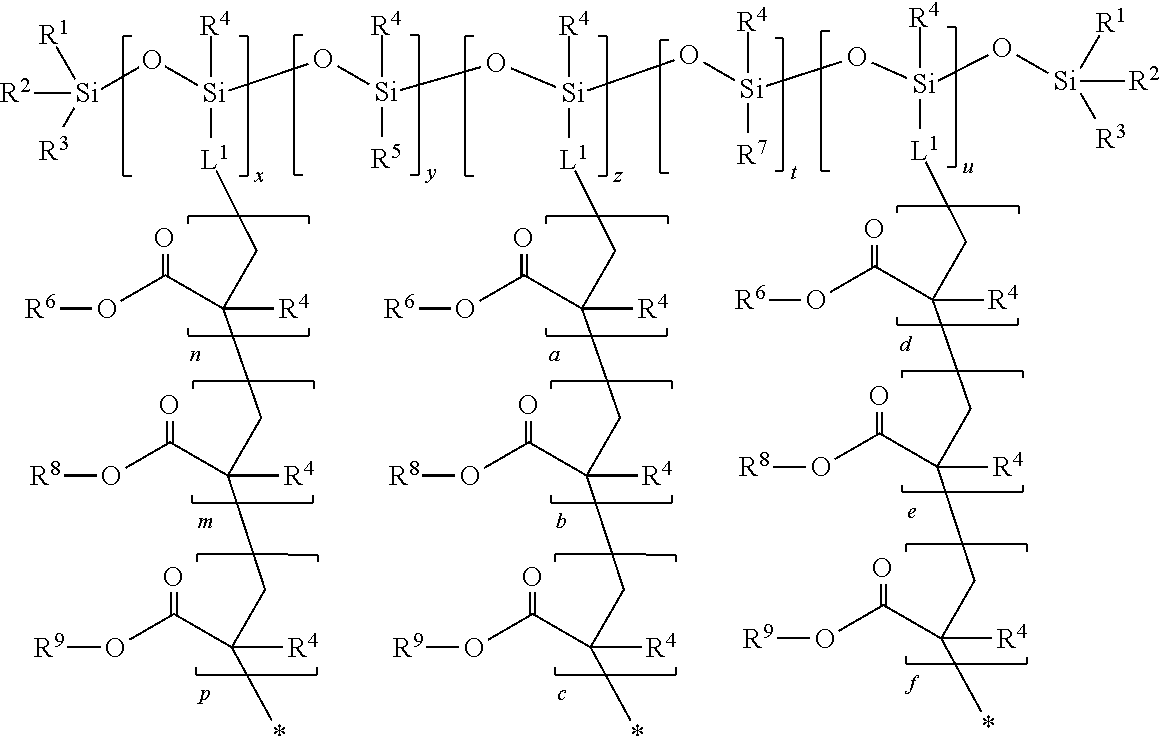
[0008]wherein x is an integer from 0 to 100;
[0009]y is an integer from 0 to 100;
[0010]z is an integer from 0 to 100;
[0011]t is an integer from 0 to 100;
[0012]u is an integer from 0 to 100;
[0013]n is an integer from 0 to 50;
[0014]m is an integer from 0 to 50;
[0015]p is an integer from 0 to 50;
[0016]a is an integer from 0 to 50;
[0017]b is an integer from 0 to 50;
[0018]c is an integer from 0 to 50;
[0019]d is an integer from 0 to 50;
[0020]e is an integer from 0 to 50;
[0021]f is an integer from 0 to 50;
[0022]at least one of x, z, or u is not 0;
[0023]at least one of n, m, or p is not 0;
[0024]at least one of a, b, or c is not 0;
[0025]at least one of d, e, or f is not 0;
[0026]L1is a linking groups;
[0027]R1, R2, and R3, are independently C1-C10alkyl, cyclopentyl, cyclohexyl, benzyl, toluoyl, xylyl or phenyl;
[0028]R4is hydrogen, C1-C10alkyl, cyclopentyl, cyclohexyl, benzyl, toluoyl, xylyl or phenyl;
[0029]R5is C1-C10alkyl, cyclopentyl, cyclohexyl, benzyl, toluoyl, xylyl, phenyl, or a cross linking group;
[0030]R7is hydrogen, C1-C10alkyl, cyclopentyl, cyclohexyl, benzyl, toluoyl, xylyl, phenyl, or a cross linking group;
[0031]R6, R8, and R9include independently a biocidal group that is toxic to organisms that cause fouling in an aquatic environment; a fouling release group; a texturizing group; or combination thereof.
[0032]In the embodiment shown previously, the polysiloxane backbone may be a random or block copolymer. Also, the polymethacrylate based polymer grafted to the polysiloxane backbone may be a random or block copolymer. Accordingly, the formulas shown herein should be understood to refer to either a block or random copolymer having the specified monomer units in any order.
[0033]In another embodiment, an anti-fouling material comprises a random or block copolymer having a formula:
[0034]
[0035]wherein x is an integer from 0 to 100;
[0036]y is an integer from 1 to 100;
[0037]z is an integer from 0 to 100;
[0038]n is an integer from 0 to 50;
[0039]m is an integer from 0 to 50;
[0040]p is an integer from 0 to 50;
[0041]v is an integer from 1 to 25;
[0042]at least one of n, m, or p is not 0;
[0043]L1and L2are linking groups;
[0044]R1, R2, and R3, are independently C1-C10alkyl, cyclopentyl, cyclohexyl, benzyl, toluoyl, xylyl or phenyl;
[0045]R4is hydrogen, C1-C10alkyl, cyclopentyl, cyclohexyl, benzyl, toluoyl, xylyl or phenyl;
[0046]R5is C1-C10alkyl, cyclopentyl, cyclohexyl, benzyl, toluoyl, xylyl, phenyl, or a cross linking group;
[0047]R7is hydrogen, C1-C10alkyl, cyclopentyl, cyclohexyl, benzyl, toluoyl, xylyl, phenyl, or a cross linking group;
[0048]R6, R8, and R9include independently a biocidal group that is toxic to organisms that cause fouling in an aquatic environment; a fouling release group; a texturizing group; or combination thereof; and
[0049]wherein at least one of R6, R8, and R9includes the biocidal group, the fouling release group, or the texturizing group and another one of R6, R8, and R9includes one of the remaining groups from the biocidal group, the fouling release group, or the texturizing group.
[0050]A number of compounds suitable for use as or in anti-fouling materials are disclosed herein. In general, anti-fouling materials refer to products, agents, or compositions which may provide biocidal and/or fouling release properties when used alone or in combination with other materials or substances. The anti-fouling materials described herein may include one or more of a number of suitable copolymers (e.g., block copolymers, graft copolymers, etc.) which provide biocidal and/or fouling release characteristics. In one embodiment, a graft copolymer may be prepared that has a polysiloxane copolymer (random or block) attached to a polymethacrylate copolymer (random or block). In one embodiment, the polymethacrylate copolymer may include biocidal groups, fouling release groups, and/or texturizing groups. In another embodiment, the polysiloxane copolymer is attached to multiple polymethacrylate copolymers, each of which may have one or more of a texturizing group, foul release group, or biocidal group. The texturizing and/or fouling release groups enhance the texture or fouling release properties of the copolymer and/or the final product which incorporates the copolymer. It may also be desirable to include functional groups which are capable of serving as sites for cross-linking reactions in the copolymer. Typically, the cross linking groups are provided on the polysiloxane copolymer (e.g., H group). However, in other embodiments, the cross linking groups may be included as part of the polymethacrylate copolymer. The copolymers may have a molecular weight from 5,000 to 50,000, or, desirably, 10,000 to 25,000. The polysiloxane copolymer may include two or more blocks where each block contains about 10 to 100 subunits.
BRIEF DESCRIPTION OF THE FIGURES
[0051]FIG. 1 is a picture of a bacterial assay of a PDMS coating.
[0052]FIG. 2 is a picture of a bacterial assay of a PDMS-co-PMHS-g-PHDFMA coating.
[0053]FIG. 3 is a picture of a bacterial assay of a PDMS-co-PMHS-g-PMEMA coating.
[0054]FIG. 4 is a picture of a bacterial assay of a PDMS-co-PMHS-g-PMEMA-b-Biocide coating.
[0055]FIG. 5 is a picture of a bacterial assay of a PDMS-co-PMHS-g-Biocide coating.
[0056]FIG. 6 shows the contact angle of one embodiment of HMS-g-PEG-b-PPF.
[0057]FIG. 7 is a transmission electron microscopy (TEM) image of HMS-g-Biocide.
[0058]FIG. 8 is an atomic force microscopy image of HMS-g-Biocide.
[0059]FIG. 9 is an atomic force microscopy image of PDMS-g-PEG-b-Biocide.
[0060]FIG. 10 is an atomic force microscopy image of HMS-g-PPF-b-PEG.
DETAILED DESCRIPTION
[0061]Generally, the antifouling materials described herein comprise functionalized polysiloxanes and/or salts thereof that exhibit biocidal and/or fouling release activity. The various embodiments and descriptions of antifouling materials may be used independently (e.g., as a single coating layer) or in combination with other materials (e.g., paint pigment, etc.) to prevent structures and other surfaces exposed to an aquatic environment (e.g., marine environments, freshwater environments, etc.) from fouling. In many situations, the composition of the coating material includes other compounds such as curing agents, crosslink initiators, and the like.
[0062]Formulas I, II and III show embodiments of a functionalized polysiloxane copolymer, a functionalized polysiloxane block copolymer, and a functionalized polysiloxane homopolymers, respectively. As shown in Formulas I, II and III, the various embodiments of functionalized polysiloxane polymers typically comprise the following the moieties: a crosslinking moiety (e.g., epoxy, olefin, amine, acid, aldehyde, ester, etc.), a biocidal moiety (e.g., Triclosan, quaternary ammonium, pyridinium, polymers and copolymers such as polymethacrylate that include these groups, etc.), a fouling release or textural moiety (e.g., hydrophilic groups such as polyether groups, hydrophobic groups such as perfluoroalkyl groups, liquid crystalline groups such as deuterobenzene groups, self-organizing groups, polymers and copolymers such as polymethacrylate including these groups, etc.), or a texturizing moiety (e.g., alkoxy alkyl groups such as alkoxy alkyl functional polymethacrylate (either polymer or copolymer), etc.).
[0063]
[0064]
[0065]The functionalized polysiloxanes shown in Formulas I, II and III may be combined in a number of ways to provide various embodiments of antifouling materials. For example, in one embodiment, the functionalized polysiloxanes may be crosslinked (e.g., polysiloxanes of Formulas I crosslinked with other polysiloxanes of Formula I, etc.; polysiloxanes of one of Formulas I, II, or III crosslinked with polysiloxanes of one or both of the remaining polysiloxanes, etc.). In another embodiment, polysiloxanes of Formulas I, II and III may be blended (i.e., physically mixed) together. Of course, any of the crosslinked polysiloxanes may be blended with other crosslinked polysiloxanes. There are numerous ways in which the polysiloxanes may be combined to provide suitable antifouling materials.
[0066]The functionalized polysiloxanes and/or polymethacrylates in the copolymer may include a pendant crosslinking moiety. Suitable examples of such crosslinking moieties include groups having Formula I:
[0067]
wherein is “A” is a spacer consisting of alkyl, ether, ester, polyether, phenyl, aryl, heterocyclic, polyaromatic, polypeptide, polysiloxane, polyamide, polysulfone, or polyurethane group. “E” is a terminal functionality consisting of an epoxy, hydroxy, amino, carboxylic, ester, capable of undergoing further reaction when brought into contact with a curing agent.
[0068]The functionalized polysiloxanes and/or polymethacrylates in the copolymer may include a pendant biocidal moiety. Suitable examples of such biocidal moieties include groups having Formula II:
[0069]
wherein is “A” is a spacer consisting of alkyl, ether, ester, polyether, phenyl, aryl, heterocyclic, polyaromatic, polypeptide, polysiloxane, polyamide, polysulfone, or polyurethane group. “G” is a terminal functionality which is a biocide for aquatic organisms such as in one embodiment, tetracyclines, triclosans, and floxacins, or, in another embodiment, ammonium salts and pyridinium salts. As mentioned previously, the spacer “A” may be selected so that it hydrolyzes and the biocide group “G” is therefore cleavable from the polysiloxane and/or polymethacrylate. Also, the spacer “A” may be chosen so that it does not undergo hydrolysis and thus the biocide group “G” is not cleavable from the polysiloxane. In one embodiment, the polysiloxane and/or the polymethacrylate includes both cleavable and non-cleavable biocide groups. In another embodiment, one compound of polysiloxane includes cleavable biocide groups and is crosslinked to other polysiloxanes, at least one of which includes non-cleavable biocide groups. Suitable examples of biocide groups include triclosan and pyridinium groups, as shown below, respectively:
[0070]
[0071]The functionalized polysiloxanes and/or polymethacrylates in the copolymer may include a pendant fouling release moiety. Suitable examples of such fouling release moieties include groups having Formula III:
[0072]
wherein is “A” is a spacer consisting of alkyl, ether, ester, polyether, phenyl, aryl, heterocyclic, polyaromatic, polypeptide, polysiloxane, polyamide, polysulfone, or polyurethane group. “J” is a terminal functionality which affects the physical properties of the polysiloxane to enhance the fouling release action as described herein such as perfluoroalkyl. Suitable examples of “J” groups include:
[0073]
[0074]The copolymer may be cross linked using any of a number of cross linking agents such as those having two vinyl groups (e.g., divinyl PDMS, divinyl benzene, etc.). In addition, the contact angle of the copolymer may be at least 105 degrees, 110 degrees, 115 degrees.
[0075]The present compositions may be used as an antifouling coatings having biocidal activity and/or fouling release activity. These coatings are more or less effective at inhibiting settlement/growth/proliferation of biological entities on the coated surface. The functionalized polysiloxane compositions can be used in conjunction with other materials to comprise formulations for use in the antifouling coatings. It is anticipated that the formulation can be used to serve as antifouling coatings in a number of applications. In particular, as mentioned previously, the present compositions may be useful for the coating of ship hulls, heat-exchangers, cooling towers, de-salination equipment, filtration membranes, docks, off-shore oil rigs, and other submerged superstructures as well as any structure or surface subject to fouling in an aquatic environment.
[0076]This patent application is related to U.S. Provisional Patent Application Ser. No. 60/506,077, filed on Sep. 25, 2003, entitled “Antifouling Materials,” U.S. Provisional Patent Application Ser. No. 60/580,834, filed on Jun. 18, 2004, entitled “Anti-fouling Materials,” and International Patent Application Serial No. PCT/US04/31140, filed on Sep. 23, 2004, entitled “Antifouling Materials,” all of which are expressly incorporated herein by reference in their entireties, as if the complete and entire text, figures, etc. had been included herein.
EXAMPLES
[0000]General Synthetic Strategy of Graft Copolymers
[0000]Synthesis of Polydimethyl Siloxane-co-Polymethylhydrosiloxane-g-Polytriclosan Methacrylate
[0077]
Compounds
- 1) PDMS-co-PMHS-g-PMEMA (Polydimethyl-co-polyhydromethylsiloxane-g-Polymethoxy Ethyl Methacrylate)
[0079]
Synthesis Procedure
[0080]HMS-82Br, 26 g was dissolved in 150 ml of dry THF in a schlenk flask and 8.3 ml of methoxy ethyl methacrylate was added to that followed by 0.41 g copper (I) bromide and 0.6 ml of pentamethyldiethylene triamine. The mixture was subjected to three freeze-thaw pump cycle and then allowed to polymerize at 90° C. for 72 h. After the reaction, the polymerization was stopped by precipitating the mixture in methanol. Copper was removed by passing the polymer through a neutral alumina column.
- Number average molecular weight, Mn=15500.
[0082]This polymer was then cross linked with divinyl polydimethyl siloxane, Mn=9000 using platinum catalyst to make the coating.
- 2) PDMS-co-PMHS-g-PMEMA-b-Biocide (Polydimethyl-co-polyhydromethylsiloxane-g-Polymethyoxy Ethyl Methacrylate-b-Polytriclosan Methacrylate)
[0084]
Synthesis Procedure
[0085]HMS-82Br, 20 g was dissolved in 150 ml of dry THF in a schlenk flask and 6.4 ml of Methoxy ethyl methacrylate was added to that followed by 0.32 g copper (I) bromide and 0.46 ml of pentamethyldiethylene triamine. The mixture was subjected to three freeze-thaw pump cycle and then allowed to polymerize at 90° C. for 72 h. After 72 h, 15.7 g methacrylate functionalized triclosan (biocide) was added to the reaction mixture under nitrogen and the polymerization continued for another 72 h. The reaction was stopped by precipitating the mixture in methanol. Copper was removed by passing the polymer through a neutral alumina column.
- Number average molecular weight, Mn=21000.
[0087]This polymer was then cross linked with divinyl polydimethyl siloxane, Mn=9000 using platinum catalyst to make the coating.
- 3) PDMS-co-PMHS-g-PHDFMA (Polydimethyl-co-polyhydromethylsiloxane-g-polyheptadecafluoro Decyl Methacrylate)
[0089]
Synthesis Procedure
[0090]HMS-82Br, 20 g was dissolved in 150 ml of dry THF in a schlenk flask and 7.4 ml of heptadecafluoro decyl methacrylate was added to that followed by 0.32 g copper (I) bromide and 0.46 ml of pentamethyldiethylene triamine. The mixture was subjected to three freeze-thaw pump cycle and then allowed to polymerize at 90° C. for 8 h. After the reaction, the polymerization was stopped by precipitating the mixture in methanol. Copper was removed by passing the polymer through a neutral alumina column.
- Number average molecular weight, Mn=14000.
[0092]This polymer was then cross linked with divinyl polydimethyl siloxane, Mn=9000 using platinum catalyst to make the coating.
- 4) PDMS-co-PMHS-g-PHDFMA-b-Biocide (Polydimethyl-co-polyhydromethylsiloxane-g-polyheptadecafluoro Decyl Methacrylate-b-Polytriclosan Methacrylate)
[0094]
Synthesis Procedure
[0095]HMS-82Br, 20 g was dissolved in 150 ml of dry THF in a schlenk flask and 7.4 ml of heptadecafluoro decyl methacrylate was added to that followed by 0.32 g copper (I) bromide and 0.46 ml of pentamethyldiethylene triamine. The mixture was subjected to three freeze-thaw pump cycle and then allowed to polymerize at 90° C. for 8 h. After 8 h, 15.7 g of methylmethacrylate triclosan (Biocide) was added to the mixture under nitrogen atmosphere and the reaction was continued for 72 h. Polymerization was stopped by precipitating the mixture in methanol. Copper was removed by passing the polymer through a neutral alumina column.
- Number average molecular weight, Mn=20000.
[0097]This polymer was then cross linked with divinyl polydimethyl siloxane, Mn=9000 using platinum catalyst to make the coating.
- 5) PDMS-co-PMHS-g-PMEMA-b-PHDFMA (Polydimethyl-co-polyhydromethylsiolxane-g-Polymethoxy Ethyl Methacrylate-b-Polyheptadecafluoro Decyl Methacrylate)
[0099]
Synthesis Procedure
[0100]HMS-82Br, 10 g was dissolved in 100 ml of dry THF in a schlenk flask and 3.2 ml of Methoxy ethyl methacrylate was added to that followed by 0.08 g copper (I) bromide and 0.11 ml of pentamethyldiethylene trimine. The mixture was subjected to three freeze-thaw pump cycle and then allowed to polymerize at 90° C. for 72 h. After 72 h, 3.7 ml of heptadecafluoro decyl methacrylate was added to the reaction mixture and the reaction was continued for another 24 h. After the reaction, the polymerization was stopped by precipitating the mixture in methanol. Copper was removed by passing the polymer through a neutral alumina column.
- Number average molecular weight, Mn=21000.
[0102]This polymer was then cross linked with divinyl polydimethyl siloxane, Mn=9000 using platinum catalyst to make the coating.
- 6) PDMS-co-PMHS-g-PHDFMA-b-PMEMA (Polydimethyl-co-polyhydromethylsioxane-g-Polyheptadecafluoro Decyl Methacrylate-b-Polymethoxy Ethyl Methacrylate
[0104]
Synthesis Procedure
[0105]HMS-82Br, 10 g was dissolved in 100 ml of dry THF in a schlenk flask and 3.7 ml of heptadecafluoro decyl methacrylate was added to that followed by 0.08 g copper (I) bromide and 0.1 ml of pentamethyldiethylene trimine. The mixture was subjected to three freeze-thaw pump cycles and then allowed to polymerize at 90° C. for 8 h. After 8 h, 3.2 ml of Methoxy ethyl methacrylate was added to the reaction mixture and the reaction was continued for another 72 h. After the reaction, the polymerization was stopped by precipitating the mixture in methanol. Copper was removed by passing the polymer through a neutral alumina column.
- Number average molecular weight, Mn=21000.
[0107]This polymer was then cross linked with divinyl polydimethyl siloxane, Mn=9000 using platinum catalyst to make the coating.
[0108]The coatings were prepared by cross linking the polymers by divinyl terminated polydimethyl siloxane using platinum catalyst. These coatings were then tested by growing bacteria (Halomonas pacifica) on the surface of coatings. The results of these assays are shown in FIGS. 1-5.
[0109]FIG. 1 shows the results for a PDMS coating. More specifically, the horizontal rows of dishes in FIG. 1 show the test results for the following coatings. The contact angle of the PDMS coating in rows 2 and 3 is 103.
- Row 1—PMMA (Polymethylmethacrylate) (top row in FIG. 1)
- Row 2—Experimental (PDMS)
- Row 3—Experimental after water jet-25Psi (PDMS)
- Row 4—Intersleek Topcoat (Commercial coating)
[0114]FIG. 2 shows the results for a PDMS-co-PMHS-g-PHDFMA coating. The specific coating applied to the dishes is shown below. The contact angle of the PDMS-co-PMHS-g-PHDFMA coating is 120.
- Row 1—PMMA (Polymethylmethacrylate)
- Row 2—Experimental (PDMS-co-PMHS-g-PHDFMA)
- Row 3—Experimental after water jet-25psi (PDMS-co-PMHS-g-PHDFMA)
- Row 4—Intersleek Topcoat (Commercial coating)
[0119]FIG. 3 shows the results for a PDMS-co-PMHS-g-PMEMA coating. The specific coating applied to the dishes is shown below. The contact angle of the PDMS-co-PMHS-g-PMEMA coating is 107.
- Row 1—PMMA (Polymethylmethacrylate)
- Row 2—Experimental (PDMS-co-PMHS-g-PMEMA)
- Row 3—Experimental after water jet-25Psi (PDMS-co-PMHS-g-PMEMA)
- Row 4—Intersleek Topcoat (Commercial coating)
[0124]FIG. 4 shows the results for a PDMS-co-PMHS-g-PMEMA-b-Biocide coating. The specific coating applied to the dishes is shown below. The contact angle of the PDMS-co-PMHS-g-PMEMA-b-Biocide coating is 105.
- Row 1—PMMA (Polymethylmethacrylate)
- Row 2—Experimental (PDMS-co-PMHS-g-PMEMA-b-Biocide)
- Row 3—Experimental after water jet-25Psi (PDMS-co-PMHS-g-PMEMA-b-Biocide)
- Row 4—Intersleek Topcoat (Commercial coating)
[0129]FIG. 5 shows the results for a PDMS-co-PMHS-g-Biocide coating. The specific coating applied to the dishes is shown below. The contact angle of the PDMS-co-PMHS-g-Biocide coating is 108.
- Row 1—PMMA (Polymethylmethacrylate)
- Row 2—Experimental (PDMS-co-PMHS-g-Biocide)
- Row 3—Experimental after water jet-25 psi (PDMS-co-PMHS-g-Biocide)
- Row 4—Intersleek Topcoat (Commercial coating)
[0134]The contact angle for the various coatings is shown below. FIG. 6 shows the advancing contact angle, θa, and the receding contact angle, θr, for HMS-g-PEG-b-PPF.
[0135] |
| | | 4. HMS-g- | |
| 1. PDMS | 2. HMS-g-Bio | 3. HMS-g-PEG | PPF | 5. HMS-g-PS |
|
| θa= 101 | θa= 102 | θa= 100 | θa = 118 | θa = 104 |
| θr= 99 | θr= 93 | θr = 90 | θr = 112 | θr = 100 |
|
| 6. HMS-g-PEG- | 7. HMS-g-PPF- | 8. HMS-g-PPF- | 9. HMS-g-PEG- |
| b-Bio | b-Bio | b-PEG | b-PPF |
|
| θa= 101 | θa= 134 | θa= 122 | θa= 133 |
| θr= 95 | θr= 125 | θr= 113 | θr= 122 |
|
[0136]Referring to FIGS. 7-10, the morphology of some of the coatings is shown. FIG. 7 shows a transmission electron microscopy (TEM) image of HMS-g-Biocide. FIG. 8 shows an atomic force microscopy (AFM) image of HMS-g-Biocide. FIG. 9 shows an AFM image of PDMS-g-PEG-b-Biocide. FIG. 10 shows an AFM image of HMS-g-PPF-b-PEG.
[0137]As used herein, (i.e., in the claims and the specification), articles such as “the,” “a,” and “an” can connote the singular or plural. Also, as used herein, the word “or” when used without a preceding “either” (or other similar language indicating that “or” is unequivocally meant to be exclusive—e.g., only one of x or y, etc.) shall be interpreted to be inclusive, that is “or” when it appears alone shall mean both “and” and “or.” Likewise, as used herein, the term “and/or” shall also be interpreted to be inclusive in that the term shall mean both “and” and “or.” In situations where “and/or” or “or” are used as a conjunction for a group of three or more items, the group should be interpreted to include one item alone, all of the items together, or any combination or number of the items. Moreover, terms used in the specification and claims such as have, having, include, and including should be construed to be synonymous with the terms comprise and comprising.
[0138]Unless otherwise indicated, all numbers or expressions, such as those expressing dimensions, physical characteristics, etc. used in the specification are understood as modified in all instances by the term “about.” At the very least, and not as an attempt to limit the application of the doctrine of equivalents to the claims, each numerical parameter recited in the specification or claims which is modified by the term “about” should at least be construed in light of the number of recited significant digits and by applying ordinary rounding techniques. Moreover, all ranges disclosed herein are to be understood to encompass any and all subranges subsumed therein. For example, a stated range of 1 to 10 should be considered to include any and all subranges between and inclusive of the minimum value of 1 and the maximum value of 10; that is, all subranges beginning with a minimum value of 1 or more and ending with a maximum value of 10 or less (e.g., 5.5 to 10).




