AREA OF INVENTION
[0001]The present invention refers to the area of pharmaceutical compositions and relates to specific medicaments for preventing and/or treating hyperpigmentation of human skin.
BACKGROUND OF THE INVENTION
[0002]Tyrosinase is a copper-containing enzyme that catalyzes the oxidation of phenols, e.g. tyrosine. It is widely distributed in almost all living organisms. In animals and humans, tyrosinase (together with the enzymes Tyrp1 and Dct) is involved in the synthesis of melanin at the membrane of melanocytes and is therefore indispensable for protection against UV radiation. In part of the organisms with albinism, the enzyme is altered or completely absent.
[0003]The production of tyrosinase increases with increased UVB radiation. The following chemical reactions then take place more intensively at the cell membrane of melanoblasts.
[0000]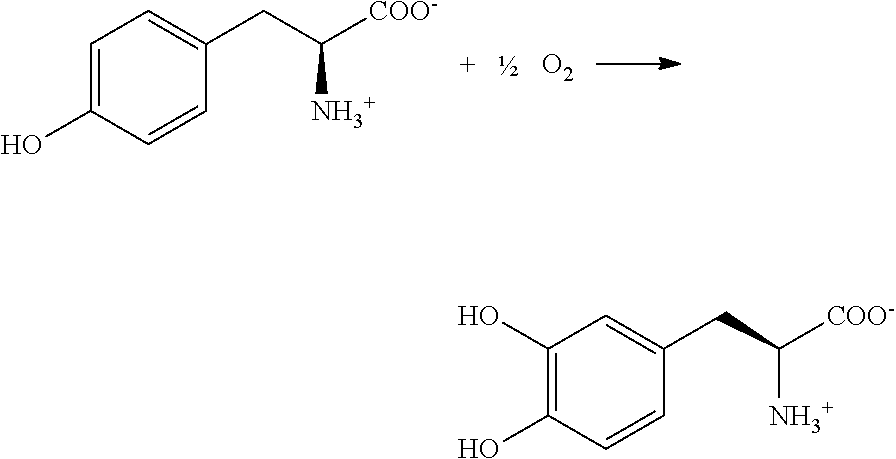
[0004]In a first step, tyrosin is oxidized to L-Dopa:
[0000]
[0005]L-dopa is further oxidized to dopachinone, which is independently oxidized in two steps to dopachrome. From here, a two-step reaction pathway to melanin is possible with the help of the enzymes TYRP1 and DCT. However, tyrosinase can also produce melanine from dopachrome itself:
[0000]
[0006]Dopachrom is subjected to decarboxylation and rearranged to give 5,6-Dihydroxyindol (DHI):
[0000]
[0007]Subsequently, DHI is oxidized to indole-5,6-quinone, which ultimately polymerizes to melanin with the help of oxygen.
[0008]While sufficiently high tyrosinase activity is necessary to tan human skin by producing melanin and thus protecting it against the harmful effects of excessive UV radiation, overproduction can lead to undesirable effects, in particular the formation of brown spots on the skin, known as hyperpigmentation, a pathologic condition of skin that can be caused for example by sun damage, inflammation, or other skin injuries, including those related to acne vulgaris (“Hyperpigmentation”. Dermatalogic Disease Database. American Osteopathic College of Dermatology. Retrieved 2006-03-08.). Hyperpigmentation is also often accompanied by other diseases such as for example insulin resistance.
[0009]In addition to this clinical picture, there is a market, particularly in Asia, for cosmetic products which also restrict tyrosinase activity, with the aim of giving the skin a particularly bright appearance. In this context, one speaks of skin whitening agents.
RELEVANT PRIOR ART
[0010]From the state of the art numerous examples for tyrosinase inhibitors are known as the following examples show:
[0011]Kojic acid and kojic acid derivatives as disclosed for example in U.S. Pat. No. 4,278,656 A (SAN SHO), U.S. Pat. No. 5,523,421 A (PACIFIC CO), WO 2000 056270 A1 (PFIZER), WO 2002 053562 A1 (AMOREPACIFIC) or WO 2019 194769 A1 (AYSE);
[0012]Resorcinol derivatives like for example phenylethyl resorcinol or butyl resorcinol as disclosed for example in FR 2993775 A1 (SISLEY) or US 2002 114770 AA (WARNER LAMBERT);
[0013]Superpoxidbismutase as disclosed for example in JP 59 065022 A (TOYO);
[0014]Benzamidoazol derivatives as disclosed for example in US 2002 044914 AA (MEDIQUEST);
[0015]Hydantoin derivatives as disclosed for example in DE 10342839 A2 (SYMRISE); Sphingosines as disclosed for example in WO 2004 045573 A1 (DOOSAN):
[0016]Protocatechuic aldehyde as disclosed for example in WO 2002 045680 A1 (GENOMINE);
[0017]N-hydroxy succinimide as disclosed for example in JP 2006 248913 A2 (KOSE);
[0018]Salicylic acid as disclosed for example in U.S. Pat. No. 5,723,109 A (L'OREAL); Extracts derived from plants belonging for example to the families:
- Aronia (JP 2013 139399 A2, POLA);
- Desmodium (WO 2019 009645 A1, KOREA RES).
- Diterocarpus (WO 2017 086692 A1, GYEONGGI);
- Ecklonia (WO 2010 098533 A2, UNIV PUKYONG);
- Glyzyrrhiza (JP 01 149706 A2, MARUZEN);
- Grape seed (JP 2000 159681 A2, HAETAE);
- Labiatae (FR 2895678 A1, L'OREAL);
- Magnolia (US 2011 318288 AA, COREANA);
- Polyporus (JP 03 109319 A2, NARISU);
- Prunus (JP 03 127714 A2, KOBAYASHI);
OBJECT OF THE INVENTION
[0029]Therefore, it has been the object of the present invention identifying compounds capable of reducing the generation of melanin by inhibiting or limiting the activity of the enzyme tyrosinase. In other words, there is a need for a medicament which is useful for preventing or treating hyperpigmentation of human skin on one hand, and for skin whitening agents for non-therapeutic, cosmetic applications.
[0030]Another task was to look for molecules that are already available in the market and are known for their toxicological safety.
BRIEF DESCRIPTION OF THE INVENTION
[0031]A first object of the present invention refers to a agonists of olfactory receptors, showing a molecular weight ranging from about 50 to about 300 Dalton, preferably from about 75 to about 250 Dalton and an evaporation rate versus butyl acetate of about 3 to about 15, preferably from about 5 to about 10, for use as a medicament for preventing or treating hyperpigmentation via inhibition of tyrosinase activity.
[0032]Surprisingly it has been found that small and volatile molecules capable of activating olfactory receptors, which is found in human skin, solve the above-identified problem. In assays with B16 melanoma cells a reduction of tyrosinase activity of up to 45% was achieved.
[0033]Another advantage is that these molecules are already known as cosmetic additives, particularly as fragrances. They are easy to obtain and can be formulated into cosmetic or pharmaceutical preparations without problems.
Olfactory Receptors
[0034]Olfactory receptors (ORs), also known as odorant receptors, are expressed in the cell membranes of olfactory receptor neurons and are responsible for the detection of air-borne odour molecules that enter the nasal cavity. Activated olfactory receptors trigger nerve impulses which transmit information about odour to the brain. These receptors are members of the class A rhodopsin-like family of G protein-coupled receptors (GPCRs). The olfactory receptors form a multigene family consisting of around 800 genes in humans. Particularly, the human nose has roughly 400 types of scent receptors that can detect at least 1 trillion different odours.
[0035]Rather than binding specific ligands, olfactory receptors display affinity for a range of odour molecules, and conversely a single odorant molecule may bind to a number of olfactory receptors with varying affinities, which depend on physio-chemical properties of molecules like their molecular volumes. Once the odorant has bound to the odour receptor, the receptor undergoes structural changes and it binds and activates the olfactory-type G protein on the inside of the olfactory receptor neuron. The G protein (Golfand/or Gs) in turn activates the lyase—adenylate cyclase—which converts ATP into cyclic AMP (cAMP). The cAMP opens cyclic nucleotide-gated ion channels which allow calcium and sodium ions to enter into the cell, depolarizing the olfactory receptor neuron and beginning an action potential which carries the information to the brain.
[0036]A nomenclature system has been devised for the olfactory receptor family and is the basis for the official Human Genome Project (HUGO) symbols for the genes that encode these receptors. The names of individual olfactory receptor family members are in the format “ORnXm” where:
- OR is the root name (Olfactory Receptor superfamily)
- n=an integer representing a family (e.g., 1-56) whose members have greater than 40% sequence identity,
- X=a single letter (A, B, C, . . . ) denoting a subfamily (>60% sequence identity), and
- m=an integer representing an individual family member (isoform).
[0041]For example, OR1A1 is the first isoform of subfamily A of olfactory receptor family. An overview on olfactory receptors can be found in the following paper submitted by Gaillard I, Rouquier S, Giorgi: D“Olfactory receptors”. Cellular and Molecular Life Sciences. 61 (4): 456-69 (2004).
[0042]The evaporation rate is the rate at which a material will vaporize (evaporate, change from liquid to vapor) compared to the rate of vaporization of butyl acetate, which is set as 1. This quantity is a ratio, therefore it is unitless.
Agonists of Olfactory Receptors
[0043]Suitable agonists according to the present invention are selected from the group consisting of:
- (−) CBG;
- Aldehyde C12;
- Allylphenoxyacetate;
- Benzaldehyde;
- Benzyl acetone;
- Claritone;
- Cyclogalbanate;
- Cyclohexylmagnol;
- Globalone;
- Mintonat (=Homomenthyl acetate);
- Phenyl acetaldehyde dimethyl acetal;
- Symrose;
- Tagetes oil;
and mixtures thereof.
[0057]The agonists can be applied in a concentration of from 0.1 to 100 μg/ml, and preferably of from 0.5 to 10 μg/ml.
Cosmetic and Pharmaceutical Compositions
[0058]Another object of the present invention refers to a cosmetic or pharmaceutical composition comprising the agonists as defined above, preferably in amounts of from 0.0001 to about 1 wt.-percent, more preferably from about 0.001 to about 0.1 wt.-percent
[0059]Said compositions may represent a lotion, a cream, an emulsion, an ointment or any other form for topical application on skin.
Carriers or Solvents
[0060]In a preferred embodiment the compositions may comprise a cosmetically or pharmaceutically acceptable carrier or solvent, such as for example water, ethanol, isopropyl alcohol, butanol, glycerol, ethylene glycol, propylene glycol and diethylene glycol or mixtures thereof. The carriers may be present in quantities of 99 wt.-percent, preferably 99.9 wt.-percent or more.
Biogenic Agents, Antioxidants and Additional Skin Whitening Agents
[0061]In another preferred embodiment the compositions may comprise at least one biogenic agent or antioxidant. Biogenic active substances include, for example, tocopherol, tocopherol acetate, tocopherol palmitate, ascorbic acid, (deoxy)ribonucleic acid and its fragmentation products, β-glucans, retinol, bisabolol, allantoin, phytantriol, panthenol, AHA acids, amino acids, ceramides, pseudoceramides, essential oils, plant extracts, such as such as prunus extract, bambaranus extract and vitamin complexes.
[0062]Antioxidants interrupt the photochemical reaction chain which is triggered when UV radiation penetrates the skin. Typical examples are amino acids (e.g. glycine, histidine, tyrosine, tryptophan) and their derivatives, imidazoles (e.g. urocanic acid) and their derivatives, peptides like D,L-carnosine, D-carnosine, L-carnosine and their derivatives (e.g. anserine), carotenoids, carotenes (e.g. -carotene, lycopene) and their derivates, chlorogenic acid and its derivatives, lipoic acid and its derivatives (e.g. dihydrolic acid), aurothioglucose, propylthiouracil and other thiols (e.g. thioredoxin, glutathione, cysteine, cystine, cystamin and their glycosyl, N-acetyl, methyl, ethyl, propyl, amyl, butyl and lauryl, palmitoyl, oleyl, linoleyl, cholesteryl and glyceryl esters) and their salts Dilaurylthiodipropionate, ditearylthiodipropionate, thiodipropionic acid and its derivatives (esters, ethers, peptides, lipids, nucleotides, nucleosides and salts) as well as sulfoximine compounds (e.g. (e.g. buthionine sulfoximines, homocysteine sulfoximines, butionine sulfones, penta-, hexa-, heptathionine sulfoximines) in very low tolerated dosages (e.g. pmol to mol/kg), furthermore (metal) chelators (e.g. hydroxy fatty acids, palmitic acid, phytinic acid, lactoferrin), hydroxy acids (e.g. (e.g. citric acid, lactic acid, malic acid), humic acid, gallic acid, bile extracts, bilirubin, biliverdin, EDTA, EGTA and their derivatives, unsaturated fatty acids and their derivatives (e.g. linolenic acid, linoleic acid, oleic acid), folic acid and its derivatives, ubiquinone and ubiquinol and their derivatives, vitamin C and its derivatives (e.g. ascorbyl palmitate, Mg-ascorbyl phosphate, ascorbylacetate), tocopherols and derivatives (e.g. vitamin E acetate), vitamin A and derivates (vitamin A palmitate) as well as conifer aryl benzoate of benzoic resin, rutinic acid and its derivatives, glycosylrutin, ferulic acid, furfurylidene glucitol, carnosine, butyl hydroxytoluene, butylhydroxyanisole, nordihydroguaiac resin acid, nordihydroguajaretic acid, trihydroxybutyrophenone, uric acid and its derivatives, mannose and its derivatives, superoxide dismutase, zinc and its derivatives (e.g. e.g. ZnO, ZnSO4) selenium and its derivatives (e.g. selenium-methionine), stilbenes and their derivatives (e.g. styrene oxide, trans-stilbene oxide) and the derivatives suitable for the invention (salts, esters, ethers, sugars etc.).
[0063]The agonists according to the present invention can also be combined with other skin whitening and/or tyrosinase inhibiting agents (different from said agonists), such as for example kojic acid and resorcinol derivatives like phenylethyl resorcinol or butyl resorcinol, preferably in ratios by weight ranging from about 10:90 to about 90:10, more preferably from about 25:75 to about 75:25 and most preferred from about 40:60 to about 60:40. Such mixtures can also be provided in encapsulated form.
Further Additives for Cosmetic and Pharmaceutical Compositions
[0064]In case the agonists according to the present invention are incorporated in or delivered to human skin by means of a cosmetic or pharmaceutical composition, these may contain further additives which are typical for skin care applications, as for example:
Surfactants
[0065]Preferred auxiliaries and additives are anionic and/or amphoteric or zwitterionic surfactants. Non-ionic and cationic surfactants can be also present in the composition. Suitable examples are mentioned along with the paragraph dealing with emulsifiers.
[0066]Typical examples for anionic and zwitterionic surfactants encompass: Almondamidopropylamine Oxide, Almondamidopropyl Betaine, Aminopropyl Laurylglutamine, Ammonium C12-15 Alkyl Sulfate, Ammonium C12-16 Alkyl Sulfate, Ammonium Capryleth Sulfate, Ammonium Cocomonoglyceride Sulfate, Ammonium Coco-Sulfate, Ammonium Cocoyl Isethionate, Ammonium Cocoyl Sarcosinate, Ammonium C12-15 Pareth Sulfate, Ammonium C9-10 Perfluoroalkylsulfonate, Ammonium Dinonyl Sulfosuccinate, Ammonium Dodecylbenzenesulfonate, Ammonium Isostearate, Ammonium Laureth-6 Carboxylate, Ammonium Laureth-8 Carboxylate, Ammonium Laureth Sulfate, Ammonium Laureth-5 Sulfate, Ammonium Laureth-7 Sulfate, Ammonium Laureth-9 Sulfate, Ammonium Laureth-12 Sulfate, Ammonium Lauroyl Sarcosinate, Ammonium Lauryl Sulfate, Ammonium Lauryl Sulfosuccinate, Ammonium Myreth Sulfate, Ammonium Myristyl Sulfate, Ammonium Nonoxynol-4 Sulfate, Ammonium Nonoxynol-30 Sulfate, Ammonium Oleate, Ammonium Palm Kernel Sulfate, Ammonium Stearate, Ammonium Tallate, AMPD-Isostearoyl Hydrolyzed Collagen, AM PD-Rosin Hydrolyzed Collagen, AMP-Isostearoyl Hydrolyzed Collagen, AMP-Isostearoyl Hydrolyzed Keratin, AMP-Isostearoyl Hydrolyzed Soy Protein, AMP-Isostearoyl Hydrolyzed Wheat Protein, Apricotamidopropyl Betaine, Arachidic Acid, Arginine Hexyldecyl Phosphate, Avocadamidopropyl Betaine, Avocado Oil Glycereth-8 Esters, Babassu Acid, Babassuamidopropylamine Oxide, Babassuamidopropyl Betaine, Beeswax Acid, Behenamidopropyl Betaine, Behenamine Oxide, Beheneth-25, Beheneth-30, Behenic Acid, Behenyl Betaine, Bis-Butyldimethicone Polyglyceryl-3, Butoxynol-5 Carboxylic Acid, Butoxynol-19 Carboxylic Acid, Butyldimoniumhydroxypropyl Butylglucosides Chloride, Butyldimoniumhydroxypropyl Laurylglucosides Chloride, Butyl Glucoside, Butylglucoside Caprate, Butylglucosides Hydroxypropyltrimonium Chloride, Butyloctanoic Acid, C18-36 Acid, C20-40 Acid, C30-50 Acid, C16-22 Acid Amide MEA, Calcium Dodecylbenzenesulfonate, Calcium Lauroyl Taurate, C9-16 Alkane/Cycloalkane, C10-14 Alkyl Benzenesulfonic Acid, C12-14 Alkyl Diaminoethylglycine HCL, C9-15 Alkyl Phosphate, Candida Bombicola/Glucose/Methyl Rapeseedate Ferment, Canolamidopropyl Betaine, Capric Acid, Caproic Acid, Caproyl Ethyl Glucoside, Capryl/Capramidopropyl Betaine, Capryleth-4 Carboxylic Acid, Capryleth-6 Carboxylic Acid, Capryleth-9 Carboxylic Acid, Caprylic Acid, Capryloyl Collagen Amino Acids, Capryloyl Glycine, Capryloyl Hydrolyzed Collagen, Capryloyl Hydrolyzed Keratin, Capryloyl Keratin Amino Acids, Capryloyl Silk Amino Acids, Caprylyl/Capryl Glucoside, Caprylyl/Capryl Wheat Bran/Straw Glycosides, Caprylyl Glucoside, Caprylyl Glyceryl Ether, Caprylyl Pyrrolidone, Carnitine, Ceteareth-20, Ceteareth-23, Ceteareth-24, Ceteareth-25, Ceteareth-27, Ceteareth-28, Ceteareth-29, Ceteareth-30, Ceteareth-33, Ceteareth-34, Ceteareth-40, Ceteareth-50, Ceteareth-55, Ceteareth-60, Ceteareth-80, Ceteareth-100, Ceteareth-25 Carboxylic Acid, Ceteareth-2 Phosphate, Ceteareth-4 Phosphate, Ceteareth-Phosphate, Ceteareth-10 Phosphate, Ceteth-20, Ceteth-23, Ceteth-24, Ceteth-25, Ceteth-30, Ceteth-40, Ceteth-45, Ceteth-150, Ceteth-8 Phosphate, Ceteth-10 Phosphate, Ceteth-20 Phosphate, Cetoleth-22, Cetoleth-24, Cetoleth-25, Cetoleth-30, Cetyl Betaine, Chrysanthemum Sinense Flower Extract, C12-14 Hydroxyalkyl Hydroxyethyl Beta-Alanine, C12-14 Hydroxyalkyl Hydroxyethyl Sarcosine, Cocamidoethyl Betaine, Cocamidopropylamine Oxide, Cocamidopropyl Betainamide MEA Chloride, Cocamidopropyl Betaine, Cocamidopropyl Hydroxysultaine, Cocamine Oxide, Cocaminobutyric Acid, Cocaminopropionic Acid, Coceth-7 Carboxylic Acid, Coceth-4 Glucoside, Cocoamphodipropionic Acid, Cocobetainamido Amphopropionate, Coco-Betaine, Cocodimonium Hydroxypropyl Hydrolyzed Rice Protein, Cocodimonium Hydroxypropyl Hydrolyzed Soy Protein, Cocodimonium Hydroxypropyl Hydrolyzed Wheat Protein, Coco-Glucoside, Cocoglucosides Hydroxypropyltrimonium Chloride, CocoHydroxysultaine, Coco-Morpholine Oxide, Coconut Acid, Coconut Oil Glycereth-8 Esters, Coco/Oleamidopropyl Betaine, Coco-Sultaine, Coco/Sunfloweramidopropyl Betaine, Cocoylcholine Methosulfate, Cocoyl Glutamic Acid, Cocoyl Hydrolyzed Collagen, Cocoyl Hydrolyzed Keratin, Cocoyl Hydrolyzed Oat Protein, Cocoyl Hydrolyzed Rice Protein, Cocoyl Hydrolyzed Silk, Cocoyl Hydrolyzed Soy Protein, Cocoyl Hydrolyzed Wheat Protein, Cocoyl Sarcosine, Corn Acid, Cottonseed Acid, Cottonseed Oil Glycereth-8 Esters, C10-16 Pareth-1, C10-16 Pareth-2, C11-13 Pareth-6, C11-13 Pareth-9, C11-13 Pareth-10, C11-15 Pareth-30, C11-15 Pareth-40, C12-13 Pareth-1, C12-13 Pareth-23, C12-14 Pareth-5, C12-14 Pareth-9, C13-15 Pareth-21, C14-15 Pareth-8, C20-22 Pareth-30, C20-40 Pareth-40, C20-40 Pareth-95, C22-24 Pareth-33, C30-50 Pareth-40, C9-11 Pareth-6 Carboxylic Acid, C9-11 Pareth-8 Carboxylic Acid, C11-15 Pareth-7 Carboxylic Acid, C12-13 Pareth-5 Carboxylic Acid, C12-13 Pareth-7 Carboxylic Acid, C12-13 Pareth-8 Carboxylic Acid, C12-13 Pareth-12 Carboxylic Acid, C12-15 Pareth-7 Carboxylic Acid, C12-15 Pareth-8 Carboxylic Acid, C12-15 Pareth-12 Carboxylic Acid, C14-15 Pareth-8 Carboxylic Acid, C6-10 Pareth-4 Phosphate, C12-13 Pareth-2 Phosphate, C12-13 Pareth-10 Phosphate, C12-15 Pareth-6 Phosphate, C12-15 Pareth-8 Phosphate, C12-15 Pareth-10 Phosphate, C12-16 Pareth-6 Phosphate, C4-18 Perfluoroalkylethyl Thiohydroxypropyltrimonium Chloride, Cupuassuamidopropyl Betaine, DEA-C12-13 Alkyl Sulfate, DEA-C12-15 Alkyl Sulfate, DEA-Ceteareth-2 Phosphate, DEA-Cetyl Sulfate, DEA-Cocoamphodipropionate, DEA-C12-13 Pareth-3 Sulfate, DEA-Cyclocarboxypropyloleate, DEA-Dodecylbenzenesulfonate, DEA-Isostearate, DEA-Laureth Sulfate, DEA-Lauryl Sulfate, DEA-Linoleate, DEAMethyl Myristate Sulfonate, DEA-Myreth Sulfate, DEA-Myristate, DEA-Myristyl Sulfate, DEAOleth-5 Phosphate, DEA-Oleth-20 Phosphate, DEA PG-Oleate, Deceth-7 Carboxylic Acid, Deceth-7 Glucoside, Deceth-9 Phosphate, Decylamine Oxide, Decyl Betaine, Decyl Glucoside, Decyltetradeceth-30, Decyltetradecylamine Oxide, Diammonium Lauramido-MEA Sulfosuccinate, Diammonium Lauryl Sulfosuccinate, Diammonium Oleamido PEG-2 Sulfosuccinate, Dibutoxymethane, Di-CI 2-15 Pareth-2 Phosphate, Di-CI 2-15 Pareth-4 Phosphate, Di-CI 2-15 Pareth-6 Phosphate, Di-C12-15 Pareth-8 Phosphate, Di-CI 2-15 Pareth-10 Phosphate, Didodecyl Butanetetracarboxylate, Diethylamine Laureth Sulfate, Diethylhexyl Sodium Sulfosuccinate, Dihydroxyethyl C8-10 Alkoxypropylamine Oxide, Dihydroxyethyl C9-11 Alkoxypropylamine Oxide, Dihydroxyethyl C12-15 Alkoxypropylamine Oxide, Dihydroxyethyl Cocamine Oxide, Dihydroxyethyl Lauramine Oxide, Dihydroxyethyl Stearamine Oxide, Dihydroxyethyl Tallowamine Oxide, Dimethicone PEG-7 Phosphate, Dimethicone PEG-10 Phosphate, Dimethicone PEG/PPG-7/4 Phosphate, Dimethicone PEG/PPG-12/4 Phosphate, Dimethicone/Polyglycerin-3 Crosspolymer, Dimethicone Propyl PG-Betaine, Dimyristyl Phosphate, Dioleoylamidoethyl Hydroxyethylmonium Methosulfate, DIPA-Hydrogenated Cocoate, DIPALanolate, DIPA-Myristate, Dipotassium Capryloyl Glutamate, Dipotassium Lauryl Sulfosuccinate, Dipotassium Undecylenoyl Glutamate, Disodium Babassuamido MEA-Sulfosuccinate, Disodium Caproamphodiacetate, Disodium Caproamphodipropionate, Disodium Capryloamphodiacetate, Disodium Capryloamphodipropionate, Disodium Capryloyl Glutamate, Disodium Cetearyl Sulfosuccinate, Disodium Cetyl Phenyl Ether Disulfonate, Disodium Cetyl Sulfosuccinate, Disodium Cocamido MEA-Sulfosuccinate, Disodium Cocamido MIPA PEG-4 Sulfosuccinate, Disodium Cocamido MIPA-Sulfosuccinate, Disodium Cocamido PEG-3 Sulfosuccinate, Disodium Coceth-3 Sulfosuccinate, Disodium Cocoamphocarboxyethylhydroxypropylsulfonate, Disodium Cocoamphodiacetate, Disodium Cocoamphodipropionate, Disodium Coco-Glucoside Sulfosuccinate, Disodium Coco-Sulfosuccinate, Disodium Cocoyl Butyl Gluceth-10 Sulfosuccinate, Disodium Cocoyl Glutamate, Disodium C12-14 Pareth-1 Sulfosuccinate, Disodium C12-14 Pareth-2 Sulfosuccinate, Disodium C12-15 Pareth Sulfosuccinate, Disodium C12-14 Sec-Pareth-3 Sulfosuccinate, Disodium C12-14 Sec-Pareth-5 Sulfosuccinate, Disodium C12-14 Sec-Pareth-7 Sulfosuccinate, Disodium C12-14 Sec-Pareth-9 Sulfosuccinate, Disodium C12-14 Sec-Pareth-12 Sulfosuccinate, Disodium Deceth-5 Sulfosuccinate, Disodium Deceth-6 Sulfosuccinate, Disodium Decyl Phenyl Ether Disulfonate, Disodium Dihydroxyethyl Sulfosuccinylundecylenate, Disodium Ethylene Dicocamide PEG-15 Disulfate, Disodium Hydrogenated Cottonseed Glyceride Sulfosuccinate, Disodium Hydrogenated Tallow Glutamate, Disodium Hydroxydecyl Sorbitol Citrate, Disodium Isodecyl Sulfosuccinate, Disodium Isostearamido MEA-Sulfosuccinate, Disodium Isostearamido MIPA-Sulfosuccinate, Disodium Isostearoamphodiacetate, Disodium Isostearoamphodipropionate, Disodium Isostearyl Sulfosuccinate, Disodium Laneth-5 Sulfosuccinate, Disodium Lauramido MEA-Sulfosuccinate, Disodium Lauramido MIPA Glycol Sulfosuccinate, Disodium Lauramido PEG-2 Sulfosuccinate, Disodium Lauramido PEG-5 Sulfosuccinate, Disodium Laureth-5 Carboxyamphodiacetate, Disodium Laureth-7 Citrate, Disodium Laureth Sulfosuccinate, Disodium Laureth-6 Sulfosuccinate, Disodium Laureth-9 Sulfosuccinate, Disodium Laureth-12 Sulfosuccinate, Disodium Lauriminobishydroxypropylsulfonate, Disodium Lauriminodiacetate, Disodium Lauriminodipropionate, Disodium Lauriminodipropionate Tocopheryl Phosphates, Disodium Lauroamphodiacetate, Disodium Lauroamphodipropionate, Disodium N-Lauroyl Aspartate, Disodium Lauroyl Glutamate, Disodium Lauryl Phenyl Ether Disulfonate, Disodium Lauryl Sulfosuccinate, Disodium Myristamido MEA-Sulfosuccinate, Disodium Nonoxynol-10 Sulfosuccinate, Disodium Oleamido MEA-Sulfosuccinate, Disodium Oleamido MIPA-Sulfosuccinate, Disodium Oleamido PEG-2 Sulfosuccinate, Disodium Oleoamphodipropionate, Disodium Oleth-3 Sulfosuccinate, Disodium Oleyl Phosphate, Disodium Oleyl Sulfosuccinate, Disodium Palmitamido PEG-2 Sulfosuccinate, Disodium Palmitoleamido PEG-2 Sulfosuccinate, Disodium PEG-4 Cocamido MIPA-Sulfosuccinate, Disodium PEG-12 Dimethicone Sulfosuccinate, Disodium PEG-8 Palm Glycerides Sulfosuccinate, Disodium PPG-2-Isodeceth-7 Carboxyamphodiacetate, Disodium Ricinoleamido MEA-Sulfosuccinate, Disodium Sitostereth-14 Sulfosuccinate, Disodium Soyamphodiacetate, Disodium Stearamido MEA-Sulfosuccinate, Disodium Steariminodipropionate, Disodium Stearoamphodiacetate, Disodium Stearoyl Glutamate, Disodium Stearyl Sulfosuccinamate, Disodium Stearyl Sulfosuccinate, Disodium 2-Sulfolaurate, Disodium 2-Sulfopalmitate, Disodium Tallamido MEA-Sulfosuccinate, Disodium Tallowamido MEASulfosuccinate, Disodium Tallowamphodiacetate, Disodium Tallowiminodipropionate, Disodium Tallow Sulfosuccinamate, Disodium Tridecylsulfosuccinate, Disodium Undecylenamido MEA-Sulfosuccinate, Disodium Undecylenamido PEG-2 Sulfosuccinate, Disodium Undecylenoyl Glutamate, Disodium Wheat Germamido MEA-Sulfosuccinate, Disodium Wheat Germamido PEG-2 Sulfosuccinate, Disodium Wheatgermamphodiacetate, Di-TEA-Cocamide Diacetate, Di-TEA-Oleamido PEG-2 Sulfosuccinate, Di-TEA-Palmitoyl Aspartate, Ditridecyl Sodium Sulfosuccinate, Dodecylbenzene Sulfonic Acid, Erucamidopropyl Hydroxysultaine, Ethylhexeth-3 Carboxylic Acid, Ethyl PEG-15 Cocamine Sulfate, Glyceryl Capryl Ether, Hexyldecanoic Acid, Hydrogenated Coconut Acid, Hydrogenated Laneth-25, Hydrogenated Menhaden Acid, Hydrogenated Palm Acid, Hydrogenated Palm Kernel Amine Oxide, Hydrogenated Tallow Acid, Hydrogenated Tallowamine Oxide, Hydrogenated Tallow Betaine, Hydrogenated Talloweth-25, Hydrogenated Tallowoyl Glutamic Acid, Hydrolyzed Candida Bombicola Extract, Hydroxyceteth-60, Hydroxyethyl Acetomonium PG-Dimethicone, Hydroxyethylbutylamine Laureth Sulfate, Hydroxyethyl Carboxymethyl Cocamidopropylamine, Hydroxyethyl Hydroxypropyl C12-15 Alkoxypropylamine Oxide, Hydroxylauryl/Hydroxymyristyl Betaine, Hydroxystearic Acid, Hydroxysuccinimidyl C10-40 Isoalkyl Acidate, Hydroxysuccinimidyl C21-22 Isoalkyl Acidate, Hydroxysultaines, IPDI/PEG-15 Soyamine Oxide Copolymer, IPDI/PEG-15 Soyethonium Ethosulfate Copolymer, IPDI/PEG-15 Soy Glycinate Copolymer, lsoceteth-30, lsolaureth-4 Phosphate, Isopolyglyceryl-3 Dimethicone, Isopolyglyceryl-3 Dimethiconol, Isopropanolamine Lanolate, Isopropylamine Dodecylbenzenesulfonate, Isostearamidopropylamine Oxide, Isostearamidopropyl Betaine, Isostearamidopropyl Morpholine Oxide, Isosteareth-8, Isosteareth-16, Isosteareth-22, Isosteareth-25, Isosteareth-50, Isostearic Acid, Isostearoyl Hydrolyzed Collagen, Jojoba Oil PEG-150 Esters, Jojoba Wax PEG-80 Esters, Jojoba Wax PEG-120 Esters, Laneth-20, Laneth-25, Laneth-40, Laneth-50, Laneth-60, Laneth-75, Lanolin Acid, Lauramidopropylamine Oxide, Lauramidopropyl Betaine, Lauramidopropyl Hydroxysultaine, Lauramine Oxide, Lauraminopropionic Acid, Laurdimoniumhydroxypropyl Decylglucosides Chloride, Laurdimoniumhydroxypropyl Laurylglucosides Chloride, Laureth-16, Laureth-20, Laureth-21, Laureth-23, Laureth-25, Laureth-30, Laureth-38, Laureth-40, Laureth-3 Carboxylic Acid, Laureth-4 Carboxylic Acid, Laureth-5 Carboxylic Acid, Laureth-6 Carboxylic Acid, Laureth-8 Carboxylic Acid, Laureth-10 Carboxylic Acid, Laureth-11 Carboxylic Acid, Laureth-12 Carboxylic Acid, Laureth-13 Carboxylic Acid, Laureth-14 Carboxylic Acid, Laureth-17 Carboxylic Acid, Laureth-6 Citrate, Laureth-7 Citrate, Laureth-1 Phosphate, Laureth-2 Phosphate, Laureth-3 Phosphate, Laureth-4 Phosphate, Laureth-7 Phosphate, Laureth-8 Phosphate, Laureth-7 Tartrate, Laurie Acid, Laurimino Bispropanediol, Lauriminodipropionic Acid, Lauroamphodipropionic Acid, Lauroyl Beta-Alanine, Lauroyl Collagen Amino Acids, Lauroyl Ethyltrimonium Methosulfate, Lauroyl Hydrolyzed Collagen, Lauroyl Hydrolyzed Elastin, Lauroyl Methyl Glucamide, Lauroyl Sarcosine, Lauroyl Silk Amino Acids, Lauryl Betaine, Lauryl Dimethicone/Polyglycerin-3 Crosspolymer, Lauryldimoniumhydroxypropyl Cocoglucosides Chloride, Lauryl Glucoside, Laurylglucosides Hydroxypropyltrimonium Chloride, Lauryl Glycol Hydroxypropyl Ether, Lauryl Hydroxysultaine, Lauryl Malamide, Lauryl Methylglucamide, Lauryl/Myristyl Glycol Hydroxypropyl Ether, Lauryl/Myristyl Wheat Bran/Straw Glycosides, Lauryl Polyglyceryl-3 Polydimethylsiloxyethyl Dimethicone, Lauryl Pyrrolidone, Lauryl Sultaine, Linoleic Acid, Linolenic Acid, Linseed Acid, Lysine Cocoate, Macadamia Seed Oil Glycereth-8 Esters, Magnesium Coceth Sulfate, Magnesium Coco-Sulfate, Magnesium Isododecylbenzene-sulfonate, Magnesium Laureth-11 Carboxylate, Magnesium Laureth Sulfate, Magnesium Laureth-5 Sulfate, Magnesium Laureth-8 Sulfate, Magnesium Laureth-16 Sulfate, Magnesium Laureth-3 Sulfosuccinate, Magnesium Lauryl Hydroxypropyl Sulfonate, Magnesium Lauryl Sulfate, Magnesium Methyl Cocoyl Taurate, Magnesium Myreth Sulfate, Magnesium Oleth Sulfate, Magnesium/TEA-Coco-Sulfate, Manicouagan Clay, MEA-Cocoate, MEA-Laureth-6 Carboxylate, MEA-Laureth Sulfate, MEA-Lauryl Sulfate, MEA PPG-6 Laureth-7 Carboxylate, MEA-PPG-8-Steareth-7 Carboxylate, MEA-Undecylenate, Meroxapol 108, Meroxapol 174, Meroxapol 178, Meroxapol 254, Meroxapol 255, Meroxapol 258, Meroxapol 314, Methoxy PEG-450 Amidoglutaroyl Succinimide, Methoxy PEG-450 Amido Hydroxysuccinimidyl Succinamate, Methoxy PEG-450 Maleimide, Methyl Morpholine Oxide, Milkamidopropyl Amine Oxide, Milkamidopropyl Betaine, Minkamidopropylamine Oxide, Minkamidopropyl Betaine, MIPA C12-15 Pareth Sulfate, MIPA-Dodecylbenzenesulfonate, MIPA-Laureth Sulfate, MIPALauryl Sulfate, Mixed Isopropanolamines Lanolate, Mixed Isopropanolamines Lauryl Sulfate, Mixed Isopropanolamines Myristate, Morpholine Oleate, Morpholine Stearate, Myreth-3 Carboxylic Acid, Myreth-5 Carboxylic Acid, Myristalkonium Chloride, Myristamidopropylamine Oxide, Myristamidopropyl Betaine, Myristamidopropyl Dimethylamine Phosphate, Myristamidopropyl Hydroxysultaine, Myristamidopropyl PG-Dimonium Chloride Phosphate, Myristamine Oxide, Myristaminopropionic Acid, Myristic Acid, Myristoyl Ethyltrimonium Methosulfate, Myristoyl Glutamic Acid, Myristoyl Hydrolyzed Collagen, Myristoyl Sarcosine, Myristyl Betaine, Myristyl/Cetyl Amine Oxide, Myristyldimoniumhydroxypropyl Cocoglucosides Chloride, Myristyl Glucoside, Myristyl Phosphate, Nonoxynol-20, Nonoxynol-23, Nonoxynol-25, Nonoxynol-30, Nonoxynol-35, Nonoxynol-40, Nonoxynol-44, Nonoxynol-50, Nonoxynol-100, Nonoxynol-120, Nonoxynol-5 Carboxylic Acid, Nonoxynol-8 Carboxylic Acid, Nonoxynol-10 Carboxylic Acid, Nonoxynol-3 Phosphate, Nonoxynol-4 Phosphate, Nonoxynol-6 Phosphate, Nonoxynol-9 Phosphate, Nonoxynol-10 Phosphate, Nonyl Nonoxynol-30, Nonyl Nonoxynol-49, Nonyl Nonoxynol-100, Nonyl Nonoxynol-150, Nonyl Nonoxynol-7 Phosphate, Nonyl Nonoxynol-8 Phosphate, Nonyl Nonoxynol-9 Phosphate, Nonyl Nonoxynol-10 Phosphate, Nonyl Nonoxynol-11 Phosphate, Nonyl Nonoxynol-15 Phosphate, Nonyl Nonoxynol-24 Phosphate, Oatamidopropyl Betaine, Octoxynol-16, Octoxynol-25, Octoxynol-30, Octoxynol-33, Octoxynol-40, Octoxynol-70, Octoxynol-20 Carboxylic Acid, Octyldodeceth-20, Octyldodeceth-25, Octyldodeceth-30, Oleamidopropylamine Oxide, Oleamidopropyl Betaine, Oleamidopropyl Hydroxysultaine, Oleamine Oxide, Oleic Acid, Oleoyl Hydrolyzed Collagen, Oleoyl Sarcosine, Oleth-20, Oleth-23, Oleth-24, Oleth-25, Oleth-30, Oleth-35, Oleth-40, Oleth-44, Oleth-50, Oleth-3 Carboxylic Acid, Oleth-6 Carboxylic Acid, Oleth-10 Carboxylic Acid, Oleyl Betaine, Olivamidopropylamine Oxide, Olivamidopropyl Betaine, Olive Acid, Olivoyl Hydrolyzed Wheat Protein, Ophiopogon Extract Stearate, Ozonized Oleth-10, Ozonized PEG-10 Oleate, Ozonized PEG-14 Oleate, Ozonized Polysorbate 80, Palm Acid, Palmamidopropyl Betaine, Palmeth-2 Phosphate, Palmitamidopropylamine Oxide, Palmitamidopropyl Betaine, Palmitamine Oxide, Palmitic Acid, Palmitoyl Collagen Amino Acids, Palmitoyl Glycine, Palmitoyl Hydrolyzed Collagen, Palmitoyl Hydrolyzed Milk Protein, Palmitoyl Hydrolyzed Wheat Protein, Palmitoyl Keratin Amino Acids, Palmitoyl Oligopeptide, Palmitoyl Silk Amino Acids, Palm Kernel Acid, Palm Kernelamidopropyl Betaine, Peach Kernel Oil Glycereth-8 Esters, Peanut Acid, PEG-10 Castor Oil, PEG-40 Castor Oil, PEG-44 Castor Oil, PEG-50 Castor Oil, PEG-54 Castor Oil, PEG-55 Castor Oil, PEG-60 Castor Oil, PEG-80 Castor Oil, PEG-100 Castor Oil, PEG-200 Castor Oil, PEG-11 Cocamide, PEG-6 Cocamide Phosphate, PEG-4 Cocamine, PEG-8 Cocamine, PEG-12 Cocamine, PEG-150 Dibehenate, PEG-90 Diisostearate, PEG-75 Dilaurate, PEG-150 Dilaurate, PEG-75 Dioleate, PEG-150 Dioleate, PEG-75 Distearate, PEG-120 Distearate, PEG-150 Distearate, PEG-175 Distearate, PEG-190 Distearate, PEG-250 Distearate, PEG-30 Glyceryl Cocoate, PEG-40 Glyceryl Cocoate, PEG-78 Glyceryl Cocoate, PEG-80 Glyceryl Cocoate, PEG-30 Glyceryl Isostearate, PEG-40 Glyceryl Isostearate, PEG-50 Glyceryl Isostearate, PEG-60 Glyceryl Isostearate, PEG-90 Glyceryl Isostearate, PEG-23 Glyceryl Laurate, PEG-30 Glyceryl Laurate, PEG-25 Glyceryl Oleate, PEG-30 Glyceryl Oleate, PEG-30 Glyceryl Soyate, PEG-25 Glyceryl Stearate, PEG-30 Glyceryl Stearate, PEG-40 Glyceryl Stearate, PEG-120 Glyceryl Stearate, PEG-200 Glyceryl Stearate, PEG-28 Glyceryl Tallowate, PEG-80 Glyceryl Tallowate, PEG-82 Glyceryl Tallowate, PEG-130 Glyceryl Tallowate, PEG-200 Glyceryl Tallowate, PEG-45 Hydrogenated Castor Oil, PEG-50 Hydrogenated Castor Oil, PEG54 Hydrogenated Castor Oil, PEG-55 Hydrogenated Castor Oil, PEG-60 Hydrogenated Castor Oil, PEG-80 Hydrogenated Castor Oil, PEG-100 Hydrogenated Castor Oil, PEG-200 Hydrogenated Castor Oil, PEG-30 Hydrogenated Lanolin, PEG-70 Hydrogenated Lanolin, PEG-50 Hydrogenated Palmamide, PEG-2 Isostearate, PEG-3 Isostearate, PEG-4 Isostearate, PEG-6 Isostearate, PEG-8 Isostearate, PEG-10 Isostearate, PEG-12 Isostearate, PEG-20 Isostearate, PEG30 Isostearate, PEG-40 Isostearate, PEG-26 Jojoba Acid, PEG-40 Jojoba Acid, PEG-15 Jojoba Alcohol, PEG-26 Jojoba Alcohol, PEG-40 Jojoba Alcohol, PEG-35 Lanolin, PEG-40 Lanolin, PEG-50 Lanolin, PEG-55 Lanolin, PEG-60 Lanolin, PEG-70 Lanolin, PEG-75 Lanolin, PEG-85 Lanolin, PEG-100 Lanolin, PEG-150 Lanolin, PEG-75 Lanolin Oil, PEG-2 Lauramide, PEG-3 Lauramine Oxide, PEG-20 Laurate, PEG-32 Laurate, PEG-75 Laurate, PEG-150 Laurate, PEG-70 Mango Glycerides, PEG-20 Mannitan Laurate, PEG-8 Methyl Ether Dimethicone, PEG-120 Methyl Glucose Dioleate, PEG-80 Methyl Glucose Laurate, PEG-120 Methyl Glucose Trioleate, PEG-4 Montanate, PEG-30 Oleamine, PEG-20 Oleate, PEG-23 Oleate, PEG-32 Oleate, PEG-36 Oleate, PEG-75 Oleate, PEG-150 Oleate, PEG-20 Palmitate, PEG-150 Polyglyceryl-2 Tristearate, PEG/PPG-28/21 Acetate Dimethicone, PEG/PPG-24/18 Butyl Ether Dimethicone, PEG/PPG-3/17 Copolymer, PEG/PPG-5/35 Copolymer, PEG/PPG-8/55 Copolymer, PEG/PPG-10/30 Copolymer, PEG/PPG-10/65 Copolymer, PEG/PPG-12/35 Copolymer, PEG/PPG-16/17 Copolymer, PEG/PPG-20/9 Copolymer, PEG/PPG-20/20 Copolymer, PEG/PPG-20/60 Copolymer, PEG/PPG-20/65 Copolymer, PEG/PPG-22/25 Copolymer, PEG/PPG-28/30 Copolymer, PEG/PPG-30-35 Copolymer, PEG/PPG-30/55 Copolymer, PEG/PPG-35/40 Copolymer, PEG/PPG-50/40 Copolymer, PEG/PPG-150/35 Copolymer, PEG/PPG-160/30 Copolymer, PEG/PPG-190/60 Copolymer, PEG/PPG-200/40 Copolymer, PEG/PPG-300/55 Copolymer, PEG/PPG-20/22 Methyl Ether Dimethicone, PEG-26-PPG-30 Phosphate, PEG/PPG-4/2 Propylheptyl Ether, PEG/PPG-6/2 Propylheptyl Ether, PEG-7/PPG-2 Propylheptyl Ether, PEG/PPG-8/2 Propylheptyl Ether, PEG/PPG-10/2 Propylheptyl Ether, PEG/PPG-14/2 Propylheptyl Ether, PEG/PPG-40/2 Propylheptyl Ether, PEG/PPG-10/2 Ricinoleate, PEG/PPG-32/3 Ricinoleate, PEG-55 Propylene Glycol Oleate, PEG-25 Propylene Glycol Stearate, PEG-75 Propylene Glycol Stearate, PEG-120 Propylene Glycol Stearate, PEG-5 Rapeseed Sterol, PEG10 Rapeseed Sterol, PEG-40 Ricinoleamide, PEG-75 Shea Butter Glycerides, PEG-75 Shorea Butter Glycerides, PEG-20 Sorbitan Cocoate, PEG-20 Sorbitan Isostearate, PEG-40 Sorbitan Lanolate, PEG-75 Sorbitan Lanolate, PEG-10 Sorbitan Laurate, PEG-40 Sorbitan Laurate, PEG44 Sorbitan Laurate, PEG-75 Sorbitan Laurate, PEG-80 Sorbitan Laurate, PEG-20 Sorbitan Oleate, PEG-80 Sorbitan Palmitate, PEG-40 Sorbitan Stearate, PEG-60 Sorbitan Stearate, PEG-160 Sorbitan Triisostearate, PEG-40 Soy Sterol, PEG-2 Stearamide Carboxylic Acid, PEG-9 Stearamide Carboxylic Acid, PEG-20 Stearate, PEG-23 Stearate, PEG-25 Stearate, PEG-30 Stearate, PEG-32 Stearate, PEG-35 Stearate, PEG-36 Stearate, PEG-40 Stearate, PEG-45 Stearate, PEG50 Stearate, PEG-55 Stearate, PEG-75 Stearate, PEG-90 Stearate, PEG-100 Stearate, PEG-120 Stearate, PEG-150 Stearate, PEG-45 Stearate Phosphate, PEG-20 Tallate, PEG-50 Tallow Amide, PEG-2 Tallowamide DEA, PEG-20 Tallowate, PEG-66 Trihydroxystearin, PEG-200 Trihydroxystearin, PEG-60 Tsubakiate Glycerides, Pelargonic Acid, Pentadoxynol-200, Pheneth-6 Phosphate, Poloxamer 105, Poloxamer 108, Poloxamer 182, Poloxamer 183, Poloxamer 184, Poloxamer 188, Poloxamer 217, Poloxamer 234, Poloxamer 235, Poloxamer 237, Poloxamer 238, Poloxamer 288, Poloxamer 334, Poloxamer 335, Poloxamer 338, Poloxamine 908, Poloxamine 1508, Polydimethylsiloxy PEG/PPG-24/19 Butyl Ether Silsesquioxane, Polydimethylsiloxy PPG-13 Butyl Ether Silsesquioxane, Polyglyceryl-6 Caprate, Polyglyceryl-10 Dilaurate, Polyglyceryl-20 Heptacaprylate, Polyglyceryl-20 Hexacaprylate, Polyglyceryl-2 Lauryl Ether, Polyglyceryl-10 Lauryl Ether, Polyglyceryl-20 Octaisononanoate, Polyglyceryl-6 Pentacaprylate, Polyglyceryl-10 Pentacaprylate, Polyglyceryl-3 Polydimethylsiloxyethyl Dimethicone, Polyglyceryl-6 Tetracaprylate, Polyglyceryl-10 Tetralaurate, Polyglyceryl-6 Tricaprylate, Polyglyceryl-10 Trilaurate, Polyquaternium-77, Polyquaternium-78, Polyquaternium-79, Polyquaternium-80, Polyquaternium-81, Polyquaternium-82, Pomaderris Kumerahou Flower/Leaf Extract, Poria Cocos Extract, Potassium Abietoyl Hydrolyzed Collagen, Potassium Babassuate, Potassium Behenate, Potassium C9-15 Alkyl Phosphate, Potassium C11-15 Alkyl Phosphate, Potassium C12-13 Alkyl Phosphate, Potassium C12-14 Alkyl Phosphate, Potassium Caprate, Potassium Capryloyl Glutamate, Potassium Capryloyl Hydrolyzed Rice Protein, Potassium Castorate, Potassium Cocoate, Potassium Cocoyl Glutamate, Potassium Cocoyl Glycinate, Potassium Cocoyl Hydrolyzed Casein, Potassium Cocoyl Hydrolyzed Collagen, Potassium Cocoyl Hydrolyzed Corn Protein, Potassium Cocoyl Hydrolyzed Keratin, Potassium Cocoyl Hydrolyzed Oat Protein, Potassium Cocoyl Hydrolyzed Potato Protein, Potassium Cocoyl Hydrolyzed Rice Bran Protein, Potassium Cocoyl Hydrolyzed Rice Protein, Potassium Cocoyl Hydrolyzed Silk, Potassium Cocoyl Hydrolyzed Soy Protein, Potassium Cocoyl Hydrolyzed Wheat Protein, Potassium Cocoyl Hydrolyzed Yeast Protein, Potassium Cocoyl PCA, Potassium Cocoyl Sarcosinate, Potassium Cocoyl Taurate, Potassium Cornate, Potassium Cyclocarboxypropyloleate, Potassium Dihydroxyethyl Cocamine Oxide Phosphate, Potassium Dimethicone PEG-7 Phosphate, Potassium Dodecylbenzenesulfonate, Potassium Hempseedate, Potassium Hydrogenated Cocoate, Potassium Hydrogenated Palmate, Potassium Hydrogenated Tallowate, Potassium Hydroxystearate, Potassium Isostearate, Potassium Lanolate, Potassium Laurate, Potassium Laureth-3 Carboxylate, Potassium Laureth-4 Carboxylate, Potassium Laureth-5 Carboxylate, Potassium Laureth-6 Carboxylate, Potassium Laureth-10 Carboxylate, Potassium Laureth Phosphate, Potassium Lauroyl Collagen Amino Acids, Potassium Lauroyl Glutamate, Potassium Lauroyl Hydrolyzed Collagen, Potassium Lauroyl Hydrolyzed Pea Protein, Potassium Lauroyl Hydrolyzed Soy Protein, Potassium Lauroyl PCA, Potassium Lauroyl Pea Amino Acids, Potassium Lauroyl Sarcosinate, Potassium Lauroyl Silk Amino Acids, Potassium Lauroyl Wheat Amino Acids, Potassium Lauryl Phosphate, Potassium Lauryl Sulfate, Potassium Linoleate, Potassium Metaphosphate, Potassium Methyl Cocoyl Taurate, Potassium Myristate, Potassium Myristoyl Glutamate, Potassium Myristoyl Hydrolyzed Collagen, Potassium Octoxynol-12 Phosphate, Potassium Oleate, Potassium Oleoyl Hydrolyzed Collagen, Potassium Olivate, Potassium Olivoyl Hydrolyzed Oat Protein, Potassium Olivoyl Hydrolyzed Wheat Protein, Potassium Olivoyl/Lauroyl Wheat Amino Acids, Potassium Olivoyl PCA, Potassium Palmate, Potassium Palmitate, Potassium Palmitoyl Hydrolyzed Corn Protein, Potassium Palmitoyl Hydrolyzed Oat Protein, Potassium Palmitoyl Hydrolyzed Rice Protein, Potassium Palmitoyl Hydrolyzed Sweet Almond Protein, Potassium Palmitoyl Hydrolyzed Wheat Protein, Potassium Palm Kernelate, Potassium Peanutate, Potassium Rapeseedate, Potassium Ricinoleate, Potassium Safflowerate, Potassium Soyate, Potassium Stearate, Potassium Stearoyl Hydrolyzed Collagen, Potassium Tallate, Potassium Tallowate, Potassium Taurate, Potassium Taurine Laurate, Potassium Trideceth-3 Carboxylate, Potassium Trideceth-4 Carboxylate, Potassium Trideceth-7 Carboxylate, Potassium Trideceth-15 Carboxylate, Potassium Trideceth-19 Carboxylate, Potassium Trideceth-6 Phosphate, Potassium Trideceth-7 Phosphate, Potassium Tsubakiate, Potassium Undecylenate, Potassium Undecylenoyl Hydrolyzed Collagen, Potassium Undecylenoyl Hydrolyzed Rice Protein, PPG-30-Buteth-30, PPG-36-Buteth-36, PPG-38-Buteth-37, PPG-30-Capryleth-4 Phosphate, PPG-10 Cetyl Ether Phosphate, PPG-2 C9-11 Pareth-8, PPG-1-Deceth-5, PPG-3-Deceth-2 Carboxylic Acid, PPG-30 Ethylhexeth-4 Phosphate, PPG-20-Glycereth-30, PPG-2 Hydroxyethyl Coco/Isostearamide, PPG-2-Isodeceth-8, PPG-2-Isodeceth-10, PPG-2-Isodeceth-18, PPG-2-Isodeceth-25, PPG-4-Isodeceth-10, Propyltrimonium Hydrolyzed Collagen, Quaternium-24, Quaternium-52, Quaternium-87, Rapeseed Acid, Rice Bran Acid, Rice Oil Glycereth-8 Esters, Ricinoleamidopropyl Betaine, Ricinoleic Acid, Ricinoleth-40, Safflower Acid, Sapindus Oahuensis Fruit Extract, Saponaria Officinalis Root Powder, Saponins, Sekken-K, Sekken-Na/K, Sekken Soji, Sekken Soji-K, Sesame Oil Glycereth-8 Esters, Sesamidopropylamine Oxide, Sesamidopropyl Betaine, Shea Butteramidopropyl Betaine, Shea Butter Glycereth-8 Esters, Sodium Arachidate, Sodium Arganampohoacetate, Sodium Astrocaryum Murumuruate, Sodium Avocadoate, Sodium Babassuamphoacetate, Sodium Babassuate, Sodium Babassu Sulfate, Sodium Behenate, Sodium Bisglycol Ricinosulfosuccinate, Sodium Bis-Hydroxyethylglycinate Coco-Glucosides Crosspolymer, Sodium Bis-Hydroxyethylglycinate Lauryl-Glucosides Crosspolymer, Sodium Borageamidopropyl PG-Dimonium Chloride Phosphate, Sodium Butoxynol-12 Sulfate, Sodium Butylglucosides Hydroxypropyl Phosphate, Sodium C13-17 Alkane Sulfonate, Sodium C14-18 Alkane Sulfonate, Sodium C12-15 Alkoxypropyl Iminodipropionate, Sodium C10-16 Alkyl Sulfate, Sodium C11-15 Alkyl Sulfate, Sodium C12-13 Alkyl Sulfate, Sodium C12-15 Alkyl Sulfate, Sodium C12-18 Alkyl Sulfate, Sodium C16-20 Alkyl Sulfate, Sodium C9-22 Alkyl Sec Sulfonate, Sodium C14-17 Alkyl Sec Sulfonate, Sodium Caprate, Sodium Caproamphoacetate, Sodium Caproamphohydroxypropylsulfonate, Sodium Caproamphopropionate, Sodium Caproyl Methyltaurate, Sodium Caprylate, Sodium Capryleth-2 Carboxylate, Sodium Capryleth-9 Carboxylate, Sodium Capryloamphoacetate, Sodium Capryloamphohydroxypropylsulfonate, Sodium Capryloamphopropionate, Sodium Capryloyl Glutamate, Sodium Capryloyl Hydrolyzed Wheat Protein, Sodium Caprylyl PG-Sulfonate, Sodium Caprylyl Sulfonate, Sodium Castorate, Sodium Ceteareth-13 Carboxylate, Sodium Cetearyl Sulfate, Sodium Ceteth-13 Carboxylate, Sodium Cetyl Sulfate, Sodium Cocamidopropyl PG-Dimonium Chloride Phosphate, Sodium Cocaminopropionate, Sodium Coceth Sulfate, Sodium Coceth-30 Sulfate, Sodium Cocoabutteramphoacetate, Sodium Cocoa Butterate, Sodium Cocoamphoacetate, Sodium Cocoamphohydroxypropylsulfonate, Sodium Cocoamphopropionate, Sodium Cocoate, Sodium Coco/Babassu/Andiroba Sulfate, Sodium Coco/Babassu Sulfate, Sodium Cocoglucosides Hydroxypropyl Phosphate, Sodium Cocoglucosides Hydroxypropylsulfonate, Sodium CocoGlucoside Tartrate, Sodium Cocoglyceryl Ether Sulfonate, Sodium Coco/Hydrogenated Tallow Sulfate, Sodium Cocoiminodiacetate, Sodium Cocomonoglyceride Sulfate, Sodium Cocomonoglyceride Sulfonate, Sodium Coco PG-Dimonium Chloride Phosphate, Sodium CocoSulfate, Sodium Coco Sulfoacetate, Sodium Cocoyl Alaninate, Sodium Cocoyl Amino Acids, Sodium Cocoyl Collagen Amino Acids, Sodium Cocoyl Glutamate, Sodium Cocoyl Glutaminate, Sodium Cocoyl Glycinate, Sodium Cocoyl/Hydrogenated Tallow Glutamate, Sodium Cocoyl Hydrolyzed Collagen, Sodium Cocoyl Hydrolyzed Keratin, Sodium Cocoyl Hydrolyzed Rice Protein, Sodium Cocoyl Hydrolyzed Silk, Sodium Cocoyl Hydrolyzed Soy Protein, Sodium Cocoyl Hydrolyzed Sweet Almond Protein, Sodium Cocoyl Hydrolyzed Wheat Protein, Sodium Cocoyl Hydrolyzed Wheat Protein Glutamate, Sodium Cocoyl Isethionate, Sodium Cocoyl Methylaminopropionate, Sodium Cocoyl Oat Amino Acids, Sodium Cocoyl/Palmoyl/Sunfloweroyl Glutamate, Sodium Cocoyl Proline, Sodium Cocoyl Sarcosinate, Sodium Cocoyl Taurate, Sodium Cocoyl Threoninate, Sodium Cocoyl Wheat Amino Acids, Sodium C12-14 Olefin Sulfonate, Sodium C14-16 Olefin Sulfonate, Sodium C14-18 Olefin Sulfonate, Sodium C16-18 Olefin Sulfonate, Sodium Cornamphopropionate, Sodium Cottonseedamphoacetate, Sodium C13-15 Pareth-8 Butyl Phosphate, Sodium C9-11 Pareth-6 Carboxylate, Sodium C11-15 Pareth-7 Carboxylate, Sodium C12-13 Pareth-5 Carboxylate, Sodium C12-13 Pareth-8 Carboxylate, Sodium C12-13 Pareth-12 Carboxylate, Sodium C12-15 Pareth-6 Carboxylate, Sodium C12-15 Pareth-7 Carboxylate, Sodium C12-15 Pareth-8 Carboxylate, Sodium C14-15 Pareth-8 Carboxylate, Sodium C12-14 Sec-Pareth-8 Carboxylate, Sodium C14-15 Pareth-PG Sulfonate, Sodium C12-13 Pareth-2 Phosphate, Sodium C13-15 Pareth-8 Phosphate, Sodium C9-15 Pareth-3 Sulfate, Sodium C10-15 Pareth Sulfate, Sodium C10-16 Pareth-2 Sulfate, Sodium C12-13 Pareth Sulfate, Sodium C12-15 Pareth Sulfate, Sodium C12-15 Pareth-3 Sulfate, Sodium C13-15 Pareth-3 Sulfate, Sodium C12-14 Sec-Pareth-3 Sulfate, Sodium C12-15 Pareth-3 Sulfonate, Sodium C12-15 Pareth-7 Sulfonate, Sodium C12-15 Pareth-15 Sulfonate, Sodium Deceth-2 Carboxylate, Sodium Deceth Sulfate, Sodium Decylbenzenesulfonate, Sodium Decylglucosides Hydroxypropyl Phosphate, Sodium Decylglucosides Hydroxypropylsulfonate, Sodium Dilaureth-7 Citrate, Sodium Dilaureth-10 Phosphate, Sodium Dilinoleamidopropyl PG-Dimonium Chloride Phosphate, Sodium Dilinoleate, Sodium Dioleth-8 Phosphate, Sodium Dodecylbenzenesulfonate, Sodium Ethyl 2-Sulfolaurate, Sodium Glyceryl Oleate Phosphate, Sodium Grapeseedamidopropyl PG-Dimonium Chloride Phosphate, Sodium Grapeseedamphoacetate, Sodium Grapeseedate, Sodium Hempseedamphoacetate, Sodium Hexeth-4 Carboxylate, Sodium Hydrogenated Cocoate, Sodium Hydrogenated Cocoyl Methyl Isethionate, Sodium Hydrogenated Palmate, Sodium Hydrogenated Tallowate, Sodium Hydrogenated Tallowoyl Glutamate, Sodium Hydroxylauryldimonium Ethyl Phosphate, Sodium Hydroxypropyl Palm Kernelate Sulfonate, Sodium Hydroxypropylphosphate Decylglucoside Crosspolymer, Sodium Hydroxypropylphosphate Laurylglucoside Crosspolymer, Sodium Hydroxypropylsulfonate Cocoglucoside Crosspolymer, Sodium Hydroxypropylsulfonate Decylglucoside Crosspolymer, Sodium Hydroxypropylsulfonate Laurylglucoside Crosspolymer, Sodium Hydroxystearate, Sodium Isostearate, Sodium Isosteareth-6 Carboxylate, Sodium Isosteareth-11 Carboxylate, Sodium Isostearoamphoacetate, Sodium Isostearoamphopropionate, Sodium N-Isostearoyl Methyltaurate, Sodium Laneth Sulfate, Sodium Lanolate, Sodium Lardate, Sodium Lauramido Diacetate, Sodium Lauraminopropionate, Sodium Laurate, Sodium Laureth-3 Carboxylate, Sodium Laureth-4 Carboxylate, Sodium Laureth-5 Carboxylate, Sodium Laureth-6 Carboxylate, Sodium Laureth-8 Carboxylate, Sodium Laureth-11 Carboxylate, Sodium Laureth-12 Carboxylate, Sodium Laureth-13 Carboxylate, Sodium Laureth-14 Carboxylate, Sodium Laureth-16 Carboxylate, Sodium Laureth-17 Carboxylate, Sodium Laureth Sulfate, Sodium Laureth-5 Sulfate, Sodium Laureth-7 Sulfate, Sodium Laureth-8 Sulfate, Sodium Laureth-12 Sulfate, Sodium Laureth-40 Sulfate, Sodium Laureth-7 Tartrate, Sodium Lauriminodipropionate, Sodium Lauroamphoacetate, Sodium Lauroamphohydroxypropylsulfonate, Sodium Lauroampho PG-Acetate Phosphate, Sodium Lauroamphopropionate, Sodium Lauroyl Aspartate, Sodium Lauroyl Collagen Amino Acids, Sodium Lauroyl Glycine Propionate, Sodium Lauroyl Hydrolyzed Collagen, Sodium Lauroyl Hydrolyzed Silk, Sodium Lauroyl Hydroxypropyl Sulfonate, Sodium Lauroyl Isethionate, Sodium Lauroyl Methylaminopropionate, Sodium Lauroyl Methyl Isethionate, Sodium Lauroyl Millet Amino Acids, Sodium Lauroyl/Myristoyl Aspartate, Sodium Lauroyl Oat Amino Acids, Sodium Lauroyl Sarcosinate, Sodium Lauroyl Silk Amino Acids, Sodium Lauroyl Taurate, Sodium Lauroyl Wheat Amino Acids, Sodium Lauryl Diethylenediaminoglycinate, Sodium Lauryl Glucose Carboxylate, Sodium Laurylglucosides Hydroxypropyl Phosphate, Sodium Laurylglucosides Hydroxypropylsulfonate, Sodium Lauryl Glycol Carboxylate, Sodium Lauryl Hydroxyacetamide Sulfate, Sodium Lauryl Phosphate, Sodium Lauryl Sulfate, Sodium Lauryl Sulfoacetate, Sodium Linoleate, Sodium Macadamiaseedate, Sodium Mangoamphoacetate, Sodium Mangoseedate, Sodium/MEA Laureth-2 Sulfosuccinate, Sodium Methoxy PPG-2 Acetate, Sodium Methyl Cocoyl Taurate, Sodium Methyl Lauroyl Taurate, Sodium Methyl Myristoyl Taurate, Sodium Methyl Oleoyl Taurate, Sodium Methyl Palmitoyl Taurate, Sodium Methyl Stearoyl Taurate, Sodium Methyl 2-Sulfolaurate, Sodium Methyl 2-Sulfopalmitate, Sodium Methyltaurate Isopalmitamide, Sodium Methyltaurine Cocoyl Methyltaurate, Sodium Myreth Sulfate, Sodium Myristate, Sodium Myristoamphoacetate, Sodium Myristoyl Glutamate, Sodium Myristoyl Hydrolyzed Collagen, Sodium Myristoyl Isethionate, Sodium Myristoyl Sarcosinate, Sodium Myristyl Sulfate, Sodium Nonoxynol-6 Phosphate, Sodium Nonoxynol-9 Phosphate, Sodium Nonoxynol-1 Sulfate, Sodium Nonoxynol-3 Sulfate, Sodium Nonoxynol-4 Sulfate, Sodium Nonoxynol-6 Sulfate, Sodium Nonoxynol-8 Sulfate, Sodium Nonoxynol-10 Sulfate, Sodium Nonoxynol-25 Sulfate, Sodium Octoxynol-2 Ethane Sulfonate, Sodium Octoxynol-2 Sulfate, Sodium Octoxynol-6 Sulfate, Sodium Octoxynol-9 Sulfate, Sodium Oleate, Sodium Oleoamphoacetate, Sodium Oleoamphohydroxypropylsulfonate, Sodium Oleoamphopropionate, Sodium Oleoyl Hydrolyzed Collagen, Sodium Oleoyl Isethionate, Sodium Oleth Sulfate, Sodium Oleyl Methyl Isethionate, Sodium Oleyl Sulfate, Sodium Olivamphoacetate, Sodium Olivate, Sodium Olivoyl Glutamate, Sodium Palmamphoacetate, Sodium Palmate, Sodium Palm Glyceride Sulfonate, Sodium Palmitate, Sodium Palmitoyl Hydrolyzed Collagen, Sodium Palmitoyl Hydrolyzed Wheat Protein, Sodium Palmitoyl Sarcosinate, Sodium Palm Kernelate, Sodium Palm Kerneloyl Isethionate, Sodium Palmoyl Glutamate, Sodium Passiflora Edulis Seedate, Sodium Peanutamphoacetate, Sodium Peanutate, Sodium PEG-6 Cocamide Carboxylate, Sodium PEG-8 Cocamide Carboxylate, Sodium PEG-4 Cocamide Sulfate, Sodium PEG-3 Lauramide Carboxylate, Sodium PEG-4 Lauramide Carboxylate, Sodium PEG-8 Palm Glycerides Carboxylate, Sodium Pentaerythrityl Hydroxypropyl Iminodiacetate Dendrimer, Sodium Propoxy PPG-2 Acetate, Sodium Rapeseedate, Sodium Ricebranamphoacetate, Sodium Ricinoleate, Sodium Ricinoleoamphoacetate, Sodium Rose Hipsamphoacetate, Sodium Rosinate, Sodium Safflowerate, Sodium Saffloweroyl Hydrolyzed Soy Protein, Sodium Sesameseedate, Sodium Sesamphoacetate, Sodium Sheabutteramphoacetate, Sodium Soyate, Sodium Soy Hydrolyzed Collagen, Sodium Stearate, Sodium Stearoamphoacetate, Sodium Stearoamphohydroxypropylsulfonate, Sodium Stearoamphopropionate, Sodium Stearoyl Casein, Sodium Stearoyl Glutamate, Sodium Stearoyl Hyaluronate, Sodium Stearoyl Hydrolyzed Collagen, Sodium Stearoyl Hydrolyzed Corn Protein, Sodium Stearoyl Hydrolyzed Silk, Sodium Stearoyl Hydrolyzed Soy Protein, Sodium Stearoyl Hydrolyzed Wheat Protein, Sodium Stearoyl Lactalbumin, Sodium Stearoyl Methyl Isethionate, Sodium Stearoyl Oat Protein, Sodium Stearoyl Pea Protein, Sodium Stearoyl Soy Protein, Sodium Stearyl Dimethyl Glycine, Sodium Stearyl Sulfate, Sodium Sunflowerseedamphoacetate, Sodium Surfactin, Sodium Sweetalmondamphoacetate, Sodium Sweet Almondate, Sodium Tallamphopropionate, Sodium Tallate, Sodium Tallowamphoacetate, Sodium Tallowate, Sodium Tallow Sulfate, Sodium Tamanuseedate, Sodium Taurate, Sodium Taurine Cocoyl Methyltaurate, Sodium Taurine Laurate, Sodium/TEA-Lauroyl Collagen Amino Acids, Sodium/TEA-Lauroyl Hydrolyzed Collagen, Sodium/TEA-Lauroyl Hydrolyzed Keratin, Sodium/TEA-Lauroyl Keratin Amino Acids, Sodium/TEA-Undecylenoyl Collagen Amino Acids, Sodium/TEA-Undecylenoyl Hydrolyzed Collagen, Sodium/TEA-Undecylenoyl Hydrolyzed Corn Protein, Sodium/TEA-Undecylenoyl Hydrolyzed Soy Protein, Sodium/TEA-Undecylenoyl Hydrolyzed Wheat Protein, Sodium Theobroma Grandiflorum Seedate, Sodium Trideceth-3 Carboxylate, Sodium Trideceth-4 Carboxylate, Sodium Trideceth-6 Carboxylate, Sodium Trideceth-7 Carboxylate, Sodium Trideceth-8 Carboxylate, Sodium Trideceth-12 Carboxylate, Sodium Trideceth-15 Carboxylate, Sodium Trideceth-19 Carboxylate, Sodium Trideceth Sulfate, Sodium Tridecylbenzenesulfonate, Sodium Tridecyl Sulfate, Sodium Trimethylolpropane Hydroxypropyl Iminodiacetate Dendrimer, Sodium Undeceth-5 Carboxylate, Sodium Undecylenate, Sodium Undecylenoamphoacetate, Sodium Undecylenoamphopropionate, Sodium Undecylenoyl Glutamate, Sodium Wheat Germamphoacetate, Sorbeth-160 Tristearate, Soy Acid, Soyamidopropylamine Oxide, Soyamidopropyl Betaine, Soybean Oil Glycereth-8 Esters, Stearamidopropylamine Oxide, Stearamidopropyl Betaine, Stearamine Oxide, Steareth-15, Steareth-16, Steareth-20, Steareth-21, Steareth-25, Steareth-27, Steareth-30, Steareth-40, Steareth-50, Steareth-80, Steareth-100, Steareth-2 Phosphate, Steareth-3 Phosphate, Stearic Acid, Stearoxypropyltrimonium Chloride, Stearoyl Glutamic Acid, Stearoyl Sarcosine, Stearyl Betaine, Stearyldimoniumhydroxypropyl Butylglucosides Chloride, Stearyldimoniumhydroxypropyl Decylglucosides Chloride, Stearyldimoniumhydroxypropyl Laurylglucosides Chloride, Sulfated Castor Oil, Sulfated Coconut Oil, Sulfated Glyceryl Oleate, Sulfated Olive Oil, Sulfated Peanut Oil, Sunfloweramide MEA, Sunflower Seed Acid, Sunflowerseedamidopropyl Hydroxyethyldimonium Chloride, Sunflower Seed Oil Glycereth-8 Esters, Tall Oil Acid, Tallow Acid, Tallowamidopropylamine Oxide, Tallowamidopropyl Betaine, Tallowamidopropyl Hydroxysultaine, Tallowamine Oxide, Tallow Betaine, Tallow Dihydroxyethyl Betaine, Tallowoyl Ethyl Glucoside, TEA-Abietoyl Hydrolyzed Collagen, TEA-C12-14 Alkyl Phosphate, TEA-C10-15 Alkyl Sulfate, TEA-C11-15 Alkyl Sulfate, TEA-C12-13 Alkyl Sulfate, TEA-C12-14 Alkyl Sulfate, TEA-C12-15 Alkyl Sulfate, TEA C14-17 Alkyl Sec Sulfonate, TEA-Canolate, TEA-Cocamide Diacetate, TEA-Cocoate, TEACoco-Sulfate, TEA-Cocoyl Alaninate, TEA-Cocoyl Glutamate, TEA-Cocoyl Glutaminate, TEA-Cocoyl Glycinate, TEA-Cocoyl Hydrolyzed Collagen, TEA-Cocoyl Hydrolyzed Soy Protein, TEA-Cocoyl Sarcosinate, TEA-Dimethicone PEG-7 Phosphate, TEA-Dodecylbenzenesulfonate, TEA-Hydrogenated Cocoate, TEA-Hydrogenated Tallowoyl Glutamate, TEA-Isostearate, TEA-Isostearoyl Hydrolyzed Collagen, TEA-Lauraminopropionate, TEA-Laurate, TEA-Laurate/Myristate, TEA-Laureth Sulfate, TEA-Lauroyl Collagen Amino Acids, TEA-Lauroyl Glutamate, TEA-Lauroyl Hydrolyzed Collagen, TEA-Lauroyl Keratin Amino Acids, TEA-Lauroyl Methylaminopropionate, TEA-Lauroyl/Myristoyl Aspartate, TEA-Lauroyl Sarcosinate, TEA-Lauryl Phosphate, TEA-Lauryl Sulfate, TEA-Myristaminopropionate, TEA-Myristate, TEA-Myristoyl Hydrolyzed Collagen, TEA-Oleate, TEA-Oleoyl Hydrolyzed Collagen, TEA-Oleoyl Sarcosinate, TEA-Oleyl Sulfate, TEA-Palmitate, TEA-Palm Kernel Sarcosinate, TEA-PEG-3 Cocamide Sulfate, TEA-Rosinate, TEA-Stearate, TEA-Tallate, TEA-Tridecylbenzenesulfonate, TEA-Undecylenate, TEA-Undecylenoyl Hydrolyzed Collagen, Tetramethyl Decynediol, Tetrasodium Dicarboxyethyl Stearyl Sulfosuccinamate, TIPA-Laureth Sulfate, TIPA-Lauryl Sulfate, TIPA-Myristate, TIPA-Stearate, Tocopheryl Phosphate, Trehalose Undecylenoate, TM-C12-15 Pareth-2 Phosphate, TM-C12-15 Pareth-6 Phosphate, TM-C12-15 Pareth-8 Phosphate, TM-C12-15 Pareth-10 Phosphate, Trideceth-20, Trideceth-50, Trideceth-3 Carboxylic Acid, Trideceth-4 Carboxylic Acid, Trideceth-7 Carboxylic Acid, Trideceth-8 Carboxylic Acid, Trideceth-15 Carboxylic Acid, Trideceth-19 Carboxylic Acid, Trideceth-10 Phosphate, Tridecylbenzenesulfonic Acid, Trilaureth-9 Citrate, Trimethylolpropane Hydroxypropyl Bis-Hydroxyethylamine Dendrimer, Trisodium Lauroampho PG-Acetate Chloride Phosphate, Undecanoic Acid, Undeceth-5 Carboxylic Acid, Undecylenamidopropylamine Oxide, Undecylenamidopropyl Betaine, Undecylenic Acid, Undecylenoyl Collagen Amino Acids, Undecylenoyl Glycine, Undecylenoyl Hydrolyzed Collagen, Undecylenoyl Wheat Amino Acids, Undecyl Glucoside, Wheat Germ Acid, Wheat Germamidopropylamine Oxide, Wheat Germamidopropyl Betaine, Yucca Schidigera Leaf/Root/Stem Extract, Yucca Schidigera Stem Extract, Zinc Coceth Sulfatea and Zinc CocoSulfate.
[0067]Preferred are one or more compounds selected from the group consisting of Sodium Laureth Sulfate, Cocamidopropyl Betaine, Sodium Cocoamphoacetate, CocoGlucoside and Ammonium Lauryl Sulfosuccinate.
[0068]The percentage content of surfactants in the preparations may be from 0.1 to 10% by weight and is preferably from 0.5 to 5% by weight, based on the preparation.
Oil Bodies
[0069]Suitable oil bodies, which form constituents of the O/W emulsions, are, for example, Guerbet alcohols based on fatty alcohols having 6 to 18, preferably 8 to 10, carbon atoms, esters of linear C6-C22-fatty acids with linear or branched C6-C22-fatty alcohols or esters of branched C6-C13-carboxylic acids with linear or branched C6-C22-fatty alcohols, such as, for example, myristyl myristate, myristyl palmitate, myristyl stearate, myristyl isostearate, myristyl oleate, myristyl behenate, myristyl erucate, cetyl myristate, cetyl palmitate, cetyl stearate, cetyl isostearate, cetyl oleate, cetyl behenate, cetyl erucate, stearyl myristate, stearyl palmitate, stearyl stearate, stearyl isostearate, stearyl oleate, stearyl behenate, stearyl erucate, isostearyl myristate, isostearyl palmitate, isostearyl stearate, isostearyl isostearate, isostearyl oleate, isostearyl behenate, isostearyl oleate, oleyl myristate, oleyl palmitate, oleyl stearate, oleyl isostearate, oleyl oleate, oleyl behenate, oleyl erucate, behenyl myristate, behenyl palmitate, behenyl stearate, behenyl isostearate, behenyl oleate, behenyl behenate, behenyl erucate, erucyl myristate, erucyl palmitate, erucyl stearate, erucyl isostearate, erucyl oleate, erucyl behenate and erucyl erucate. Also suitable are esters of linear C6-C22-fatty acids with branched alcohols, in particular 2-ethylhexanol, esters of C18-C38-alkylhydroxy carboxylic acids with linear or branched C6-C22-fatty alcohols, in particular Dioctyl Malate, esters of linear and/or branched fatty acids with polyhydric alcohols (such as, for example, propylene glycol, dimerdiol or trimertriol) and/or Guerbet alcohols, triglycerides based on C6-C10-fatty acids, liquid mono-/di-/triglyceride mixtures based on C6-C18-fatty acids, esters of C6-C22-fatty alcohols and/or Guerbet alcohols with aromatic carboxylic acids, in particular benzoic acid, esters of C2-C12-dicarboxylic acids with linear or branched alcohols having 1 to 22 carbon atoms or polyols having 2 to 10 carbon atoms and 2 to 6 hydroxyl groups, vegetable oils, branched primary alcohols, substituted cyclohexanes, linear and branched C6-C22-fatty alcohol carbonates, such as, for example, Dicaprylyl Carbonate (Cetiol® CC), Guerbet carbonates, based on fatty alcohols having 6 to 18, preferably 8 to 10, carbon atoms, esters of benzoic acid with linear and/or branched C6-C22-alcohols (e.g. Finsolv® TN), linear or branched, symmetrical or asymmetrical dialkyl ethers having 6 to 22 carbon atoms per alkyl group, such as, for example, dicaprylyl ether (Cetiol® OE), ring-opening products of epoxidized fatty acid esters with polyols, silicone oils (cyclomethicones, silicone methicone grades, etc.) and/or aliphatic or naphthenic hydrocarbons, such as, for example, squalane, squalene or dialkylcyclohexanes.
[0071]Other non-ionic or cationic surfactants may also be added to the preparations as emulsifiers, including for example:
- products of the addition of 2 to 30 mol ethylene oxide and/or 0 to 5 mol propylene oxide onto linear C8-22fatty alcohols, onto C12-22fatty acids and onto alkyl phenols containing 8 to 15 carbon atoms in the alkyl group;
- C12/18fatty acid monoesters and diesters of addition products of 1 to 30 mol ethylene oxide onto glycerol;
- glycerol mono- and diesters and sorbitan mono- and diesters of saturated and unsaturated fatty acids containing 6 to 22 carbon atoms and ethylene oxide addition products thereof;
- addition products of 15 to 60 mol ethylene oxide onto castor oil and/or hydrogenated castor oil;
- polyol esters and, in particular, polyglycerol esters such as, for example, polyglycerol polyricinoleate, polyglycerol poly-12-hydroxystearate or polyglycerol dimerate isostearate. Mixtures of compounds from several of these classes are also suitable;
- addition products of 2 to 15 mol ethylene oxide onto castor oil and/or hydrogenated castor oil;
- partial esters based on linear, branched, unsaturated or saturated C6/22fatty acids, ricinoleic acid and 12-hydroxystearic acid and glycerol, polyglycerol, pentaerythritol, -dipentaerythritol, sugar alcohols (for example sorbitol), alkyl glucosides (for example methyl glucoside, butyl glucoside, lauryl glucoside) and polyglucosides (for example cellulose);
- mono-, di and trialkyl phosphates and mono-, di- and/or tri-PEG-alkyl phosphates and salts thereof;
- wool wax alcohols;
- polysiloxane/polyalkyl polyether copolymers and corresponding derivatives;
- mixed esters of pentaerythritol, fatty acids, citric acid and fatty alcohol and/or mixed esters of C6-22fatty acids, methyl glucose and polyols, preferably glycerol or polyglycerol,
- polyalkylene glycols and
- glycerol carbonate.
[0085]The addition products of ethylene oxide and/or propylene oxide onto fatty alcohols, fatty acids, alkylphenols, glycerol mono- and diesters and sorbitan mono- and diesters of fatty acids or onto castor oil are known commercially available products. They are homologue mixtures of which the average degree of alkoxylation corresponds to the ratio between the quantities of ethylene oxide and/or propylene oxide and substrate with which the addition reaction is carried out. C12/18fatty acid monoesters and diesters of addition products of ethylene oxide onto glycerol are known as lipid layer enhancers for cosmetic formulations. The preferred emulsifiers are described in more detail as follows:
[0086]Partial glycerides. Typical examples of suitable partial glycerides are hydroxystearic acid monoglyceride, hydroxystearic acid diglyceride, isostearic acid monoglyceride, isostearic acid diglyceride, oleic acid monoglyceride, oleic acid diglyceride, ricinoleic acid monoglyceride, ricinoleic acid diglyceride, linoleic acid monoglyceride, linoleic acid diglyceride, linolenic acid monoglyceride, linolenic acid diglyceride, erucic acid monoglyceride, erucic acid diglyceride, tartaric acid monoglyceride, tartaric acid diglyceride, citric acid monoglyceride, citric acid diglyceride, malic acid monoglyceride, malic acid diglyceride and technical mixtures thereof which may still contain small quantities of triglyceride from the production process. Addition products of 1 to 30 and preferably 5 to 10 mol ethylene oxide onto the partial glycerides mentioned are also suitable.
[0087]Sorbitan esters. Suitable sorbitan esters are sorbitan monoisostearate, sorbitan sesquiisostearate, sorbitan diisostearate, sorbitan triisostearate, sorbitan monooleate, sorbitan sesquioleate, sorbitan dioleate, sorbitan trioleate, sorbitan monoerucate, sorbitan sesquierucate, sorbitan dierucate, sorbitan trierucate, sorbitan monoricinoleate, sorbitan sesquiricinoleate, sorbitan diricinoleate, sorbitan triricinoleate, sorbitan monohydroxystearate, sorbitan sesquihydroxystearate, sorbitan dihydroxystearate, sorbitan trihydroxystearate, sorbitan monotartrate, sorbitan sesquitartrate, sorbitan ditartrate, sorbitan tritartrate, sorbitan monocitrate, sorbitan sesquicitrate, sorbitan dicitrate, sorbitan tricitrate, sorbitan monomaleate, sorbitan sesquimaleate, sorbitan dimaleate, sorbitan trimaleate and technical mixtures thereof. Addition products of 1 to 30 and preferably 5 to 10 mol ethylene oxide onto the sorbitan esters mentioned are also suitable.
[0088]Polyglycerol esters. Typical examples of suitable polyglycerol esters are Polyglyceryl-2 Dipolyhydroxystearate (Dehymuls® PGPH), Polyglycerin-3-Diisostearate (Lameform® TGI), Polyglyceryl-4 Isostearate (Isolan® GI 34), Polyglyceryl-3 Oleate, Diisostearoyl Polyglyceryl-3 Diisostearate (Isolan® PDI), Polyglyceryl-3 Methylglucose Distearate (Tego Care® 450), Polyglyceryl-3 Beeswax (Cera BeHine), Polyglyceryl-4 Caprate (Polyglycerol Caprate T2010/90), Polyglyceryl-3 Cetyl Ether (Chimexane® NL), Polyglyceryl-3 Distearate (Cremophor® GS 32) and Polyglyceryl Polyricinoleate (Admul® WOL 1403), Polyglyceryl Dimerate Isostearate and mixtures thereof. Examples of other suitable polyolesters are the mono-, di- and triesters of trimethylol propane or pentaerythritol with lauric acid, cocofatty acid, tallow fatty acid, palmitic acid, stearic acid, oleic acid, behenic acid and the like optionally reacted with 1 to 30 mol ethylene oxide.
[0089]Tetraalkyl ammonium salts. Cationically active surfactants comprise the hydrophobic high molecular group required for the surface activity in the cation by dissociation in aqueous solution. A group of important representatives of the cationic surfactants are the tetraalkyl ammonium salts of the general formula: (R1R2R3R4N+) X−. Here R1 stands for C1-C8alk(en)yl, R2, R3and R4, independently of each other, for alk(en)yl radicals having 1 to 22 carbon atoms. X is a counter ion, preferably selected from the group of the halides, alkyl sulfates and alkyl carbonates. Cationic surfactants, in which the nitrogen group is substituted with two long acyl groups and two short alk(en)yl groups, are particularly preferred.
[0090]Esterquats. A further class of cationic surfactants particularly useful as co-surfactants for the present invention is represented by the so-called esterquats. Esterquats are generally understood to be quaternised fatty acid triethanolamine ester salts. These are known compounds which can be obtained by the relevant methods of preparative organic chemistry. Reference is made in this connection to International patent application WO 91/01295 A1, according to which triethanolamine is partly esterified with fatty acids in the presence of hypophosphorous acid, air is passed through the reaction mixture and the whole is then quaternised with dimethyl sulphate or ethylene oxide. In addition, German patent DE 4308794 C1 describes a process for the production of solid esterquats in which the quaternisation of triethanolamine esters is carried out in the presence of suitable dispersants, preferably fatty alcohols.
[0091]Typical examples of esterquats suitable for use in accordance with the invention are products of which the acyl component derives from monocarboxylic acids corresponding to formula RCOOH in which RCO is an acyl group containing 6 to 10 carbon atoms, and the amine component is triethanolamine (TEA). Examples of such monocarboxylic acids are caproic acid, caprylic acid, capric acid and technical mixtures thereof such as, for example, so-called head-fractionated fatty acid. Esterquats of which the acyl component derives from monocarboxylic acids containing 8 to 10 carbon atoms, are preferably used. Other esterquats are those of which the acyl component derives from dicarboxylic acids like malonic acid, succinic acid, maleic acid, fumaric acid, glutaric acid, sorbic acid, pimelic acid, azelaic acid, sebacic acid and/or dodecanedioic acid, but preferably adipic acid. Overall, esterquats of which the acyl component derives from mixtures of monocarboxylic acids containing 6 to 22 carbon atoms, and adipic acid are preferably used. The molar ratio of mono and dicarboxylic acids in the final esterquat may be in the range from 1:99 to 99:1 and is preferably in the range from 50:50 to 90:10 and more particularly in the range from 70:30 to 80:20. Besides the quaternised fatty acid triethanolamine ester salts, other suitable esterquats are quaternized ester salts of mono-/dicarboxylic acid mixtures with diethanolalkyamines or 1,2-dihydroxypropyl dialkylamines. The esterquats may be obtained both from fatty acids and from the corresponding triglycerides in admixture with the corresponding dicarboxylic acids. One such process, which is intended to be representative of the relevant prior art, is proposed in European patent EP 0750606 B1. To produce the quaternised esters, the mixtures of mono- and dicarboxylic acids and the triethanolamine—based on the available carboxyl functions—may be used in a molar ratio of 1.1:1 to 3:1. With the performance properties of the esterquats in mind, a ratio of 1.2:1 to 2.2:1 and preferably 1.5:1 to 1.9:1 has proved to be particularly advantageous. The preferred esterquats are technical mixtures of mono-, di- and triesters with an average degree of esterification of 1.5 to 1.9.
Superfatting Agents and Consistency Factors
[0092]Superfatting agents may be selected from such substances as, for example, lanolin and lecithin and also polyethoxylated or acylated lanolin and lecithin derivatives, polyol fatty acid esters, monoglycerides and fatty acid alkanolamides, the fatty acid alkanolamides also serving as foam stabilizers.
[0093]The consistency factors mainly used are fatty alcohols or hydroxyfatty alcohols containing 12 to 22 and preferably 16 to 18 carbon atoms and also partial glycerides, fatty acids or hydroxyfatty acids. A combination of these substances with alkyl oligoglucosides and/or fatty acid N-methyl glucamides of the same chain length and/or polyglycerol poly-12-hydroxystearates is preferably used.
Thickening Agents and Rheology Additives
[0094]Suitable thickeners are polymeric thickeners, such as Aerosil® types (hydrophilic silicas), polysaccharides, more especially xanthan gum, guar-guar, agar-agar, alginates and tyloses, carboxymethyl cellulose and hydroxyethyl cellulose, also relatively high molecular weight polyethylene glycol monoesters and diesters of fatty acids, polyacrylates (for example Carbopols® [Goodrich] or Synthalens® [Sigma]), polyacrylamides, polyvinyl alcohol and polyvinyl pyrrolidone, surfactants such as, for example, ethoxylated fatty acid glycerides, esters of fatty acids with polyols, for example pentaerythritol or trimethylol propane, narrow-range fatty alcohol ethoxylates and electrolytes, such as sodium chloride and ammonium chloride.
Polymers
[0095]Suitable cationic polymers are, for example, cationic cellulose derivatives such as, for example, the quaternized hydroxyethyl cellulose obtainable from Amerchol under the name of Polymer JR 400®, cationic starch, copolymers of diallyl ammonium salts and acrylamides, quaternized vinyl pyrrolidone/vinyl imidazole polymers such as, for example, Luviquat® (BASF), condensation products of polyglycols and amines, quaternized collagen polypeptides such as, for example, Lauryldimonium Hydroxypropyl Hydrolyzed Collagen (Lamequat® L, Grünau), quaternized wheat polypeptides, polyethyleneimine, cationic silicone polymers such as, for example, amodimethicone, copolymers of adipic acid and dimethylaminohydroxypropyl diethylenetriamine (Cartaretine®, Sandoz), copolymers of acrylic acid with dimethyl diallyl ammonium chloride (Merquat® 550, Chemviron), polyaminopolyamides and crosslinked water-soluble polymers thereof, cationic chitin derivatives such as, for example, quaternized chitosan, optionally in microcrystalline distribution, condensation products of dihaloalkyls, for example dibromobutane, with bis-dialkylamines, for example bisdimethylamino-1,3-propane, cationic guar gum such as, for example, Jaguar® CBS, Jaguar C-17, Jaguar® C-16 of Celanese, quaternized ammonium salt polymers such as, for example, Mirapol® A-15, Mirapol® AD-1, Mirapol® AZ-1 of Miranol and the various polyquaternium types (for example 6, 7, 32 or 37) which can be found in the market under the tradenames Rheocare® CC or Ultragel® 300.
[0096]Suitable anionic, zwitterionic, amphoteric and nonionic polymers are, for example, vinyl acetate/crotonic acid copolymers, vinyl pyrrolidone/vinyl acrylate copolymers, vinyl acetate/butyl maleate/isobornyl acrylate copolymers, methyl vinylether/maleic anhydride copolymers and esters thereof, uncrosslinked and polyol-crosslinked polyacrylic acids, acrylamidopropyl trimethylammonium chloride/acrylate copolymers, octylacrylamide/methyl methacrylate/tert.-butylaminoethyl methacrylate/2-hydroxypropyl methacrylate copolymers, polyvinyl pyrrolidone, vinyl pyrrolidone/vinyl acetate copolymers, vinyl pyrrolidone/dimethylaminoethyl methacrylate/vinyl caprolactam terpolymers and optionally derivatized cellulose ethers and silicones.
Pearlizing Agents
[0097]Suitable pearlising waxes are, for example, alkylene glycol esters, especially ethylene glycol distearate; fatty acid alkanolamides, especially cocofatty acid diethanolamide; partial glycerides, especially stearic acid monoglyceride; esters of polybasic, optionally hydroxy-substituted carboxylic acids with fatty alcohols containing 6 to 22 carbon atoms, especially long-chain esters of tartaric acid; fatty compounds, such as for example fatty alcohols, fatty ketones, fatty aldehydes, fatty ethers and fatty carbonates which contain in all at least 24 carbon atoms, especially laurone and distearylether; fatty acids, such as stearic acid, hydroxystearic acid or behenic acid, ring opening products of olefin epoxides containing 12 to 22 carbon atoms with fatty alcohols containing 12 to 22 carbon atoms and/or polyols containing 2 to 15 carbon atoms and 2 to 10 hydroxyl groups and mixtures thereof.
Silicones
[0098]Suitable silicones can be chosen from the group consisting of: Acefylline Methylsilanol Mannuronate, Acetylmethionyl Methylsilanol Elastinate Acrylates/Behenyl, Acrylate/Dimethicone Methacrylate Copolymer, Acrylates/Behenyl Methacrylate/Dimethicone Methacrylate Copolymer, Acrylates/Bis-Hydroxypropyl Dimethicone Crosspolymer, Acrylates/Dimethicone Copolymer, Acrylates/Dimethicone Methacrylate/Ethylhexyl Acrylate Copolymer, Acrylates/Dimethiconol Acrylate Copolymer, Acrylates/Ethylhexyl Acrylate/Dimethicone Methacrylate Copolymer, Acrylates/Octylacrylamide/Diphenyl Amodimethicone Copolymer, Acrylates/Polytrimethylsiloxymethacrylate Copolymer, Acrylates/Propyl Trimethicone Methacrylate Copolymer, Acrylates/Stearyl Acrylate/Dimethicone Methacrylate Copolymer, Acrylates/Tridecyl Acrylate/Triethoxysilylpropyl Methacrylate/Dimethicone Methacrylate Copolymer, Acrylates/Trifluoropropylmethacrylate/Polytrimethyl Siloxymethacrylate Copolymer, Amino Bispropyl Dimethicone, Aminoethylaminopropyl Dimethicone, Aminopropyl Dimethicone, Aminopropyl Phenyl Trimethicone, Aminopropyl Triethoxysilane, Ammonium Dimethicone PEG-7 Sulfate, Amodimethicone, Amodimethicone Hydroxystearate, Amodimethicone/Silsesquioxane Copolymer, Ascorbyl Carboxydecyl Trisiloxane, Ascorbyl Methylsilanol Pectinate, Behenoxy Dimethicone, Behentrimonium Dimethicone PEG-8 Phthalate, Behenyl Dimethicone, Bisamino PEG/PPG-41/3 Aminoethyl PG-Propyl Dimethicone, Bis-Aminopropyl/Ethoxy Aminopropyl Dimethicone, Bis(Butylbenzoate) Diaminotriazine Aminopropyltrisiloxane, Bis-Butyldimethicone Polyglyceryl-3, BisButyloxyamodimethicone/PEG-60 Copolymer, Bis(C13-15 Alkoxy) Hydroxybutamidoamodimethicone, Bis(C13-15 Alkoxy) PG-Amodimethicone, Bis-(C1-8 Alkyl Lauroyl Lysine Decylcarboxamide) Dimethicone, Bis-Cetyl Cetyl Dimethicone, Bis-Cetyl/PEG-8 Cetyl PEG-8 Dimethicone, Bis-Diphenylethyl Disiloxane, Bis-Ethyl Ethyl Methicone, Bis-Gluconamidoethylaminopropyl Dimethicone, Bis-Hydrogen Dimethicone, Bis-Hydroxyethoxypropyl Dimethicone Bis-Hydroxylauryl, Dimethicone/IPDI Copolymer, Bis-Hydroxy/Methoxy Amodimethicone, Bis-Hydroxypropyl Dimethicone Behenate, Bis-Hydroxypropyl Dimethicone/SMDI Copolymer, Bis-Isobutyl PEG-14/Amodimethicone Copolymer, Bis-Isobutyl PEG15/Amodimethicone Copolymer, Bis-Isobutyl PEG/PPG-20/35/Amodimethicone Copolymer, Bis-Isobutyl PEG/PPG-10/7/Dimethicone Copolymer, Bis-Isobutyl PEG-24/PPG-7/Dimethicone Copolymer, Bis-PEG-1 Dimethicone, Bis-PEG-4 Dimethicone, Bis-PEG-8 Dimethicone, Bis-PEG-12 Dimethicone,Bis-PEG-20 Dimethicone, Bis-PEG-12 Dimethicone Beeswax, Bis-PEG-12 Dimethicone Candelillate, Bis-PEG-15 Dimethicone/IPDI Copolymer, Bis-PEG-15 Methyl Ether Dimethicone, Bis-PEG-18 Methyl Ether Dimethyl Silane, Bis-PEG/PPG-14/14 Dimethicone, Bis-PEG/PPG-15/5 Dimethicone, Bis-PEG/PPG-18/6 Dimethicone, Bis-PEG/PPG-20/20 Dimethicone, Bis-PEG/PPG-16/16 PEG/PPG-16/16 Dimethicone, Bis-PEG/PPG-20/5 PEG/PPG-20/5 Dimethicone, Bisphenylhexamethicone, Bis-Phenylpropyl Dimethicone, Bispolyethylene Dimethicone, Bis-(Polyglyceryl-3 Oxyphenylpropyl) Dimethicone, Bis-(Polyglyceryl-7 Oxyphenylpropyl) Dimethicone, Bis-PPG-15 Dimethicone/IPDI Copolymer, Bis(PPG-7 Undeceneth-21) Dimethicone, Bis-Stearyl Dimethicone, Bis-Trimethoxysilylethyl Tetramethyldisiloxyethyl Dimethicone, Bis-Vinyldimethicone, Bis-Vinyl Dimethicone/Dimethicone Copolymer, Borage Seed Oil PEG-7 Dimethicone Esters, Butyl Acrylate/C6-14 Perfluoroalkylethyl Acrylate/Mercaptopropyl Dimethicone Copolymer, Butyl Acrylate/Hydroxypropyl Dimethicone Acrylate Copolymer, Butyl Dimethicone Acrylate/Cyclohexylmethacrylate/Ethylhexyl Acrylate Copolymer, Butyldimethicone Methacrylate/Methyl Methacrylate Crosspolymer, tButyl Dimethyl Silyl Grape Seed Extract, Butyl Polydimethylsiloxyl Ethylene/Propylene/Vinylnorbornene Copolymer, C6-8 Alkyl C3-6 Alkyl Glucoside Dimethicone, C20-24 Alkyl Dimethicone,C24-28 Alkyl Dimethicone, C26-28 Alkyl Dimethicone, C30-45 Alkyl Dimethicone, C30-60 Alkyl Dimethicone, C32 Alkyl Dimethicone, C30-45 Alkyl Dimethicone/Polycyclohexene Oxide Crosspolymer, C26-28 Alkyldimethylsilyl Polypropylsilsesquioxane, C30-45 Alkyldimethylsilyl Polypropylsilsesquioxane, C20-24 Alkyl Methicone, C24-28 Alkyl Methicone, C26-28 Alkyl Methicone, C30-45 Alkyl Methicone, C20-28 Alkyl Perfluorodecylethoxy Dimethicone, C26-54 Alkyl Tetradecyl Dimethicone, Capryl Dimethicone, Caprylyl Dimethicone Ethoxy Glucoside, Caprylyl Methicone, Caprylyl Trimethicone, Carboxydecyl Trisiloxane, Castor Oil Bis-Hydroxypropyl Dimethicone Esters Cerotyl Dimethicone, Cetearyl Dimethicone Crosspolymer, Cetearyl Dimethicone/Vinyl Dimethicone Crosspolymer, Cetearyl Methicone, Cetrimonium Carboxydecyl PEG-8 Dimethicone, Cetrimonium Dimethicone PEG-7 Phthalate, Cetyl Behenyl Dimethicone, Cetyl Dimethicone, Cetyl Dimethicone/Bis-Vinyldimethicone Crosspolymer, Cetyl Hexacosyl Dimethicone, Cetyloxy Dimethicone, Cetyl PEG-8 Dimethicone, Cetyl PEG/PPG-15/15 Butyl Ether Dimethicone, Cetyl PEG/PPG-7/3 Dimethicone, Cetyl PEG/PPG-10/1 Dimethicone, Cetyl Triethylmonium Dimethicone PEG-8 Phthalate, Cetyl Triethylmonium Dimethicone PEG-8 Succinate, Copper Acetyl Tyrosinate Methylsilanol, Copper PCA Methylsilanol, C4-14 Perfluoroalkylethoxy Dimethicone, Cycloethoxymethicone, Cycloheptasiloxane, Cyclohexasiloxane, Cyclomethicone, Cyclopentasiloxane, Cyclophenylmethicone, Cyclotetrasiloxane,mCyclovinylmethicone, Cystine Bis-PG-Propyl Silanetriol, DEA PG-Propyl PEG/PPG-18/21 Dimethicone, Diisostearoyl Trimethylolpropane Siloxy Silicate, Dilauroyl Trimethylolpropane Siloxy Silicate, Dilinoleamidopropyl Dimethylamine Dimethicone PEG-7 Phosphate, Dimethicone, Dimethicone Crosspolymer, Dimethicone Crosspolymer-3, Dimethicone/Divinyldimethicone/Silsesquioxane Crosspolymer, Dimethicone Ethoxy Glucoside, Dimethicone Hydroxypropyl Trimonium Chloride, Dimethicone/Mercaptopropyl Methicone Copolymer, Dimethicone PEG-15 Acetate Dimethicone PEG-8 Adipate, Dimethicone PEG-7 Avocadoate, Dimethicone PEG-8 Avocadoate, Dimethicone PEG-8 Beeswax, Dimethicone PEG-8 Benzoate, Dimethicone PEG-8 Borageate, Dimethicone PEG-7 Cocoate, Dimethicone/PEG-10 Crosspolymer, Dimethicone/PEG-10/15 Crosspolymer, Dimethicone/PEG-15 Crosspolymer, Dimethicone PEG-7 Isostearate, Dimethicone PEG8 Isostearate, Dimethicone PEG-7 Lactate, Dimethicone PEG-8 Lanolate, Dimethicone PEG-8 Laurate, Dimethicone PEG-8 Meadowfoamate, Dimethicone PEG-7 Octyldodecyl Citrate, Dimethicone PEG-7 Olivate, Dimethicone PEG-8 Olivate, Dimethicone PEG-7 Phosphate, Dimethicone PEG-8 Phosphate, Dimethicone PEG-10 Phosphate, Dimethicone PEG-7 Phthalate, Dimethicone PEG-8 Phthalate, Dimethicone PEG-8 Polyacrylate, Dimethicone PEG/PPG-20/23 Benzoate, Dimethicone PEG/PPG-7/4 Phosphate, Dimethicone PEG/PPG-12/4 Phosphate, Dimethicone PEG-7 Succinate, Dimethicone PEG-8 Succinate, Dimethicone PEG-7 Sulfate, Dimethicone PEG-7 Undecylenate, Dimethicone PG-Diethylmonium Chloride, Dimethicone/Phenyl Vinyl Dimethicone Crosspolymer, Dimethicone/Polyglycerin-3 Crosspolymer, Dimethicone/PPG-20 Crosspolymer, Dimethicone Propylethylenediamine Behenate, Dimethicone Propyl PG-Betaine, Dimethicone/Silsesquioxane Copolymer, Dimethicone Silylate, Dimethicone?/inyl Dimethicone Crosspolymer, Dimethicone/Vinyltrimethylsiloxysilicate Crosspolymer, Dimethiconol, Dimethiconol Arginine, Dimethiconol Beeswax, Dimethiconol Behenate, Dimethiconol Borageate, Dimethiconol Candelillate, Dimethiconol Carnaubate, Dimethiconol Cysteine, Dimethiconol Dhupa Butterate, Dimethiconol Fluoroalcohol Dilinoleic Acid, Dimethiconol Hydroxystearate, Dimethiconol Illipe Butterate, Dimethiconol/IPDI Copolymer, Dimethiconol Isostearate, Dimethiconol Kokum Butterate, Dimethiconol Lactate, Dimethiconol Meadowfoamate, Dimethiconol Methionine, Dimethiconol/Methylsilanol/Silicate Crosspolymer, Dimethiconol Mohwa Butterate, Dimethiconol Panthenol, Dimethiconol Sal Butterate, Dimethiconol/Silica Crosspolymer, Dimethiconol/Silsesquioxane Copolymer, Dimethiconol Stearate, Dimethiconol/Stearyl, Methicone/Phenyl Trimethicone Copolymer, Dimethoxysilyl Ethylenediaminopropyl Dimethicone, Dimethylaminopropylamido PCA Dimethicone, Dimethyl Oxobenzo Dioxasilane, Dimethylsilanol Hyaluronate, Dioleyl Tocopheryl Methylsilanol, Diphenyl Amodimethicone, Diphenyl Dimethicone, Diphenyl Dimethicone Crosspolymer Diphenyl Dimethicone?/inyl Diphenyl Dimethicone/Silsesquioxane Crosspolymer, Diphenylethyl Benzyloxy Dilsiloxane, Diphenylisopropyl Dimethicone, Diphenylsiloxy Phenyl/Propyl Trimethicone, Diphenylsiloxy Phenyl Trimethicone Disiloxane, Disodium Amodimethicone Disuccinamide, Disodium PEG-12 Dimethicone Sulfosuccinate, Disodium PEG-8 Lauryl Dimethicone Sulfosuccinate, Divinyldimethicone/Dimethicone Copolymer, Divinyldimethicone/Dimethicone Crosspolymer, Drometrizole Trisiloxane, Ethylhexyl Acrylate/VP/Dimethicone Methacrylate Copolymer, Ethyl Methicone, Ethyl Trisiloxane, Fluoro C2-8 Alkyldimethicone, Gluconamidopropyl Aminopropyl Dimethicone, 4-(2-Beta-Glucopyranosiloxy) Propoxy-2-Hydroxybenzophenone, Glyceryl Undecyl Dimethicone, Glycidoxy Dimethicone, Hexadecyl Methicone, Hexyl Dimethicone, Hexyl Methicone, Hexyltrimethoxysilane, Hydrogen Dimethicone, Hydrogen Dimethicone/Octyl Silsesquioxane Copolymer, Hydrolyzed Collagen PG-Propyl Dimethiconol, Hydrolyzed Collagen PG-Propyl Methylsilanediol, Hydrolyzed Collagen PG-Propyl Silanetriol, Hydrolyzed Keratin PG-Propyl Methylsilanediol, Hydrolyzed Sesame Protein PG-Propyl Methylsilanediol, Hydrolyzed Silk PG-Propyl Methylsilanediol, Hydrolyzed Silk PG-Propyl Methylsilanediol Crosspolymer, Hydrolyzed Soy Protein/Dimethicone PEG-7 Acetate, Hydrolyzed Soy Protein PG-Propyl Methylsilanediol, Hydrolyzed Vegetable Protein PG-Propyl Silanetriol, Hydrolyzed Wheat Protein/Cystine Bis-PG-Propyl Silanetriol Copolymer, Hydrolyzed Wheat Protein/Dimethicone PEG-7 Acetate, Hydrolyzed Wheat Protein/Dimethicone PEG-7 Phosphate Copolymer, Hydrolyzed Wheat Protein PG-Propyl Methylsilanediol, Hydrolyzed Wheat Protein PG-Propyl Silanetriol, Hydroxyethyl Acetomonium PG-Dimethicone, Hydroxypropyldimethicone, Hydroxypropyl Dimethicone Behenate, Hydroxypropyl Dimethicone Isostearate, Hydroxypropyl Dimethicone Stearate, Isobutylmethacrylate/Bis-Hydroxypropyl Dimethicone Acrylate Copolymer, Isobutylmethacrylate/Trifluoroethylmethacrylate/Bis-Hydroxypropyl Dimethicone Acrylate Copolymer, Isopentyl Trimethoxycinnamate Trisiloxane, Isopolyglyceryl-3 Dimethicone, Isopolyglyceryl-3 Dimethiconol, Isopropyl Titanium Triisostearate/Triethoxysilylethyl, Polydimethylsiloxyethyl Dimethicone Crosspolymer, Isostearyl Carboxydecyl PEG-8 Dimethicone, Lactoyl Methylsilanol Elastinate, Lauryl Dimethicone, Lauryl Dimethicone PEG-15 Crosspolymer, Lauryl Dimethicone PEG-10 Phosphate, Lauryl Dimethicone/Polyglycerin-3 Crosspolymer, Lauryl Methicone, Lauryl PEG-8 Dimethicone, Lauryl PEG-10 Methyl Ether Dimethicone, Lauryl PEG-9 Polydimethylsiloxyethyl Dimethicone, Lauryl PEG/PPG-18/18 Methicone, Lauryl Phenylisopropyl Methicone, Lauryl Phenylpropyl Methicone, Lauryl Polydimethylsiloxyethyl Dimethicone/Bis-Vinyldimethicone Crosspolymer, Lauryl Polyglyceryl-3 Polydimethylsiloxyethyl Dimethicone, Lauryl Trimethicone, Linoleamidopropyl PG-Dimonium Chloride Phosphate Dimethicone, Methacryloyl Propyltrimethoxysilane, Methicone, Methoxy Amodimethicone/Silsesquioxane Copolymer, Methoxycinnamidopropyl Polysilsesquioxane, Methoxycinnamoylpropyl Silsesquioxane Silicate, Methoxy PEG-13 Ethyl Polysilsesquioxane, Methoxy PEG/PPG-7/3 Aminopropyl Dimethicone, Methoxy PEG/PPG-25/4 Dimethicone, Methoxy PEG-10 Propyltrimethoxysilane, Methyleugenyl PEG-8 Dimethicone, Methylpolysiloxane Emulsion, Methylsilanol Acetylmethionate, Methylsilanol Acetyltyrosine, Methylsilanol Ascorbate, Methylsilanol Carboxymethyl Theophylline, Methylsilanol Carboxymethyl Theophylline Alginate, Methylsilanol Elastinate, Methylsilanol Glycyrrhizinate, Methylsilanol Hydroxyproline, Methylsilanol Hydroxyproline Aspartate, Methylsilanol Mannuronate, Methylsilanol PCA, Methylsilanol PEG-7 Glyceryl Cocoate, Methylsilanol/Silicate Crosspolymer, Methylsilanol Spirulinate, Methylsilanol Tri-PEG-8 Glyceryl Cocoate, Methyl Trimethicone, Methyltrimethoxysilane, Myristylamidopropyl Dimethylamine Dimethicone PEG-7 Phosphate, Myristyl Methicone, Myristyl Trisiloxane, Nylon-611/Dimethicone Copolymer, PCA Dimethicone, PEG-7 Amodimethicone, PEG-8 Amodimethicone, PEG-8 Cetyl Dimethicone, PEG-3 Dimethicone, PEG-6 Dimethicone, PEG-7 Dimethicone, PEG-8 Dimethicone, PEG-9 Dimethicone, PEG-10 Dimethicone, PEG-12 Dimethicone, PEG-14 Dimethicone, PEG-17 Dimethicone, PEG-10 Dimethicone Crosspolymer, PEG-12 Dimethicone Crosspolymer, PEG-8 Dimethicone Dimer Dilinoleate, PEG-8 Dimethicone/Dimer Dilinoleic Acid Copolymer, PEG-10 Dimethicone/Vinyl Dimethicone Crosspolymer, PEG-8 Distearmonium Chloride PG-Dimethicone, PEG-10/Lauryl Dimethicone Crosspolymer, PEG-15/Lauryl Dimethicone Crosspolymer, PEG-15/Lauryl Polydimethylsiloxyethyl Dimethicone Crosspolymer, PEG-8 Methicone, PEG-6 Methicone Acetate, PEG-6 Methyl Ether Dimethicone, PEG-7 Methyl Ether Dimethicone, PEG-8 Methyl Ether Dimethicone, PEG9 Methyl Ether Dimethicone, PEG-10 Methyl Ether Dimethicone, PEG-11 Methyl Ether Dimethicone, PEG-32 Methyl Ether Dimethicone, PEG-8 Methyl Ether Triethoxysilane, PEG-10 Nonafluorohexyl Dimethicone Copolymer, PEG-4 PEG-12 Dimethicone, PEG-8 PG-CocoGlucoside Dimethicone, PEG-9 Polydimethylsiloxyethyl Dimethicone, PEG/PPG-20/22 Butyl Ether Dimethicone, PEG/PPG-22/22 Butyl Ether Dimethicone, PEG/PPG-23/23 Butyl Ether Dimethicone, PEG/PPG-24/18 Butyl Ether Dimethicone, PEG/PPG-27/9 Butyl Ether Dimethicone, PEG/PPG-3/10 Dimethicone, PEG/PPG-4/12 Dimethicone, PEG/PPG-6/4 Dimethicone, PEG/PPG-6/11 Dimethicone, PEG/PPG-8/14 Dimethicone, PEG/PPG-8/26 Dimethicone, PEG/PPG-10/2 Dimethicone, PEG/PPG-12/16 Dimethicone, PEG/PPG-12/18 Dimethicone, PEG/PPG-14/4 Dimethicone, PEG/PPG-15/5 Dimethicone, PEG/PPG-15/15 Dimethicone, PEG/PPG-16/2 Dimethicone, PEG/PPG-16/8 Dimethicone, PEG/PPG-17/18 Dimethicone, PEG/PPG-18/6 Dimethicone, PEG/PPG-18/12 Dimethicone, PEG/PPG-18/18 Dimethicone, PEG/PPG-19/19 Dimethicone, PEG/PPG-20/6 Dimethicone, PEG/PPG-20/15 Dimethicone, PEG/PPG-20/20 Dimethicone, PEG/PPG-20/23 Dimethicone, PEG/PPG-20/29 Dimethicone, PEG/PPG-22/23 Dimethicone, PEG/PPG-22/24 Dimethicone, PEG/PPG-23/6 Dimethicone, PEG/PPG-25/25 Dimethicone, PEG/PPG-27/27 Dimethicone, PEG/PPG-30/10 Dimethicone, PEG/PPG-25/25 Dimethicone/Acrylates Copolymer, PEG/PPG-20/22 Methyl Ether Dimethicone, PEG/PPG-24/24 Methyl Ether Glycidoxy Dimethicone, PEG/PPG-10/3 Oleyl Ether Dimethicone, PEG/PPG-5/3 Trisiloxane, PEG-4 Trifluoropropyl Dimethicone Copolymer, PEG-8 Trifluoropropyl Dimethicone Copolymer, PEG-10 Trifluoropropyl Dimethicone Copolymer, PEG8 Trisiloxane, Perfluorocaprylyl riethoxysilylethyl Methicone, Perfluorononyl Dimethicone, Perfluorononyl Dimethicone/Methicone/Amodimethicone Crosspolymer, Perfluorononylethyl Carboxydecyl Behenyl Dimethicone, Perfluorononylethyl Carboxydecyl Hexacosyl Dimethicone, Perfluorononylethyl Carboxydecyl Lauryl/Behenyl Dimethicone, Perfluorononylethyl Carboxydecyl Lauryl Dimethicone, Perfluorononylethyl Carboxydecyl PEG-8 Dimethicone, Perfluorononylethyl Carboxydecyl PEG-10 Dimethicone, Perfluorononylethyl Dimethicone/Methicone Copolymer, Perfluorononylethyl PEG-8 Dimethicone, Perfluorononylethyl Stearyl Dimethicone, Perfluorooctylethyl/Diphenyl Dimethicone Copolymer, Perfluorooctylethyl Triethoxysilane, Perfluorooctylethyl Trimethoxysilane, Perfluorooctylethyl Trisiloxane, Perfluorooctyl Triethoxysilane, PG-Amodimethicone, Phenethyl Dimethicone, Phenethyl Disiloxane, Phenyl Dimethicone, Phenylisopropyl Dimethicone, Phenyl Methicone, Phenyl Methiconol, Phenylpropyldimethylsiloxysilicate, Phenylpropyl Ethyl Methicone, Phenyl Propyl Trimethicone, Phenyl Propyl Trimethicone/Diphenylmethicone, Phenyl Trimethicone, Platinum Divinyldisiloxane, Polyacrylate-6, Polydiethylsiloxane, Polydimethylsiloxyethyl Dimethicone/Bis-Vinyldimethicone Crosspolymer, Polydimethylsiloxyethyl Dimethicone/Methicone Copolymer, Polydimethylsiloxy PEG/PPG-24/19 Butyl Ether Silsesquioxane, Polydimethylsiloxy PPG-13 Butyl Ether Silsesquioxane, Polyglyceryl-3 Disiloxane Dimethicone, Polyglyceryl-3/Lauryl Polydimethylsiloxyethyl Dimethicone Crosspolymer, Polyglyceryl-3 Polydimethylsiloxyethyl Dimethicone, Poly(Glycol Adipate)/Bis-Hydroxyethoxypropyl Dimethicone Copolymer, Polymethylsilsesquioxane, Polymethylsilsesquioxane/Trimethylsiloxysilicate, Polyphenylsilsesquioxane, Polypropylsilsesquioxane, Polysilicone-1, Polysilicone-2, Polysilicone-3, Polysilicone-4, Polysilicone-5, Polysilicone-6, Polysilicone-7, Polysilicone-8, Polysilicone-9, Polysilicone-10, Polysilicone-11, Polysilicone-12, Polysilicone-13, Polysilicone-14, Polysilicone-15, Polysilicone-16, Polysilicone-17, Polysilicone-18, Polysilicone-19, Polysilicone-20, Polysilicone-21, Polysilicone-18 Cetyl Phosphate, Polysilicone-1 Crosspolymer, Polysilicone-18 Stearate, Polyurethane-10, Potassium Dimethicone PEG-7 Panthenyl Phosphate, Potassium Dimethicone PEG-7 Phosphate, PPG-12 Butyl Ether Dimethicone, PPG-2 Dimethicone, PPG-12 Dimethicone, PPG-27 Dimethicone, PPG-4 Oleth-10 Dimethicone, Propoxytetramethyl Piperidinyl Dimethicone, Propyl Trimethicone, Quaternium-80, Retinoxytrimethylsilane, Silanediol Salicylate, Silanetriol, Silanetriol Arginate, Silanetriol Glutamate, Silanetriol Lysinate, Silanetriol Melaninate, Silanetriol Trehalose Ether, Silica, Silica Dimethicone Silylate, Silica Dimethyl Silylate, Silica Silylate, Silicon Carbide, Silicone Quaternium-1, Silicone Quaternium-2, Silicone Quaternium-2 Panthenol Succinate, Silicone Quaternium-3, Silicone Quaternium-4, Silicone Quaternium-5, Silicone Quaternium-6, Silicone Quaternium-7, Silicone Quaternium-8, Silicone Quaternium-9, Silicone Quaternium-10, Silicone Quaternium-11, Silicone Quaternium-12, Silicone Quaternium-15, SiliconeQuaternium-16, Silicone Quaternium-16/Glycidoxy Dimethicone Crosspolymer, Silicone Quaternium-17, Silicone Quaternium-18, Silicone Quaternium-19, Silicone Quaternium-20, Silicone Quaternium-21, Silicone Quaternium-22, Silicone Quaternium-24, Silicone Quaternium-25, Siloxanetriol Alginate, Siloxanetriol Phytate, Simethicone, Sodium Carboxydecyl PEG-8 Dimethicone, Sodium Dimethicone PEG-7 Acetyl Methyltaurate, Sodium Hyaluronate Dimethylsilanol, Sodium Lactate Methylsilanol, Sodium Mannuronate Methylsilanol, Sodium PCA Methylsilanol, Sodium PG-Propyldimethicone Thiosulfate Copolymer, Sodium PG-Propyl Thiosulfate Dimethicone, Sodium Propoxyhydroxypropyl Thiosulfate Silica, Sorbityl Silanediol, Soy Triethoxysilylpropyldimonium Chloride, Stearalkonium Dimethicone PEG-8 Phthalate, Stearamidopropyl Dimethicone, Steardimonium Hydroxypropyl Panthenyl PEG-7 Dimethicone Phosphate Chloride, Steardimonium Hydroxypropyl PEG-7 Dimethicone Phosphate Chloride, Stearoxy Dimethicone, Stearoxymethicone/Dimethicone Copolymer, Stearoxytrimethylsilane, Stearyl Aminopropyl Methicone, Stearyl Dimethicone, Stearyl/Lauryl Methacrylate Crosspolymer, Stearyl Methicone, Stearyl Triethoxysilanek, Stearyl Trimethicone, Styrene/Acrylates/Dimethicone Acrylate Crosspolymer, Styrene/Acrylates/Dimethicone Copolymer, TEA-Dimethicone PEG-7 Phosphate, Tetrabutoxypropyl Trisiloxane, Tetramethyl Hexaphenyl Tetrasiloxane, Tetramethyl Tetraphenyl Trisiloxane, Tocopheryloxypropyl Trisiloxane, Trideceth-9 PG-Amodimethicone, Triethoxycaprylylsilane, Triethoxysilylethyl Dimethicone/Methicone Copolymer, Triethoxysilylethyl Polydimethylsiloxyethyl Dimethicone, Triethoxysilylethyl Polydimethylsiloxyethyl Hexyl Dimethicone, Triethoxysilylpropylcarbamoyl Ethoxypropyl Butyl Dimethicone, Trifluoromethyl C1-4 Alkyl Dimethicone, Trifluoropropyl Cyclopentasiloxane, Trifluoropropyl Cyclotetrasiloxane, Trifluoropropyl Dimethicone, Trifluoropropyl Dimethicone/PEG-10 Crosspolymer, Trifluoropropyl Dimethicone/Trifluoropropyl Divinyldimethicone Crosspolymer, Trifluoropropyl Dimethicone/Vinyl Trifluoropropyl, Dimethicone/Silsesquioxane Crosspolymer, Trifluoropropyl Dimethiconol, Trifluoropropyldimethyl/trimethylsiloxysilicate, Trifluoropropyl Methicone, Trimethoxycaprylylsilane, Trimethoxysilyl Dimethicone, Trimethyl Pentaphenyl Trisiloxane, Trimethylsiloxyamodimethicone, Trimethylsiloxyphenyl Dimethicone, Trimethylsiloxysilicate, Trimethylsiloxysilicate/Dimethicone Crosspolymer, Trimethylsiloxysilicate/Dimethiconol Crosspolymer, Trimethylsiloxysilylcarbamoyl Pullulan, Trimethylsilyl Hydrolyzed Conchiolin Protein PG-Propyl Methylsilanediol Crosspolymer, Trimethylsilyl Hydrolyzed Silk PG-Propyl Methylsilanediol Crosspolymer, Trimethylsilyl Hydrolyzed Wheat Protein PG-Propyl Methylsilanediol Crosspolymer, Trimethylsilyl Pullulan, Trimethylsilyl Trimethylsiloxy Glycolate, Trimethylsilyl Trimethylsiloxy Lactate, Trimethylsilyl Trimethylsiloxy Salicylate, Triphenyl Trimethicone, Trisiloxane, Tris-Tributoxysiloxymethylsilane, Undecylcrylene Dimethicone, Vinyl Dimethicone, Vinyl Dimethicone/Lauryl Dimethicone Crosspolymer, Vinyl Dimethicone/Methicone Silsesquioxane Crosspolymer, Vinyldimethyl/Trimethylsiloxysilicate Stearyl Dimethicone Crosspolymer, VP/Dimethiconylacrylate/Polycarbamyl/Polyglycol Ester, Zinc Carboxydecyl Trisiloxane and Zinc Dimethicone PEG-8 Succinate and mixtures thereof.
[0099]More preferably the silicones to be contained in the mixture according to the inventions are Dimethicone, Cyclomethicone, Phenyl Trimethicone, Cyclohexasiloxane and Cyclopentasiloxane. A detailed overview of suitable volatile silicones can be found in Todd et al. in Cosm. Toil. 91 27 (1976).
Waxes and Stabilizers
[0100]Besides natural oils used, waxes may also be present in the preparations, more especially natural waxes such as, for example, candelilla wax, carnauba wax, Japan wax, espartograss wax, cork wax, guaruma wax, rice oil wax, sugar cane wax, ouricury wax, montan wax, beeswax, shellac wax, spermaceti, lanolin (wool wax), uropygial fat, ceresine, ozocerite (earth wax), petrolatum, paraffin waxes and microwaxes; chemically modified waxes (hard waxes) such as, for example, montan ester waxes, sasol waxes, hydrogenated jojoba waxes and synthetic waxes such as, for example, polyalkylene waxes and polyethylene glycol waxes.
[0101]Metal salts of fatty acids such as, for example, magnesium, aluminium and/or zinc stearate or ricinoleate may be used as stabilizers.
Primary Sun Protection Filters
[0102]Primary sun protection factors in the context of the invention are, for example, organic substances (light filters) which are liquid or crystalline at room temperature and which are capable of absorbing ultraviolet radiation and of releasing the energy absorbed in the form of longer-wave radiation, for example heat.
[0103]The formulations according to the invention advantageously contain at least one UVA filter and/or at least one UV-B filter and/or a broadband filter and/or at least one inorganic pigment. Formulations according to the invention preferably contain at least one UV-B filter or a broadband filter, more particularly preferably at least one UV-A filter and at least one UV-B filter.
[0104]Preferred cosmetic compositions, preferably topical formulations according to the present invention comprise one, two, three or more sun protection factors selected from the group consisting of 4-aminobenzoic acid and derivatives, salicylic acid derivatives, benzophenone derivatives, dibenzoylmethane derivatives, diphenyl acrylates, 3-imidazol-4-yl acrylic acid and esters thereof, benzofuran derivatives, benzylidene malonate derivatives, polymeric UV absorbers containing one or more organosilicon radicals, cinnamic acid derivatives, camphor derivatives, trianilino-s-triazine derivatives, 2-hydroxyphenylbenzotriazole derivatives, phenylbenzimidazole sulfonic acid derivatives and salts thereof, anthranilic acid menthyl esters, benzotriazole derivatives and indole derivatives.
[0105]In addition, it is advantageous to combine compounds of formula (I) with active ingredients which penetrate into the skin and protect the skin cells from inside against sunlight-induced damage and reduce the level of cutaneous matrix metalloproteases. Preferred respective ingredients, so called arylhydrocarbon receptor antagonists, are described in WO 2007/128723, incorporated herein by reference. Preferred is 2-benzylidene-5,6-dimethoxy-3,3-dimethylindan-1-one.
[0106]The UV filters cited below which can be used within the context of the present invention are preferred but naturally are not limiting.
[0107]UV filters which are preferably used are selected from the group consisting of
- p-aminobenzoic acid
- p-aminobenzoic acid ethyl ester (25 mol) ethoxylated (INCI name: PEG-25 PABA)
- p-dimethylaminobenzoic acid-2-ethylhexyl ester
- p-aminobenzoic acid ethyl ester (2 mol)N-propoxylated
- p-aminobenzoic acid glycerol ester
- salicylic acid homomenthyl ester (homosalates) (Neo Heliopan® HMS)
- salicylic acid-2-ethylhexyl ester (Neo Heliopan® 05)
- triethanolamine salicylate
- 4-isopropyl benzyl salicylate
- anthranilic acid menthyl ester (Neo Heliopan®MA)
- diisopropyl cinnamic acid ethyl ester
- p-methoxycinnamic acid-2-ethylhexyl ester (Neo Heliopan®AV)
- diisopropyl cinnamic acid methyl ester
- p-methoxycinnamic acid isoamyl ester (Neo Heliopan®E 1000)
- p-methoxycinnamic acid diethanolamine salt
- p-methoxycinnamic acid isopropyl ester
- 2-phenylbenzimidazole sulfonic acid and salts (Neo Heliopan® Hydro)
- 3-(4′-trimethylammonium) benzylidene bornan-2-one methyl sulfate
- beta-imidazole-4(5)-acrylic acid (urocanic acid)
- 3-(4′-sulfo)benzylidene bornan-2-one and salts
- 3-(4′-methyl benzylidene)-D,L-camphor (Neo Heliopan®MBC)
- 3-benzylidene-D,L-camphor
- N-[(2 and 4)-[2-(oxoborn-3-ylidene) methyl]benzyl] acrylamide polymer
- 4,4′-[(6-[4-(1,1-dimethyl)aminocarbonyl) phenylamino]-1,3,5-triazine-2,4-diyl)diimino]-bis-(benzoic acid-2-ethylhexyl ester) (Uvasorb®HEB)
- benzylidene malonate polysiloxane (Parsol®SLX)
- glyceryl ethylhexanoate dimethoxycinnamate
- dipropylene glycol salicylate
- tris(2-ethylhexyl)-4,4′,4″-(1,3,5-triazine-2,4,6-triyltriimino)tribenzoate (=2,4,6-trianilino(p-carbo-2′-ethylhexyl-1′-oxy)-1,3,5-triazine) (Uvinul®150).
[0136]Broadband filters which are preferably combined with one or more compounds of formula (I) in a preparation according to the present invention are selected from the group consisting of
- 2-ethylhexyl-2-cyano-3,3-diphenyl acrylate (Neo Heliopan® 303)
- ethyl-2-cyano-3,3′-diphenyl acrylate
- 2-hydroxy-4-methoxybenzophenone (Neo Heliopan®BB)
- 2-hydroxy-4-methoxybenzophenone-5-sulfonic acid
- dihydroxy-4-methoxybenzophenone
- 2,4-dihydroxybenzophenone
- tetrahydroxybenzophenone
- 2,2′-dihydroxy-4,4′-dimethoxybenzophenone
- 2-hydroxy-4-n-octoxybenzophenone
- 2-hydroxy-4-methoxy-4′-methyl benzophenone
- sodium hydroxymethoxybenzophenone sulfonate
- disodium-2,2′-dihydroxy-4,4′-dimethoxy-5,5′-disulfobenzophenone
- phenol, 2-(2H-benzotriazol-2-yl)-4-methyl-6-(2-methyl-3(1,3,3,3-tetramethyl-1-(trimethylsilyl)oxy)disiloxyanyl) propyl) (Mexoryl®XL)
- 2,2′-methylene bis-(6-(2H-benzotriazol-2-yl)-4-1,1,3,3-tetramethylbutyl) phenol) (Tinosorb®M)
- 2,4-bis-[4-(2-ethylhexyloxy)-2-hydroxyphenyl]-1,3,5-triazine
- 2,4-bis-[{(4-(2-ethylhexyloxy)-2-hydroxy}phenyl]-6-(4-methoxyphenyl)-1,3,5-triazine (Tinosorb'S)
- 2,4-bis-[{(4-(3-sulfonato)-2-hydroxypropyloxy)-2-hydroxy}phenyl]-6-(4-methoxyphenyl)-1,3,5-triazine sodium salt
- 2,4-bis-[{(3-(2-propyloxy)-2-hydroxypropyloxy)-2-hydroxy}phenyl]-6-(4-methoxyphenyl)-1,3,5-triazine
- 2,4-bis-[{4-(2-ethylhexyloxy)-2-hydroxy}phenyl]-6-[4-(2-methoxyethyl carbonyl) phenylamino]-1,3,5-triazine
- 2,4-bis-[{4-(3-(2-propyloxy)-2-hydroxypropyloxy)-2-hydroxy}phenyl]-6-[4-(2-ethylcarboxyl) phenylamino]-1,3,5-triazine
- 2,4-bis-[{4-(2-ethylhexyloxy)-2-hydroxy}phenyl]-6-(1-methylpyrrol-2-yl)-1,3,5-triazine
- 2,4-bis-[{4-tris-(trimethylsiloxysilylpropyloxy)-2-hydroxy}phenyl]-6-(4-methoxyphenyl)-1,3,5-triazine
- 2,4-bis-[{4-(2″-methylpropenyloxy)-2-hydroxy}phenyl]-6-(4-methoxyphenyl)-1,3,5-triazine
- 2,4-bis-[{4-(1′,1′,1′,3′,5′,5′,5′-heptamethylsiloxy-2″-methylpropyloxy)-2-hydroxy}phenyl]-6-(4-methoxyphenyl)-1,3,5-triazine.
[0161]The compositions can comprise further typical detergent and cleansing composition ingredients such as UV-A filters filters which are preferably combined with one or more compounds of formula (I) in a preparation according to the present invention are selected from the group consisting of
- 4-isopropyl dibenzoyl methane
- terephthalylidene dibornane sulfonic acid and salts (Mexoryl®SX)
- 4-t-butyl-4′-methoxydibenzoyl methane (avobenzone)/(Neo Heliopan® 357)
- phenylene bis-benzimidazyl tetrasulfonic acid disodium salt (Neo Heliopan®AP)
- 2,2′-(1,4-phenylene)-bis-(1H-benzimidazole-4,6-disulfonic acid), monosodium salt
- 2-(4-diethylamino-2-hydroxybenzoyl) benzoic acid hexyl ester (Uvinul® A Plus)
- indanylidene compounds in accordance with DE 100 55 940 A1 (=WO 2002 038537 A1)
[0169]The compositions can comprise further typical detergent and cleansing composition ingredients such as UV filters which are more preferably combined with one or more compounds of formula (I) in a preparation according to the present invention are selected from the group consisting of
- p-aminobenzoic acid
- 3-(4′-trimethylammonium) benzylidene bornan-2-one methyl sulfate
- salicylic acid homomenthyl ester (Neo Heliopan®HMS)
- 2-hydroxy-4-methoxybenzophenone (Neo Heliopan®BB)
- 2-phenylbenzimidazole sulfonic acid (Neo Heliopan® Hydro)
- terephthalylidene dibornane sulfonic acid and salts (Mexoryl®SX)
- 4-tert-butyl-4′-methoxydibenzoyl methane (Neo Heliopan® 357)
- 3-(4′-sulfo)benzylidene bornan-2-one and salts
- 2-ethylhexyl-2-cyano-3,3-diphenyl acrylate (Neo Heliopan® 303)
- N-[(2 and 4)-[2-(oxoborn-3-ylidene) methyl]benzyl] acrylamide polymer
- p-methoxycinnamic acid-2-ethylhexyl ester (Neo Heliopan®AV)
- p-aminobenzoic acid ethyl ester (25 mol) ethoxylated (INCI name: PEG-25 PABA)
- p-methoxycinnamic acid isoamyl ester (Neo Heliopan® E1000)
- 2,4,6-trianilino-(p-carbo-2′-ethylhexyl-1′-oxy)-1,3,5-triazine (Uvinul® T150)
- phenol, 2-(2H-benzotriazol-2-yl)-4-methyl-6-(2-methyl-3(1,3,3,3-tetramethyl-1-(trimethylsilyl)oxy)disiloxyanyl) propyl) (Mexoryl®XL)
- 4,4′-[(6-[4-(1,1-dimethyl)aminocarbonyl) phenylamino]-1,3,5-triazine-2,4-diyl)diimino]bis-(benzoic acid-2-ethylhexyl ester) (Uvasorb HEB)
- 3-(4′-methyl benzylidene)-D,L-camphor (Neo Heliopan® MBC)
- 3-benzylidene camphor
- salicylic acid-2-ethylhexyl ester (Neo Heliopan® OS)
- 4-dimethylaminobenzoic acid-2-ethylhexyl ester (Padimate O)
- hydroxy-4-methoxybenzophenone-5-sulfonic acid and Na salt
- 2,2′-methylene bis-(6-(2H-benzotriazol-2-yl)-4-1,1,3,3-tetramethylbutyl) phenol) (Tinosorb®M)
- phenylene bis-benzimidazyl tetrasulfonic acid disodium salt (Neo Heliopan® AP)
- 2,4-bis-[{(4-(2-ethylhexyloxy)-2-hydroxy}phenyl]-6-(4-methoxyphenyl)-1,3,5-triazine (Tinosorb®S)
- benzylidene malonate polysiloxane (Parsol®SLX)
- menthyl anthranilate (Neo Heliopan® MA)
- 2-(4-diethylamino-2-hydroxybenzoyl) benzoic acid hexyl ester (Uvinul® A Plus)
- indanylidene compounds in accordance with DE 100 55 940 (=WO 02/38537).
[0198]Advantageous primary and also secondary sun protection factors are mentioned in WO 2005 123101 A1. Advantageously, these preparations contain at least one UVA filter and/or at least one UVB filter and/or at least one inorganic pigment. The preparations may be present here in various forms such as are conventionally used for sun protection preparations. Thus, they may be in form of a solution, an emulsion of the water-in-oil type (W/O) or of the oil-in-water type (O/W) or a multiple emulsion, for example of the water-in-oil-in-water type (W/O/W), a gel, a hydrodispersion, a solid stick or else an aerosol.
[0199]In a further preferred embodiment a formulation according to the invention contains a total amount of sunscreen agents, i.e. in particular UV filters and/or inorganic pigments (UV filtering pigments) so that the formulation according to the invention has a light protection factor of greater than or equal to 2 (preferably greater than or equal to 5). Such formulations according to the invention are particularly suitable for protecting the skin and hair.
Secondary Sun Protection Filters
[0200]Besides the groups of primary sun protection factors mentioned above, secondary sun protection factors of the antioxidant type may also be used. Secondary sun protection factors of the antioxidant type interrupt the photochemical reaction chain which is initiated when UV rays penetrate into the skin. Typical examples are amino acids (for example glycine, histidine, tyrosine, tryptophane) and derivatives thereof, imidazoles (for example urocanic acid) and derivatives thereof, peptides, such as D,L-carnosine, D-carnosine, L-carnosine and derivatives thereof (for example anserine), carotinoids, carotenes (for example alphacarotene, beta-carotene, lycopene) and derivatives thereof, chlorogenic acid and derivatives thereof, liponic acid and derivatives thereof (for example dihydroliponic acid), aurothioglucose, propylthiouracil and other thiols (for example thioredoxine, glutathione, cysteine, cystine, cystamine and glycosyl, N-acetyl, methyl, ethyl, propyl, amyl, butyl and lauryl, palmitoyl, oleyl, alpha-linoleyl, cholesteryl and glyceryl esters thereof) and their salts, dilaurylthiodipropionate, distearylthiodipropionate, thiodipropionic acid and derivatives thereof (esters, ethers, peptides, lipids, nucleotides, nucleosides and salts) and sulfoximine compounds (for example butionine sulfoximines, homocysteine sulfoximine, butionine sulfones, penta-, hexa- and hepta-thionine sulfoximine) in very small compatible dosages, also (metal) chelators (for example alpha-hydroxyfatty acids, palmitic acid, phytic acid, lactoferrine), alpha-hydroxy acids (for example citric acid, lactic acid, malic acid), humic acid, bile acid, bile extracts, bilirubin, biliverdin, EDTA, EGTA and derivatives thereof, unsaturated fatty acids and derivatives thereof (for example linoleic acid, oleic acid), folic acid and derivatives thereof, ubiquinone and ubiquinol and derivatives thereof, vitamin C and derivatives thereof (for example ascorbyl palmitate, Mg ascorbyl phosphate, ascorbyl acetate), tocopherols and derivatives (for example vitamin E acetate), vitamin A and derivatives (vitamin A palmitate) and coniferyl benzoate of benzoin resin, rutinic acid and derivatives thereof, glycosyl rutin, ferulic acid, furfurylidene glucitol, carnosine, butyl hydroxytoluene, butyl hydroxyanisole, nordihydroguaiac resin acid, nordihydroguaiaretic acid, trihydroxybutyrophenone, uric acid and derivatives thereof, mannose and derivatives thereof, superoxide dismutase, titanium dioxide (for example dispersions in ethanol), zinc and derivatives thereof (for example ZnO, ZnSO4), selenium and derivatives thereof (for example selenium methionine), stilbenes and derivatives thereof (for example stilbene oxide, trans-stilbene oxide) and derivatives of these active substances suitable for the purposes of the invention (salts, esters, ethers, sugars, nucleotides, nucleosides, peptides and lipids).
[0201]Advantageous inorganic secondary light protection pigments are finely dispersed metal oxides and metal salts which are also mentioned in WO 2005 123101 A1. The total quantity of inorganic pigments, in particular hydrophobic inorganic micro-pigments in the finished cosmetic preparation according to the present invention is advantageously from 0.1 to 30% by weight, preferably 0.5 to 10.0% by weight, in each case based on the total weight of the preparation.
[0202]Also preferred are particulate UV filters or inorganic pigments, which can optionally be hydrophobed, can be used, such as the oxides of titanium (TiO2), zinc (ZnO), iron (Fe2O3), zirconium (ZrO2), silicon (SiO2), manganese (e.g. MnO), aluminium (Al2O3), cerium (e.g. Ce2O3) and/or mixtures thereof.
Anti-Inflammatory Agents
[0203]Suitable anti-inflammatory agent encompass in particular steroidal substances of the corticosteroid type selected from the group consisting of hydrocortisone, dexamethasone, dexamethasone phosphate, methyl prednisolone or cortisone, are advantageously used as anti-inflammatory active ingredients or active ingredients to relieve reddening and itching, the list of which can be extended by the addition of other steroidal anti-inflammatories. Nonsteroidal anti-inflammatories can also be used. More particularly:
- (i) steroidal anti-inflammatory substances of the corticosteroid type, in particular hydrocortisone, hydrocortisone derivatives such as hydrocortisone 17-butyrate, dexamethasone, dexamethasone phosphate, methylprednisolone or cortisone,
- (ii) non-steroidal anti-inflammatory substances, in particular oxicams such as piroxicam or tenoxicam, salicylates such as aspirin, disalcid, solprin or fendosal, acetic acid derivatives such as diclofenac, fenclofenac, indomethacin, sulindac, tolmetin or clindanac, fenamates such as mefenamic, meclofenamic, flufenamic or niflumic, propionic acid derivatives such as ibuprofen, naproxen or benoxaprofen, pyrazoles such as phenylbutazone, oxyphenylbutazone, febrazone or azapropazone,
- (iii) natural or naturally occurring anti-inflammatory substances or substances that alleviate reddening and/or itching, in particular extracts or fractions from camomile, Aloe vera, Commiphora species, Rubia species, willow, willow-herb, oats, calendula, arnica, St John's wort, honeysuckle, rosemary, Passiflora incarnata, witch hazel, ginger or Echinacea, or single active compounds thereof,
- (iv) histamine receptor antagonists, serine protease inhibitors (e.g. of Soy extracts), TRPV1 antagonists (e.g. 4-t-Butylcyclohexanol), NK1 antagonists (e.g. Aprepitant, Hydroxyphenyl Propamidobenzoic Acid), cannabinoid receptor agonists (e.g. Palmitoyl Ethanolamine) and TRPV3 antagonists.
[0208]Examples which can be cited here are oxicams such as piroxicam or tenoxicam; salicylates such as aspirin, disalcid, solprin or fendosal; acetic acid derivatives such as diclofenac, fenclofenac, indomethacin, sulindac, tolmetin or clindanac; fenamates such as mefenamic, meclofenamic, flufenamic or niflumic; propionic acid derivatives such as ibuprofen, naproxen, benoxaprofen or pyrazoles such as phenylbutazone, oxyphenylbutazone, febrazone or azapropazone. Anthranilic acid derivatives, in particular avenanthramides described in WO 2004 047833 A1, are also preferred in a composition according to the present invention.
[0209]Also useful are natural or naturally occurring anti-inflammatory mixtures of substances or mixtures of substances such as for example alpha-bisabolol, apigenin, apigenin-7-glucoside, gingerols, shogaols, gingerdiols, dehydrogingerdiones, paradols, natural or naturally occuring avenanthramides, preferably tranilast, avenanthramide A, avenanthramide B, avenanthramide C, non-natural or non-naturally occuring avenanthramides, preferably dihydroavenanthramide D, dihydroavenanthramide E, avenanthramide D, avenanthramide E, avenanthramide F, boswellic acid, phytosterols, glycyrrhizin, glabridin and licochalcone A; preferably selected from the group consisting of alpha-bisabolol, natural avenanthramides, non-natural avenanthramides, preferably dihydroavenanthramide D (as described in WO 2004 047833 A1), and/or allantoin, panthenol, lanolin, (pseudo-)ceramides [preferably Ceramide 2, hydroxypropyl bispalmitamide MEA, cetyloxypropyl glyceryl methoxypropyl myristamide, N(1-hexadecanoyl)-4-hydroxy-L-proline (1-hexadecyl) ester, hydroxyethyl palmityl oxyhydroxypropyl palmitamide], glycosphingolipids, phytosterols, chitosan, mannose, lactose and beta-glucans, in particular 1,3-1,4-beta-glucan from oats.
[0210]When bisabolol is used in the context of the present invention it can be of natural or synthetic origin, and is preferably “alpha-bisabolol”. Preferably, the bisabolol used is synthetically prepared or natural (−)-alpha-bisabolol and/or synthetic mixed-isomer alpha-bisabolol. If natural (−)-alpha-bisabolol is used, this can also be employed as a constituent of an essential oil or of a plant extract or of a fraction thereof, for example as a constituent of (fractions of) oil or extracts of camomile or of Vanillosmopsis (in particular Vanillosmopsis erythropappa or Vanillosmopsis arborea). Synthetic alpha-bisabolol is obtainable, for example, under the name “Dragosantol” from Symrise.
[0211]In case ginger extract is used in the context of the present invention, preferably extracts of the fresh or dried ginger root are used which are prepared by extraction with methanol, ethanol, iso-propanol, acetone, ethyl acetate, carbon dioxide (CO2), hexane, methylene chloride, chloroform or other solvents or solvent mixtures of comparable polarity. The extracts are characterized by the presence of active skin irritation-reducing amounts of constituents such as e.g. gingerols, shogaols, gingerdiols, dehydrogingerdiones and/or paradols.
Physiological Cooling Agents
[0212]The compositions may also contain one or more substances with a physiological cooling effect (cooling agents), which are preferably selected here from the following list: menthol and menthol derivatives (for example L-menthol, D-menthol, racemic menthol, isomenthol, neoisomenthol, neomenthol) menthylethers (for example (I-menthoxy)-1,2-propandiol, (1-menthoxy)-2-methyl-1,2-propandiol, 1-menthyl-methylether), menthylesters (for example menthylformiate, menthylacetate, menthylisobutyrate, menthyllactates, L-menthyl-L-lactate, L-menthyl-D-lactate, menthyl-(2-methoxy)acetate, menthyl-(2-methoxyethoxy)acetate, menthylpyroglutamate), menthylcarbonates (for example menthylpropyleneglycolcarbonate, menthylethyleneglycolcarbonate, menthylglycerolcarbonate or mixtures thereof), the semiesters of menthols with a dicarboxylic acid or derivatives thereof (for example monomenthylsuccinate, mono-menthylglutarate, mono-menthylmalonate, O-menthyl succinic acid ester-N,N-(dimethyl)amide, O-menthyl succinic acid ester amide), menthanecarboxylic acid amides (in this case preferably menthanecarboxylic acid-N-ethylamide [WS3] or Nα-(menthanecarbonyl)glycinethylester [WS5], as described in U.S. Pat. No. 4,150,052, menthanecarboxylic acid-N-(4-cyanophenyl)amide or menthanecarboxylic acid-N-(4-cyanomethylphenyl)amide as described in WO 2005 049553 A1, methanecarboxylic acid-N-(alkoxyalkyl)amides), menthone and menthone derivatives (for example L-menthone glycerol ketal), 2,3-dimethyl-2-(2-propyl)-butyric acid derivatives (for example 2,3-dimethyl-2-(2-propyl)-butyric acid-N-methylamide [WS23]), isopulegol or its esters (I-(−)-isopulegol, I-(−)-isopulegolacetate), menthane derivatives (for example p-menthane-3,8-diol), cubebol or synthetic or natural mixtures, containing cubebol, pyrrolidone derivatives of cycloalkyldione derivatives (for example 3-methyl-2(1-pyrrolidinyl)-2-cyclopentene-1-one) or tetrahydropyrimidine-2-one (for example iciline or related compounds, as described in WO 2004/026840), further carboxamides (for example N-(2-(pyridin-2-yl)ethyl)-3-p-menthanecarboxamide or related compounds), (1R,2S,5R)—N-(4-Methoxyphenyl)-5-methyl-2-(1-isopropyl)cyclohexane-carboxamide [WS12], oxamates (preferably those described in EP 2033688 A2).
Anti-Microbial Agents
[0213]Suitable anti-microbial agents are, in principle, all substances effective against Gram-positive bacteria, such as, for example, 4-hydroxybenzoic acid and its salts and esters, N-(4-chlorophenyl)-N′-(3,4-dichlorophenyl)urea, 2,4,4′-trichloro-2′-hydroxy-diphenyl ether (triclosan), 4-chloro-3,5-dimethyl-phenol, 2,2′-methylenebis(6-bromo-4-chlorophenol), 3-methyl-4-(1-methylethyl)phenol, 2-benzyl-4-chloro-phenol, 3-(4-chlorophenoxy)-1,2-propanediol, 3-iodo-2-propynyl butylcarbamate, chlorhexidine, 3,4,4′-trichlorocarbanilide (TTC), antibacterial fragrances, thymol, thyme oil, eugenol, oil of cloves, menthol, mint oil, farnesol, phenoxyethanol, glycerol monocaprate, glycerol monocaprylate, glycerol monolaurate (GML), diglycerol monocaprate (DMC), salicylic acid N-alkylamides, such as, for example, n-octylsalicylamide or n-decylsalicylamide.
Preservatives
[0214]Suitable preservatives are, for example, phenoxyethanol, formaldehyde solution, parabens, pentanediol or sorbic acid and the other classes of compounds listed in Appendix 6, Parts A and B of the Kosmetikverordnung (“Cosmetics Directive”).
Preparations
[0215]Preferred compositions according to the present inventions are selected from the group of products for treatment, protecting, care and cleansing of the skin and/or hair or as a make-up product, preferably as a leave-on product (meaning that the one or more compounds of formula (I) stay on the skin and/or hair for a longer period of time, compared to rinse-off products, so that the moisturizing and/or anti-ageing and/or wound healing promoting action thereof is more pronounced).
[0216]The formulations according to the invention are preferably in the form of an emulsion, e.g. W/O (water-in-oil), O/W (oil-in-water), W/O/W (water-in-oil-in-water), O/W/O (oil-in-water-in-oil) emulsion, PIT emulsion, Pickering emulsion, emulsion with a low oil content, micro- or nanoemulsion, a solution, e.g. in oil (fatty oils or fatty acid esters, in particular C6-C32fatty acid C2-C30esters) or silicone oil, dispersion, suspension, creme, lotion or milk, depending on the production method and ingredients, a gel (including hydrogel, hydrodispersion gel, oleogel), spray (e.g. pump spray or spray with propellant) or a foam or an impregnating solution for cosmetic wipes, a detergent, e.g. soap, synthetic detergent, liquid washing, shower and bath preparation, bath product (capsule, oil, tablet, salt, bath salt, soap, etc.), effervescent preparation, a skin care product such as e.g. an emulsion (as described above), ointment, paste, gel (as described above), oil, balsam, serum, powder (e.g. face powder, body powder), eau de perfume, eau de toilette, after-shave, a mask, a pencil, stick, roll-on, pump, aerosol (foaming, non-foaming or post-foaming), a deodorant and/or antiperspirant, mouthwash and mouth rinse, a foot care product (including keratolytic, deodorant), an insect repellent, a sunscreen, aftersun preparation, a shaving product, aftershave balm, pre- and aftershave lotion, a depilatory agent, a hair care product such as e.g. shampoo (including 2-in-1 shampoo, anti-dandruff shampoo, baby shampoo, shampoo for dry scalps, concentrated shampoo), conditioner, hair tonic, hair water, hair rinse, styling creme, pomade, perm and setting lotion, hair spray, styling aid (e.g. gel or wax), hair smoothing agent (detangling agent, relaxer), hair dye such as e.g. temporary direct-dyeing hair dye, semi-permanent hair dye, permanent hair dye, hair conditioner, hair mousse, eye care product, make-up, make-up remover or baby product.
[0217]The formulations according to the invention are particularly preferably in the form of an emulsion, in particular in the form of a W/O, O/W, W/O/W, O/W/O emulsion, PIT emulsion, Pickering emulsion, emulsion with a low oil content, micro- or nanoemulsion, a gel (including hydrogel, hydrodispersion gel, oleogel), a solution e.g. in oil (fatty oils or fatty acid esters, in particular C6-C32fatty acid C2-C30esters)) or silicone oil, or a spray (e.g. pump spray or spray with propellant).
[0218]Auxiliary substances and additives can be included in quantities of 5 to 99% b.w., preferably 10 to 80% b.w., based on the total weight of the formulation. The amounts of cosmetic or dermatological auxiliary agents and additives and perfume to be used in each case can easily be determined by the person skilled in the art by simple trial and error, depending on the nature of the particular product.
[0219]The preparations can also contain water in a quantity of up to 99% b.w., preferably 5 to 80% b.w., based on the total weight of the preparation
INDUSTRIAL APPLICATION
[0220]Another object of the present invention concerns a non-therapeutical, cosmetic method for whitening human skin comprising or consisting of the following steps:
- (a) providing the agonists as defined above optionally dissolved in a pharmaceutically acceptable carrier,
- (b) applying the agonists or a composition comprising them topically to the skin of an individual.
[0223]Finally, the present invention covers the use of agonists as defined above for whitening human skin.
[0224]Finally, the present invention also refers to the use of said agonists of olfactory receptors as cosmetic ingredients. For the sake of good order it is emphasized that all preferred embodiments, ranges, combinations and compositions as described above are also valid with respective to the claimed industrial applications. Any repretition is therefor superfluous.
EXAMPLES
Examples 1 to 24
[0225]Tyrosinase is an oxidase that is the rate-limiting enzyme for controlling the production of melanin. The enzyme is mainly involved in two distinct reactions of melanin synthesis; firstly, the hydroxylation of a monophenol and secondly, the conversion of an o-diphenol to the corresponding o-quinone. o-quinone undergoes several reactions to eventually form melanin Tyrosinase is a copper-containing enzyme present in plant and animal tissues that catalyzes the production of melanin and other pigments from tyrosine by oxidation. It is found inside melanosomes which are synthesized in the skin melanocytes. In humans, the tyrosinase enzyme is encoded by the TYR gene.
[0226]To measure the tyrosinase activity of the cells, the B16 cells treated for 3 days with several doses of compounds were lysed by incubation at 4° C. for 30 min in lysis buffer (20 mM sodium phosphate, pH 6.8, 1% Triton X-100, 1 mM PMSF, 1 mM EDTA) containing protease inhibitors cocktail. The lysates were centrifuged at 15,000×g for 10 min to obtain the supernatant as the source of tyrosinase. The reaction mixture contained 20 mM phosphate buffer, pH 6.8, 1.25 mM L-dopa (Sigma-Aldrich). After incubation at 37° C. for 2 h, dopachrome formation was monitored by measuring absorbance at a wavelength of 475 nm in a microplate reader (TECAN). Kojic acid was used as a positive control. The results are shown in Table 1.
[0000] |
| Effect of the test substances on tyrosinase |
| activity in B16 melanoma cells |
| | Sample | Kojic | Tyrosinase |
| | conc. | acid | Activation |
| Ex. | Sample | [μg/ml] | [mM] | [%] |
|
| 0 | Control | — | — | 100 |
| 0 | Control | — | 2 | 78 |
| 1 | (−) CBG | 0.5 | — | 62 |
| 2 | (−) CBG | 1 | — | 55 |
| 3 | Aldehyde C12 | 0.1 | — | 78 |
| 4 | Aldehyde C12 | 1 | — | 82 |
| 5 | Allyl phenoxyacetate | 1 | — | 62 |
| 6 | Allyl phenoxyacetate | 10 | — | 50 |
| 7 | Allyl phenoxyacetate | 50 | — | 48 |
| 8 | Amelia Oil | 10 | — | 80 |
| 9 | Benzaldehyde | 10 | | 75 |
| 10 | Benzyl acetone | 5 | — | 90 |
| 11 | Benzyl acetone | 25 | — | 80 |
| 12 | Benzyl acetone | 100 | — | 90 |
| 13 | Claritone | 2.5 | — | 70 |
| 14 | Cyclogalbanate | 10 | — | 73 |
| 15 | Cyclohexylmagnol | 10 | — | 80 |
| 16 | Globalone | 0.1 | — | 90 |
| 17 | Globalone | 1 | — | 80 |
| 18 | Globalone | 2.5 | — | 78 |
| 19 | Mintonat | 1 | — | 80 |
| 20 | Phenyl acetaldehyde | 10 | — | 80 |
| dimethyl acetal |
| 21 | Phenyl acetaldehyde | 100 | — | 78 |
| dimethyl acetal |
| 22 | Symrose | 1 | — | 80 |
| 23 | Tagetes Oil | 1 | — | 85 |
| 24 | Tagetes Oil | 5 | — | 78 |
|



