In one aspect, a method of forming a phase change material layer is provided. The method includes supplying a reaction gas including the composition of Formula 1 into a reaction chamber, supplying a first source which includes Ge(II) into the reaction chamber, and supplying a second source into the reaction chamber. Formula 1 is NR1R2R3, where R1, R2 and R3 are each independently at least one selected from the group consisting of H, CH3, C2H5, C3H7, C4H9, Si(CH3)3, NH2, NH(CH3), N(CH3)2, NH(C2H5) and N(C2H5)2.
1. A method of forming a phase change material layer, the method comprising:
supplying a reaction gas including the composition of Formula 1 into a reaction chamber; supplying a first source which includes Ge(II) into the reaction chamber; and supplying a second source into the reaction chamber;
wherein R1, R2and R3are each independently at least one selected from the group consisting of H, CH3, C2H5, C3H7, C4H9, Si(CH3)3, NH2, NH(CH3), N(CH3)2, NH(C2H5) and N(C2H5)2. 2. The method of 3. The method of 4. The method of 5. The method of wherein X1and X2are each independently at least one of N and P, and wherein R1, R2, R3and R4are each independently at least one selected from the group consisting of (a) a hydrogen atom, (b) a C1-C10alkyl group, (c) a C1-C10alkyl group, where CH3is substituted with an imine group, an amine group, an alkoxy group or a ketone group, (d) a C1-C10alkyl group, where CH3is substituted with an imine group, an amine group, an alkoxy group or a ketone group, and where N of the imine group, N of the amine group, O of the alkoxy group or O of the ketone group is coordinated with Ge, (d) a C2-C12olefinic group, (f) a C3-C12olefinic group, where CH3is substituted with an imine group, an amine group, an alkoxy group or a ketone group, (g) a C3-C12olefinic group, where CH3is substituted with an imine group, an amine group, an alkoxy group or a ketone group, where N of the imine group, N of the amine group, O of the alkoxy group or O of the ketone group is coordinated with Ge, (h) a C2-C13acetylenic group, (i) an allenic group (CHCCH2), (j) a cyano group (CN), (k) a NCX group, where X is O, S, Se or Te, (l) an azide ligand (N3), (m) an amide ligand (NR5R6, where R5and R6are each independently a hydrogen atom, a C1-C10alkyl group, a C2-C12olefinic group, a C2-C13acetylenic group or an allenic group), (n) SiR7R8R9, where R7, R8and R9are each independently a hydrogen atom, a C1-C10alkyl group, a C2-C12olefinic group, a C2-C13acetylenic group or an allenic group, and wherein the representation of Formula 2 includes non-ring systems and ring systems in which at least two of the R1, R2, R3and R4are chemically linked;
wherein Y1and Y2are each independently at least one of O and S, wherein R1and R2are each independently at least one selected from the group consisting of (a) a hydrogen atom, (b) a C1-C10alkyl group, (c) a C1-C10alkyl group, where CH3is substituted with an imine group, an amine group, an alkoxy group or a ketone group, (d) a C1-C10alkyl group, where CH3is substituted with an imine group, an amine group, an alkoxy group or a ketone group, and where N of the imine group, N of the amine group, O of the alkoxy group or O of the ketone group is coordinated with Ge, (e) a C2-C12olefinic group, (f) a C3-C12olefinic group, where CH3is substituted with an imine group, an amine group, an alkoxy group or a ketone group, (g) a C3-C12olefinic group, where CH3is substituted with an imine group, an amine group, an alkoxy group or a ketone group, and where N of the imine group, N of the amine group, O of the alkoxy group or O of the ketone group is coordinated with Ge, (h) a C2-C13acetylenic group, (i) an allenic group (CHCCH2), (j) a cyano group (CN), (k) a NCX group, where X is O, S, Se or Te, (l) an azide ligand (N3), (m) an amide ligand (NR3R4, where R3and R4are each independently a hydrogen atom, a C1-C10alkyl group, a C2-C12olefinic group, a C2-C13acetylenic group or an allenic group), (n) SiR5R6R7, where R5, R6and R7are each independently at least one of a hydrogen atom, a C1-C10alkyl group, a C2-C12olefinic group, a C2-C13acetylenic group or an allenic group, and wherein the representation of Formula 3 includes non-ring systems and ring systems in which R1and R2are chemically linked;
wherein X is at least one of N and P, and Y is at least one of O and S, wherein R1, R2and R3are each independently at least one selected from the group consisting of (a) a hydrogen atom, (b) a C1-C10alkyl group, (c) a C1-C10alkyl group, where CH3is substituted with an imine group, an amine group, an alkoxy group or a ketone group, (d) a C1-C10alkyl group, where CH3is substituted with an imine group, an amine group, an alkoxy group or a ketone group, and where N of the imine group, N of the amine group, O of the alkoxy group or O of the ketone group is coordinated with Ge, (d) a C2-C12olefinic group, (f) a C3-C12olefinic group, where CH3is substituted with an imine group, an amine group, an alkoxy group or a ketone group, and where N of the imine group, N of the amine group, O of the alkoxy group or O of the ketone group is coordinated with Ge, (g) a C2-C13acetylenic group, (h) an allenic group (CHCCH2), (i) a cyano group (CN), (j) a NCX group, where X is O, S, Se or Te, (k) an azide ligand (N3), (l) an amide ligand (NR4R5, where R4and R5are each independently a hydrogen atom, a C1-C10alkyl group, a C2-C12olefinic group, a C2-C13acetylenic group or an allenic group), (m) SiR6R7R8, where R6, R7and R8are each independently a hydrogen atom, a C1-C10alkyl group, a C2-C12olefinic group, a C2-C13acetylenic group or an allenic group, and wherein the representation of Formula 4 includes non-ring systems and ring systems in which at least two of R1, R2and R3are chemically linked. 6. The method of wherein X1and X2are each independently one of N and P, and wherein R1, R2, R3and R4are each independently one selected from the group consisting of a hydrogen atom, a C1-C10alkyl group, a C2-C12olefinic group, a C2-C13acetylenic group and an allenic group; wherein X1and X2are each independently one of N and P, and wherein R1and R2are each independently one selected from the group consisting of a hydrogen atom, a C1-C10alkyl group, a C2-C12olefinic group, a C2-C13acetylenic group and an allenic group; wherein X1, X2, X3and X4are each independently one of N and P, and wherein R1, R2, R3, R4, R5and R6are each independently one selected from the group consisting of a hydrogen atom, a C1-C10alkyl group, a C2-C12olefinic group, a C2-C13acetylenic group and an allenic group; wherein X1and X2are each independently one of N and P, wherein Y1and Y2are each independently one of O and S, and wherein R1, R2, R3, R4, R5, R6, R7and R8are each independently one selected from the group consisting of a hydrogen atom, a C1-C10alkyl group, a C2-C12olefinic group, a C2-C13acetylenic group and an allenic group; wherein X1, X2, X3and X4are each independently one of N and P, and wherein R1, R2, R3, R4, R5, R6, R7, R8, R9and R10are each independently one selected from the group consisting of a hydrogen atom, a C1-C10alkyl group, a C2-C12olefinic group, a C2-C13acetylenic group and an allenic group; wherein X1, X2, X3and X4are each independently one of N and P, and wherein R1, R2, R3, R4, R5and R6are each independently one selected from the group consisting of a hydrogen atom, a C1-C10alkyl group, a C2-C12olefinic group, a C2-C13acetylenic group and an allenic group; and wherein X1and X2are each independently one of N and P, wherein Y1and Y2are each independently one of O and S, and wherein R1, R2, R3and R4are each independently one selected from the group consisting of a hydrogen atom, a C1-C10alkyl group, a C2-C12olefinic group, a C2-C13acetylenic group and an allenic group. 7. The method of wherein Y1and Y2are each independently one of O and S, and wherein R1and R2are each independently one selected from the group consisting of a hydrogen atom, a C1-C10alkyl group, a C2-C12olefinic group, a C2-C13acetylenic group and an allenic group; wherein Y1and Y2are each independently one of O and S, and wherein R1and R2are each independently one selected from the group consisting of a hydrogen atom, a C1-C10alkyl group, a C2-C12olefinic group, a C2-C13acetylenic group and an allenic group; wherein Y1, Y2, Y3and Y4are each independently one of O and S, and wherein R1, R2, R3, R4, R5and R6are each independently one selected from the group consisting of a hydrogen atom, a C1-C10alkyl group, a C2-C12olefinic group, a C2-C13acetylenic group and an allenic group; wherein X1and X2are each independently one of N and P, wherein Y1and Y2are each independently one of O and S, and wherein R1, R2, R3and R4are each independently one selected from the group consisting of a hydrogen atom, a C1-C10alkyl group, a C2-C12olefinic group, a C2-C13acetylenic group and an allenic group, and wherein Y1, Y2, Y3and Y4are each independently one of O and S, and wherein R1and R2are each independently one selected from the group consisting of a hydrogen atom, a C1-C10alkyl group, a C2-C12olefinic group, a C2-C13acetylenic group and an allenic group. 8. The method of wherein X is one of N and P, wherein Y is one of O and S, and wherein R1, R2and R3are each independently one selected from the group consisting of a hydrogen atom, a C1-C10alkyl group, a C2-C12olefinic group, a C2-C13acetylenic group and an allenic group. 9. The method of 10. The method of 11. The method of 12. The method of 13. The method of 14. A method of forming a phase change material layer, the method comprising:
supplying a first source including Ge(II) into a reaction chamber; and supplying a second source into the reaction chamber, wherein the first source comprises at least one selected from the group consisting of an amide ligand, a phosphanido ligand, an alkoxide ligand and a thiolate ligand. 15. The method of wherein X1and X2are each independently at least one of N and P, and wherein R1, R2, R3and R4are each independently at least one selected from the group consisting of (a) a hydrogen atom, (b) a C1-C10alkyl group, (c) a C1-C10alkyl group, where CH3is substituted with an imine group, an amine group, an alkoxy group or a ketone group, (d) a C1-C10alkyl group, where CH3is substituted with an imine group, an amine group, an alkoxy group or a ketone group, and where N of the imine group, N of the amine group, O of the alkoxy group or O of the ketone group is coordinated with Ge, (d) a C2-C12olefinic group, (f) a C3-C12olefinic group, where CH3is substituted with an imine group, an amine group, an alkoxy group or a ketone group, (g) a C3-C12olefinic group, where CH3is substituted with an imine group, an amine group, an alkoxy group or a ketone group, where N of the imine group, N of the amine group, O of the alkoxy group or O of the ketone group is coordinated with Ge, (h) a C2-C13acetylenic group, (i) an allenic group (CHCCH2), (j) a cyano group (CN), (k) a NCX group, where X is O, S, Se or Te, (l) an azide ligand (N3), (m) an amide ligand (NR5R6, where R5and R6are each independently a hydrogen atom, a C1-C10alkyl group, a C2-C12olefinic group, a C2-C13acetylenic group or an allenic group), (n) SiR7R8R9, where R7, R8and R9are each independently a hydrogen atom, a C1-C10alkyl group, a C2-C12olefinic group, a C2-C13acetylenic group or an allenic group, and wherein the representation of Formula 2 includes non-ring systems and ring systems in which at least two of the R1, R2, R3and R4are chemically linked;
wherein Y1and Y2are each independently at least one of O and S, wherein R1and R2are each independently at least one selected from the group consisting of (a) a hydrogen atom, (b) a C1-C10alkyl group, (c) a C1-C10alkyl group, where CH3is substituted with an imine group, an amine group, an alkoxy group or a ketone group, (d) a C1-C10alkyl group, where CH3is substituted with an imine group, an amine group, an alkoxy group or a ketone group, and where N of the imine group, N of the amine group, O of the alkoxy group or O of the ketone group is coordinated with Ge, (e) a C2-C12olefinic group, (f) a C3-C12olefinic group, where CH3is substituted with an imine group, an amine group, an alkoxy group or a ketone group, (g) a C3-C12olefinic group, where CH3is substituted with an imine group, an amine group, an alkoxy group or a ketone group, and where N of the imine group, N of the amine group, O of the alkoxy group or O of the ketone group is coordinated with Ge, (h) a C2-C13acetylenic group, (i) an allenic group (CHCCH2), (j) a cyano group (CN), (k) a NCX group, where X is O, S, Se or Te, (l) an azide ligand (N3), (m) an amide ligand (NR3R4, where R3and R4are each independently a hydrogen atom, a C1-C10alkyl group, a C2-C12olefinic group, a C2-C13acetylenic group or an allenic group), (n) SiR5R6R7, where R5, R6and R7are each independently at least one of a hydrogen atom, a C1-C10alkyl group, a C2-C12olefinic group, a C2-C13acetylenic group or an allenic group, and wherein the representation of Formula 3 includes non-ring systems and ring systems in which R1and R2are chemically linked;
wherein X is at least one of N and P, and Y is at least one of O and S, wherein R1, R2and R3are each independently at least one selected from the group consisting of (a) a hydrogen atom, (b) a C1-C10alkyl group, (c) a C1-C10alkyl group, where CH3is substituted with an imine group, an amine group, an alkoxy group or a ketone group, (d) a C1-C10alkyl group, where CH3is substituted with an imine group, an amine group, an alkoxy group or a ketone group, and where N of the imine group, N of the amine group, O of the alkoxy group or O of the ketone group is coordinated with Ge, (d) a C2-C12olefinic group, (f) a C3-C12olefinic group, where CH3is substituted with an imine group, an amine group, an alkoxy group or a ketone group, and where N of the imine group, N of the amine group, O of the alkoxy group or O of the ketone group is coordinated with Ge, (g) a C2-C13acetylenic group, (h) an allenic group (CHCCH2), (i) a cyano group (CN), (j) a NCX group, where X is O, S, Se or Te, (k) an azide ligand (N3), (l) an amide ligand (NR4R5, where R4and R5are each independently a hydrogen atom, a C1-C10alkyl group, a C2-C12olefinic group, a C2-C13acetylenic group or an allenic group), (m) SiR6R7R8, where R6, R7and R8are each independently a hydrogen atom, a C1-C10alkyl group, a C2-C12olefinic group, a C2-C13acetylenic group or an allenic group, and wherein the representation of Formula 4 includes non-ring systems and ring systems in which at least two of R1, R2and R3are chemically linked. 16. A method of forming a phase change material layer, the method comprising:
supplying a first source including Ge(II) into a reaction chamber; and supplying a second source into the reaction chamber wherein the first source includes the composition of at least one of Formulae 5 to 17: wherein X1and X2are each independently one of N and P, and wherein R1, R2, R3and R4are each independently one selected from the group consisting of a hydrogen atom, a C1-C10alkyl group, a C2-C12olefinic group, a C2-C13acetylenic group and an allenic group; wherein X1and X2are each independently one of N and P, and wherein R1and R2are each independently one selected from the group consisting of a hydrogen atom, a C1-C10alkyl group, a C2-C12olefinic group, a C2-C13acetylenic group and an allenic group; wherein X1, X2, X3and X4are each independently one of N and P, and wherein R1, R2, R3, R4, R5and R6are each independently one selected from the group consisting of a hydrogen atom, a C1-C10alkyl group, a C2-C12olefinic group, a C2-C13acetylenic group and an allenic group; wherein X1and X2are each independently one of N and P, wherein Y1and Y2are each independently one of O and S, and wherein R1, R2, R3, R4, R5, R6, R7and R8are each independently one selected from the group consisting of a hydrogen atom, a C1-C10alkyl group, a C2-C12olefinic group, a C2-C13acetylenic group and an allenic group; wherein X1, X2, X3and X4are each independently one of N and P, and wherein R1, R2, R3, R4, R5, R6, R7, R8, R9and R10are each independently one selected from the group consisting of a hydrogen atom, a C1-C10alkyl group, a C2-C12olefinic group, a C2-C13acetylenic group and an allenic group; wherein X1, X2, X3and X4are each independently one of N and P, and wherein R1, R2, R3, R4, R5and R6are each independently one selected from the group consisting of a hydrogen atom, a C1-C10alkyl group, a C2-C12olefinic group, a C2-C13acetylenic group and an allenic group; and wherein X1and X2are each independently one of N and P, wherein Y1and Y2are each independently one of O and S, and wherein R1, R2, R3and R4are each independently one selected from the group consisting of a hydrogen atom, a C1-C10alkyl group, a C2-C12olefinic group, a C2-C13acetylenic group and an allenic group; wherein Y1and Y2are each independently one of O and S, and wherein R1and R2are each independently one selected from the group consisting of a hydrogen atom, a C1-C10alkyl group, a C2-C12olefinic group, a C2-C13acetylenic group and an allenic group; wherein Y1and Y2are each independently one of O and S, and wherein R1and R2are each independently one selected from the group consisting of a hydrogen atom, a C1-C10alkyl group, a C2-C12olefinic group, a C2-C13acetylenic group and an allenic group; wherein Y1, Y2, Y3and Y4are each independently one of O and S, and wherein R1, R2, R3, R4, R5and R6are each independently one selected from the group consisting of a hydrogen atom, a C1-C10alkyl group, a C2-C12olefinic group, a C2-C13acetylenic group and an allenic group; wherein X1and X2are each independently one of N and P, wherein Y1and Y2are each independently one of O and S, and wherein R1, R2, R3and R4are each independently one selected from the group consisting of a hydrogen atom, a C1-C10alkyl group, a C2-C12olefinic group, a C2-C13acetylenic group and an allenic group, and wherein Y1, Y2, Y3and Y4are each independently one of O and S, and wherein R1and R2are each independently one selected from the group consisting of a hydrogen atom, a C1-C10alkyl group, a C2-C12olefinic group, a C2-C13acetylenic group and an allenic group; wherein X is one of N and P, wherein Y is one of O and S, and wherein R1, R2and R3are each independently one selected from the group consisting of a hydrogen atom, a C1-C10alkyl group, a C2-C12olefinic group, a C2-C13acetylenic group and an allenic group. 17. The method of 18. A method of fabricating a phase change memory device, the method comprising:
loading a substrate comprising a lower electrode in a reaction chamber; forming a Ge-containing phase change material layer on the lower electrode by supplying a reaction gas including the composition of Formula 1, a first source including Ge(II), and a second source into the reaction chamber in which the substrate is loaded; and forming an upper electrode on the phase change material layer;
wherein R1, R2and R3are each independently at least one selected from the group consisting of H, CH3, C2H5, C3H7, C4H9, Si(CH3)3, NH2, NH(CH3), N(CH3)2, NH(C2H5) and N(C2H5)2. 19. The method of wherein X1and X2are each independently at least one of N and P, and wherein R1, R2, R3and R4are each independently at least one selected from the group consisting of (a) a hydrogen atom, (b) a C1-C10alkyl group, (c) a C1-C10alkyl group, where CH3is substituted with an imine group, an amine group, an alkoxy group or a ketone group, (d) a C1-C10alkyl group, where CH3is substituted with an imine group, an amine group, an alkoxy group or a ketone group, and where N of the imine group, N of the amine group, O of the alkoxy group or O of the ketone group is coordinated with Ge, (d) a C2-C12olefinic group, (f) a C3-C12olefinic group, where CH3is substituted with an imine group, an amine group, an alkoxy group or a ketone group, (g) a C3-C12olefinic group, where CH3is substituted with an imine group, an amine group, an alkoxy group or a ketone group, where N of the imine group, N of the amine group, O of the alkoxy group or O of the ketone group is coordinated with Ge, (h) a C2-C13acetylenic group, (i) an allenic group (CHCCH2), (j) a cyano group (CN), (k) a NCX group, where X is O, S, Se or Te, (l) an azide ligand (N3), (m) an amide ligand (NR5R6, where R5and R6are each independently a hydrogen atom, a C1-C10alkyl group, a C2-C12olefinic group, a C2-C13acetylenic group or an allenic group), (n) SiR7R8R9, where R7, R8and R9are each independently a hydrogen atom, a C1-C10alkyl group, a C2-C12olefinic group, a C2-C13acetylenic group or an allenic group, and wherein the representation of Formula 2 includes non-ring systems and ring systems in which at least two of the R1, R2, R3and R4are chemically linked;
wherein Y1and Y2are each independently at least one of O and S, wherein R1and R2are each independently at least one selected from the group consisting of (a) a hydrogen atom, (b) a C1-C10alkyl group, (c) a C1-C10alkyl group, where CH3is substituted with an imine group, an amine group, an alkoxy group or a ketone group, (d) a C1-C10alkyl group, where CH3is substituted with an imine group, an amine group, an alkoxy group or a ketone group, and where N of the imine group, N of the amine group, O of the alkoxy group or O of the ketone group is coordinated with Ge, (e) a C2-C12olefinic group, (f) a C3-C12olefinic group, where CH3is substituted with an imine group, an amine group, an alkoxy group or a ketone group, (g) a C3-C12olefinic group, where CH3is substituted with an imine group, an amine group, an alkoxy group or a ketone group, and where N of the imine group, N of the amine group, O of the alkoxy group or O of the ketone group is coordinated with Ge, (h) a C2-C13acetylenic group, (i) an allenic group (CHCCH2), (j) a cyano group (CN), (k) a NCX group, where X is O, S, Se or Te, (l) an azide ligand (N3), (m) an amide ligand (NR3R4, where R3and R4are each independently a hydrogen atom, a C1-C10alkyl group, a C2-C12olefinic group, a C2-C13acetylenic group or an allenic group), (n) SiR5R6R7, where R5, R6and R7are each independently at least one of a hydrogen atom, a C1-C10alkyl group, a C2-C12olefinic group, a C2-C13acetylenic group or an allenic group, and wherein the representation of Formula 3 includes non-ring systems and ring systems in which R1and R2are chemically linked;
wherein X is at least one of N and P, and Y is at least one of O and S, wherein R1, R2and R3are each independently at least one selected from the group consisting of (a) a hydrogen atom, (b) a C1-C10alkyl group, (c) a C1-C10alkyl group, where CH3is substituted with an imine group, an amine group, an alkoxy group or a ketone group, (d) a C1-C10alkyl group, where CH3is substituted with an imine group, an amine group, an alkoxy group or a ketone group, and where N of the imine group, N of the amine group, O of the alkoxy group or O of the ketone group is coordinated with Ge, (d) a C2-C12olefinic group, (f) a C3-C12olefinic group, where CH3is substituted with an imine group, an amine group, an alkoxy group or a ketone group, and where N of the imine group, N of the amine group, O of the alkoxy group or O of the ketone group is coordinated with Ge, (g) a C2-C13acetylenic group, (h) an allenic group (CHCCH2), (i) a cyano group (CN), (j) a NCX group, where X is O, S, Se or Te, (k) an azide ligand (N3), (l) an amide ligand (NR4R5, where R4and R5are each independently a hydrogen atom, a C1-C10alkyl group, a C2-C12olefinic group, a C2-C13acetylenic group or an allenic group), (m) SiR6R7R8, where R6, R7and R8are each independently a hydrogen atom, a C1-C10alkyl group, a C2-C12olefinic group, a C2-C13acetylenic group or an allenic group, and wherein the representation of Formula 4 includes non-ring systems and ring systems in which at least two of R1, R2and R3are chemically linked.
NR1R2R3 Formula 1
R1R2X1—Ge—X2R3R4 Formula 2
R1Y1—Ge—Y2R2 Formula 3
R1R2X—Ge—YR3 Formula 4
R1R2X1—Ge—X2R3R4 Formula 2
R1Y1—Ge—Y2R2 Formula 3
R1R2X—Ge—YR3 Formula 4
NR1R2R3 Formula 1
R1R2X—Ge—X2R3R4 Formula 2
R1Y1—Ge—Y2R2 Formula 3
R1R2X—Ge—YR3 Formula 4
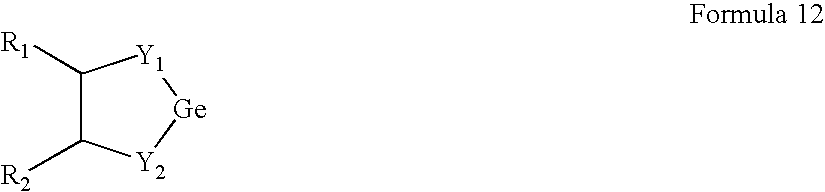
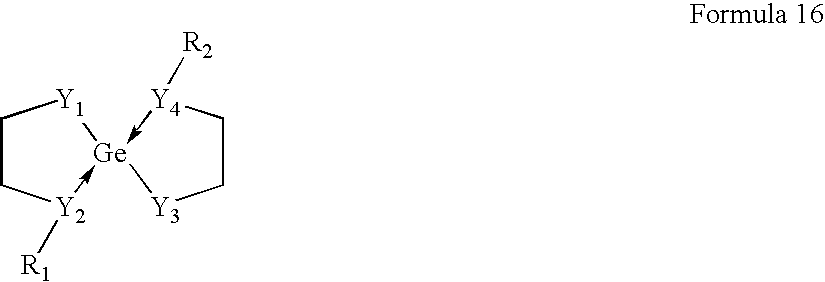
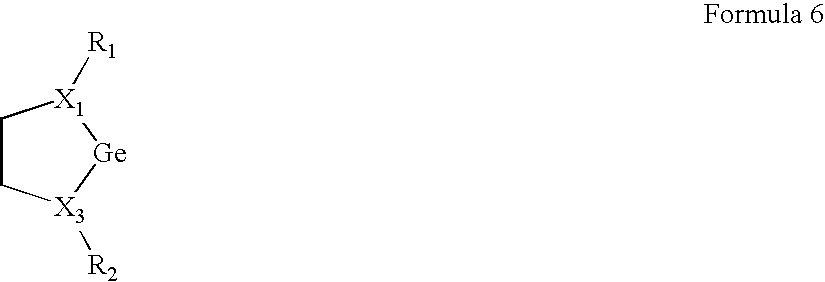
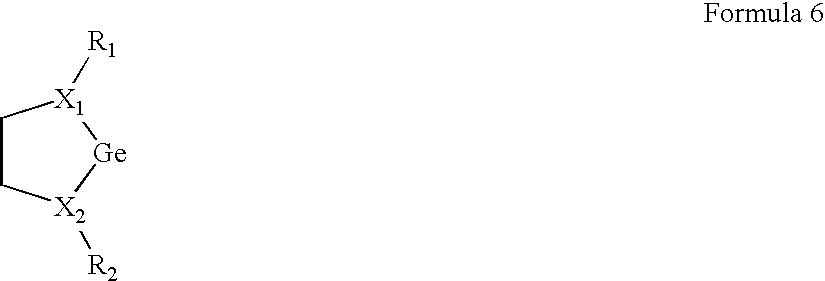
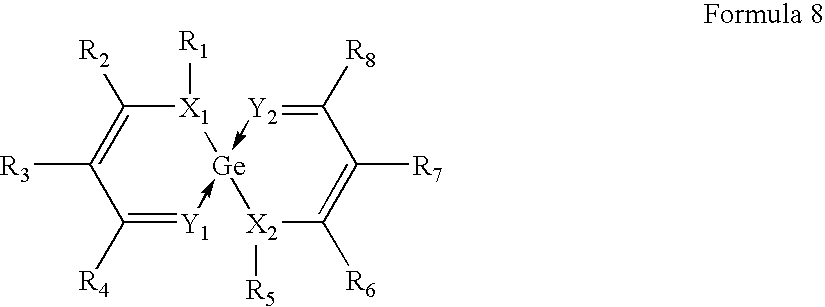
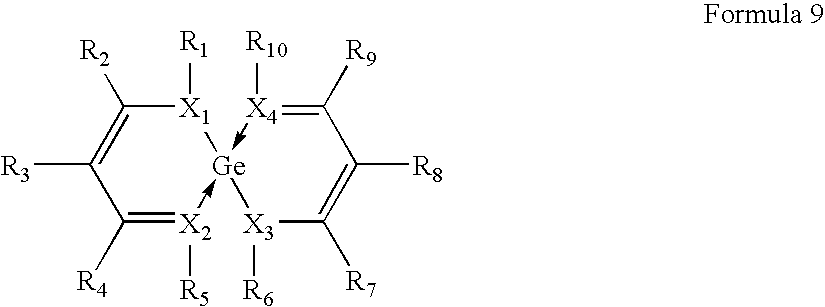
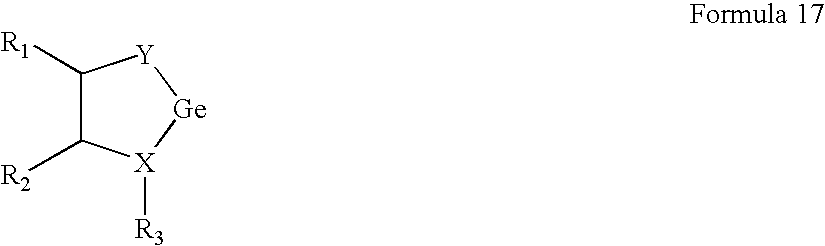
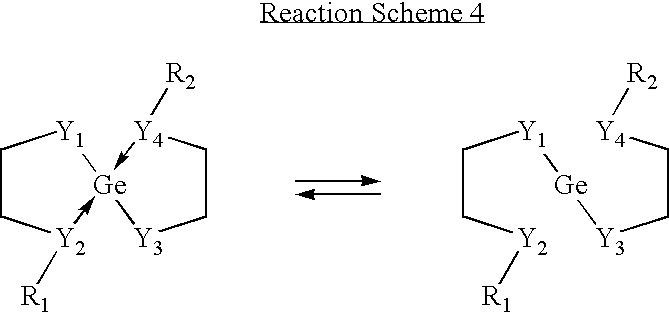
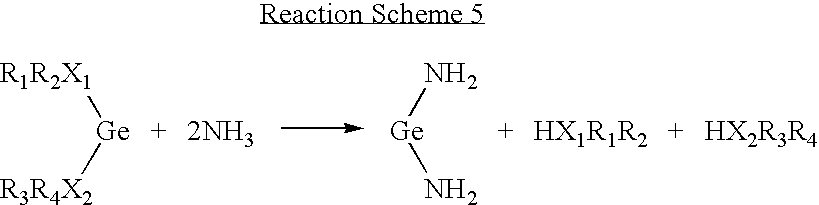
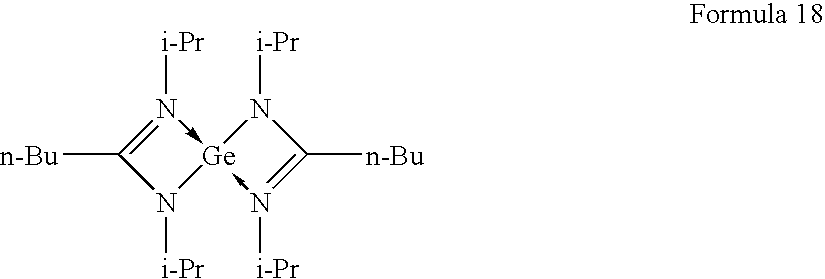
A claim of priority is made to Korean Patent Application No. 10-2007-0102585, filed Oct. 11, 2007, in the Korean Intellectual Property Office, the disclosure of which is incorporated herein in its entirety by reference. The present invention generally relates to methods of forming a phase change material layer using a Ge(II) source, and to methods of fabricating a phase change memory device. Chalcogenide is responsive to temperature conditions to as to be stably transformed between crystalline and amorphous states. The crystalline state has a lower specific resistance than the amorphous state, and this phase change property can be utilized to store data. A phase change random access memory (PRAM) is one example of a memory device which utilizes the phase change characteristics of chalcogenide to store data. Each unit memory cell of a PRAM generally includes an access device and a phase change resistor which may, for example, be electrically connected between a bit line and a word line of the PRAM. The phase change resistor is a variable resistor and generally includes a phase change material film disposed between a lower electrode and an upper electrode. Typically, the access device is electrically connected to the lower electrode. As shown in The heat treatment itself is achieved by controlling a write current through the phase change resistor to create joule heating conditions which result in temperature profiles that mirror those illustrated in As mentioned above, the present invention generally relates to methods of forming a phase change material layer using a Ge(II) source and methods of fabricating a phase change memory device. According to an aspect of the present invention, a method of forming a phase change material layer is provided. The method includes supplying a reaction gas including the composition of Formula 1 into a reaction chamber, supplying a first source which includes Ge(II) into the reaction chamber, and supplying a second source into the reaction chamber. Formula 1 is NR1R2R3, where R1, R2and R3are each independently at least one selected from the group consisting of H, CH3, C2H5, C3H7, C4H9, Si(CH3)3, NH2, NH(CH3), N(CH3)2, NH(C2H5) and N(C2H5)2. According to another aspect of the present invention, a method of forming a phase change material layer is provided. The method include supplying a first source including Ge(II) into a reaction chamber, and supplying a second source into the reaction chamber. According to still another aspect of the present invention, a method of fabricating a phase change memory device is provided. The method includes loading a substrate including a lower electrode in a reaction chamber, forming a Ge-containing phase change material layer on the lower electrode by supplying a reaction gas including the composition of Formula 1, a first source including Ge(II), and a second source into the reaction chamber in which the substrate is loaded, and forming an upper electrode on the phase change material layer. Formula 1 is NR1R2R3, where R1, R2and R3are each independently at least one selected from the group consisting of H, CH3, C2H5, C3H7, C4H9, Si(CH3)3, NH2, NH(CH3), N(CH3)2, NH(C2H5) and N(C2H5)2. The above and other aspects and features of the present invention will become readily apparent from the detailed description that follows, with reference to the accompanying drawings, in which: The present invention will now be described more fully with reference to the accompanying drawings, in which exemplary embodiments of the invention are shown. The invention may, however, be embodied in many different forms and should not be construed as being limited to the embodiments set forth herein; rather, these embodiments are provided to present a thorough and complete disclosure, and to fully convey concepts of the invention to those skilled in the art. In the drawings, the relative thicknesses of layers and regions are not necessarily drawn to scale and are exaggerated for clarity. To avoid redundancy in the disclosure, like reference numerals denote the same or similar elements throughout the drawings. Referring to The reaction chamber may, for example, be a cold wall type reaction chamber or a hot wall type reaction chamber. Generally, a cold wall type reaction chamber is capable of processing a single substrate at a time, and includes a substrate stage having heating wires and a shower head located on the substrate stage. On the other hand, the hot wall type reaction chamber includes heating wires in a wall thereof, such that multiple substrates can be vertically stacked within the chamber and batched processed at the same time. In any event, the embodiment is not limited to any particular type of reaction chamber. Referring again to the example of In the preceding paragraph and throughout this disclosure, the word “independently” means that any two or more of R1, R2and R3can be the same as each other, or R1, R2and R3can all be different from each other. The representation of Formula 1 includes non-ring systems, and ring systems in which two or more of R1, R2and R3are bonded to each other. In other words, according to Formula 1, two or more of R1, R2and R3may or may not be bonded to each other. As one particular example, the reaction gas is an NH2gas. Other specific examples of the reaction gas any one or more of ammonia, primary amine and hydrazine. Referring again to The Ge(II) source may, for example, be supplied together with a carrier gas. Examples of the carrier gas include an inert gas such as argon (Ar), helium (He) or nitrogen (N2). As another example, the Ge(II) source may be supplied into the reacton chamber by being dissolved in a solvent and rapidly gasified in a gasifier. Examples of Ge(II) source include an amide ligand, a phosphanido ligand, an alkoxide ligand or a thiolate ligand. In the case where the Ge(II) source includes an amide ligand and/or a phosphanido ligand, the Ge(II) source may include a composition represented by Formula 2 below:
The representation of Formula 2 includes non-ring systems, and ring-systems in which two or more of R1, R2, R3and R4are bonded to each other. In other words, according to Formula 2, two or more of R1, R2, R3and R4may or may not be bonded to each other. In the case where the Ge(II) source includes an alkoxide ligand and/or a thiolate ligand, the Ge(II) source may include a composition represented by Formula 3 below:
The representation of Formula 2 includes non-ring systems, and ring systems in which R1and R2are bonded to each other. In other words, according to Formula 3, R1and R2may or may not be bonded to each other. In the case where the Ge(II) source includes one of the amide ligand and the phosphanido ligand; and one of the alkoxide ligand and the thiolate ligand, the Ge(II) may include a composition represented by Formula 4 below:
The representation of Formula 4 includes non-ring systems, and ring systems in which two or more of R1, R2and R3are bonded to each other. In other words, according to Formula 4, two or more of R1, R2and R3may or may not be bonded to each other. Examples of Ge(II) source compositions represented by Formula 2 are presented below as Formulae 5 to 11: Examples of Ge(II) source compositions represented by Formula 3 are presented below as Formulae 12 to 16: AN example of a Ge(II) source composition represented by Formula 4 is presented below as Formula 17: When compared to a Ge(IV) source, the Ge(II) sources described above exhibit fewer ligands and a weaker covalent bond property between the Ge and the ligands. According, steric hindrance caused by ligands is relatively weak in the Ge(II) source. Even when the number of ligands of the Ge(II) source and Ge(IV) source is the same, a dative bond among the Ge-ligand bonds of the Ge(II) source may be relatively easily disconnected by heat of the reaction chamber, and thus the Ge (II) source is transformed to a structure with low steric hindrance due to the reduced number of the ligands linked to Ge. Accordingly, the Ge(II) source exhibits improved reactivity when compared to the Ge(IV) source, and thus a temperature required to form the phase change material layer can be reduced. In particular, for example, the Ge(II) source represented by Formulae 5, 6, 12, 13 and 17 has two atoms linked to Ge, and thus steric hindrance is relatively low. The Ge(II) source represented by Formulae 7, 8, 9 and 14 has four atoms linked to Ge, but the steric hindrance is still relatively low since the top and bottom of the Ge are sterically opened since two ligands of both sides of Ge are almost in the same plane. The Ge(II) source represented by Formulae 10, 11, 15 and 16 also has four atoms linked to Ge, but the steric hindrance is also relatively low since the Ge(II) source is transformed to a structure having two atoms linked to Ge because a dative bond among the Ge-ligand bonds is easily disconnected by heat of the reaction chamber as shown in Reaction Schemes 1 to 4. In Reaction Scheme 1, X1, X2, X3and X4are each independently N or P, and R1, R2, R3, R4, R5and R6are each independently a hydrogen atom, a C1-C10alkyl group, a C2-C12olefinic group, a C2-C13acetylenic group or an allenic group. In Reaction Scheme 2, X1and X2are each independently N or P, Y1and Y2are each independently O or S, and R1, R2, R3and R4are each independently a hydrogen atom, a C1-C10alkyl group, a C2-C12olefinic group, a C2-C13acetylenic group or an allenic group. In Reaction Scheme 3, X1and X2are each independently N or P, Y1and Y2are each independently O or S, and R1, R2, R3and R4are each independently a hydrogen atom, a C1-C10alkyl group, a C2-C12olefinic group, a C2-C13acetylenic group or an allenic group. In Reaction Scheme 4, Y1, Y2, Y3and Y4are each independently O or S, and R1and R2are each independently a hydrogen atom, a C1-C10alkyl group, a C2-C12olefinic group, a C2-C13acetylenic group or an allenic group. Returning once again to The second source may also be supplied into the reaction chamber with a carrier gas. Examples of the carrier gas include an inert gas such as argon (Ar), helium (He) or nitrogen (N2). As an alternative example, the second source may be supplied into the reaction chamber by being dissolved in a solvent and rapidly gasified in a gasifier. Examples of the second source include one or more of a Te source, a Sb source, a Bi source, an As source, a Sn source, an O source, an Au source, a Pd source, a Se source, a Ti source and a S source. The resultant Ge-containing phase change material layer may, for example, be formed as a Ge—Sb—Te layer, Ge—Bi—Te layer, Ge—Sb layer, Ge—Te—As layer, Ge—Te—Sn layer, Ge—Te layer, Ge—Te—Sn—O layer, Ge—Te—Sn—Au layer, Ge—Te—Sn—Pd layer, Ge—Te—Se layer, Ge—Te—Ti layer, (Ge, Sn)—Sb—Te layer, Ge—Sb—(Se, Te) layer or Ge—Sb—Te—S layer. The Ge-containing phase change material layer may also include one or more impurities such as N, O, Bi, Sn, B, Si or a combination thereof. For example, when a Te source and/or a Sb source is supplied as the second source, the Ge-containing phase change material layer formed on the substrate may be Ge—Sb—Te layer, Ge—Te layer or Ge—Sb layer. Specific examples of the Te source include Te(CH3)2, Te(C2H5)2, Te(n-C3H7)2, Te(i-C3H7)2, Te(t-C4H9)2, Te(i-C4H9)2, Te(CH═CH2)2, Te(CH2CH═CH2)2, or Te[N(Si(CH3)3)2]2. Specific examples of the Sb source include Sb(CH3)3, Sb(C2H5)3, Sb(i-C3H7)3, Sb(n-C3H7)3, Sb(i-C4H9)3, Sb(t-C4H9)3, Sb(N(CH3)2)3, Sb(N(CH3)(C2H5))3, Sb(N(C2H5)2)3, Sb(N(i-C3H7)2)3or Sb[N(Si(CH3)3)2]3. The Ge(II) source may react with the reaction gas to form a Ge(II) intermediate in which ligands neighboring the Ge are substituted by the reaction gas. The Ge(II) intermediate may include two NR1R2ligands, wherein R1and R2are each independently H, CH3, C2H5, C3H7, C4H9, Si(CH3)3, NH2, NH(CH3), N(CH3)2, NH(C2H5) or N(C2H5)2around Ge. Here, since reactivity between the Ge(II) source and the reaction gas is improved when compared to the reactivity between the Ge(IV) source and the reaction gas, the reaction temperature may be reduced. For example, the Ge(II) source represented by Formula 5 reacts with ammonia to form a Ge(II) intermediate as shown in Reaction Scheme 5 below. In Reaction Scheme 5, X1and X2are each independently N or P, and R1, R2, R3and R4are each independently a hydrogen atom, a C1-C10alkyl group, a C2-C12olefinic group, a C2-C13acetylenic group or an allenic group. The Ge(II) intermediate may react with the second source to form a Ge-containing phase change material layer. For example, the Ge(II) intermediate prepared according to Reaction Scheme 5 reacts with a Te source to form a phase change material layer as shown in Reaction Scheme 6 below. In Reaction Scheme 6, R′ is CH(CH3)2. The Ge(II) intermediate is highly reactive with the second source. Further, similar to the Ge(II) source, the Ge(II) intermediate exhibits low steric hindrance by ligands. As a result, the reaction temperature may be further reduced, and the deposition temperature of the Ge-containing phase change material layer may be reduced. For example, the deposition temperature of the Ge-containing phase change material layer may be less than 300° C., and further, may be 200° C. or less. The grain size of a phase change material layer deposited at such a low temperature is smaller than that of a phase change material layer deposited at a higher temperature. A smaller grain size improves step coverage, which allows a conformal phase change material layer to be formed on the side wall of a contact hole or trench without blocking the hole or trench inlet, thereby avoid the formation of voids within the hole or trench. The Ge-containing phase change material layer may, for example, be formed using chemical vapor deposition (CVD) or atomic layer deposition (ALD). Referring to Referring to Then, physically adsorbed Ge(II) source and Te source; and unreacted Ge(II) source and Te source are removed by supplying the first carrier gas and the first reaction gas to the reaction chamber while the supply of the sources is suspended for time T2 (second operation). A Sb source and a Te source are injected to the reaction chamber while supplying a second carrier and a second reaction gas to the reaction chamber for time T3 to form a Sb—Te layer, for example, a Sb2Te3layer (third operation). The second reaction gas may independently include hydrogen (H2), oxygen (O2), ozone (O3), water vapor (H2O), silane (SiH4), diborane (B2H6), hydrazine (N2H4), primary amine or ammonia (NH3), and the second carrier gas may independently include an inert gas such as argon (Ar), helium (He) or nitrogen (N2). Physically adsorbed Sb source and Te source, and unreacted Sb source and Te source are removed by supplying the second carrier gas and the second reaction gas to the reaction chamber while the supply of the sources is suspended for time T4 (fourth operation). A unit cycle including the first to fourth operations (T1˜T4) may be repeated to form a Ge—Sb—Te layer, for example, a Ge—Sb—Te layer having Ge2Sb2Te5composition. Each of the Ge(II) source, the Sb source and the Te source may be injected at 10 to 1000 sccm for 0.1 to 60 seconds. Referring to A gate spacer insulating layer is stacked on the substrate 100 on which the low concentration impurity region 101 The low concentration impurity region 101 A first interlayer insulating layer 120 is formed on the substrate 100 on which the source/drain regions 102 and 103 are formed, and a contact plug 125 passing through the first interlayer insulating layer 120 and connected to the drain region 103 is formed within the first interlayer insulating layer 120. The contact plug 125 may, for example, be formed of a tungsten layer. A lower electrode 135 covering the contact plug 125 is formed on the contact plug 125. The lower electrode 135 may, for example, be formed of a titanium nitride layer (TiN), a titanium aluminum nitride layer (TiAlN), a tantalum nitride layer (TaN), a tungsten nitride layer (WN), a molybdenum nitride layer (MoN), a niobium nitride layer (NbN), a titanium silicon nitride layer (TiSiN), a titanium boron nitride layer (TiBN), a zirconium silicon nitride layer (ZrSiN), a tungsten silicon nitride layer (WSiN), a tungsten boron nitride layer (WBN), a zirconium aluminum nitride layer (ZrAlN), a molybdenum aluminum nitride layer (MoAlN), a tantalum silicon nitride layer (TaSiN), a tantalum aluminum nitride layer (TaAlN), a titanium tungsten layer (TiW), a titanium aluminum layer (TiAl), a titanium oxynitride layer (TiON), a titanium aluminum oxynitride layer (TiAlON), a tungsten oxynitride layer (WON) or a tantalum oxynitride layer (TaON). A mold insulating layer 140 is formed on the lower electrode 135, and a via hole 140 Then, a phase change material layer 150 is formed on the substrate on which the via hole 140 Referring to Referring to Referring to The substrate on which the buffer insulating layer 155 is formed is planarized to expose the upper surface of the phase change material spacer 153. For example, the substrate may be planarized to the dashed line shown in Referring to Described next are a number of Experimental Examples (1˜13) and Comparative Examples (1˜2). A substrate was loaded in a reaction chamber. Ar as a carrier gas was supplied into the reaction chamber at 500 sccm and NH3as a reaction gas was supplied into the reaction chamber at 100 sccm. A Ge(II) source represented by Formula 18 below was supplied into the reaction chamber at 100 sccm. Simultanesouly, Te(CH(CH3)2)2was supplied into the reaction chamber at 100 sccm to form a GeTe layer on the substrate. The supply of the Ge(II) source and the Te(CH(CH3)2)2was performed for 900 seconds. The temperature of a heater of the reaction chamber was set to 320° C. A GeTe layer was formed on the substrate in the same manner as in Experimental Example 1, except that the temperature of a heater of the reaction chamber was set to 280° C. A GeTe layer was formed on the substrate in the same manner as in Experimental Example 1, except that the temperature of a heater of the reaction chamber was set to 240° C. A GeTe layer was formed on the substrate in the same manner as in Experimental Example 1, except that the temperature of a heater of the reaction chamber was set to 200° C. A substrate was loaded in a reaction chamber. Ar as a carrier gas was supplied into the reaction chamber at 500 sccm and NH3as a reaction gas was supplied into the reaction chamber at 100 sccm. A Ge(II) source represented by Formula 19 below was supplied into the reaction chamber at 100 sccm. Simultanesouly, Te(CH(CH3)2)2was supplied into the reaction chamber at 100 sccm to form a GeTe layer on the substrate. The supply of the Ge(II) source and the Te(CH(CH3)2)2was performed for 900 seconds. The temperature of a heater of the reaction chamber was set to 320° C. A GeTe layer was formed on the substrate in the same manner as in Experimental Example 5, except that the temperature of a heater of the reaction chamber was set to 280° C. A GeTe layer was formed on the substrate in the same manner as in Experimental Example 5, except that the temperature of a heater of the reaction chamber was set to 240° C. A substrate was loaded in a reaction chamber. Ar as a carrier gas was supplied into the reaction chamber at 500 sccm and H2as a reaction gas was supplied into the reaction chamber at 100 sccm. A Ge(II) source represented by Formula 18 was supplied into the reaction chamber at 100 sccm. Simultanesouly, Te(CH(CH3)2)2was supplied into the reaction chamber at 100 sccm to form a GeTe layer on the substrate. The supply of the Ge(II) source and the Te(CH(CH3)2)2was performed for 900 seconds. The temperature of a heater of the reaction chamber was set to 320° C. A GeTe layer was formed on the substrate in the same manner as in Experimental Example 8, except that the temperature of a heater of the reaction chamber was set to 280° C. A GeTe layer was formed on the substrate in the same manner as in Experimental Example 8, except that the temperature of a heater of the reaction chamber was set to 240° C. A substrate was loaded in a reaction chamber. Ar as a carrier gas was supplied into the reaction chamber at 500 sccm and H2as a reaction gas was supplied into the reaction chamber at 100 sccm. A Ge(II) source represented by Formula 19 was supplied into the reaction chamber at 100 sccm. Simultanesouly, Te(CH(CH3)2)2was supplied into the reaction chamber at 100 sccm to form a GeTe layer on the substrate. The supply of the Ge(II) source and the Te(CH(CH3)2)2was performed for 900 seconds. The temperature of a heater of the reaction chamber was set to 320° C. A GeTe layer was formed on the substrate in the same manner as in Experimental Example 11, except that the temperature of a heater of the reaction chamber was set to 280° C. A GeTe layer was formed on the substrate in the same manner as in Experimental Example 11, except that the temperature of a heater of the reaction chamber was set to 240° C. A substrate was loaded in a reaction chamber. Ar as a carrier gas was supplied into the reaction chamber at 500 sccm and NH3as a reaction gas was supplied into the reaction chamber at 100 sccm. Ge(N(CH3)2)4as a Ge(IV) source was supplied into the reaction chamber at 100 sccm. Simultanesouly, Te(CH(CH3)2)2was supplied into the reaction chamber at 100 sccm to form a GeTe layer on the substrate. The supply of the Ge(IV) source and the Te(CH(CH3)2)2was performed for 900 seconds. The temperature of a heater of the reaction chamber was set to 320° C. A GeTe layer was formed on the substrate in the same manner as in Comparative Example 1, except that the temperature of a heater of the reaction chamber was set to 280° C. Experimental conditions of Experimental Examples 1 to 13, and Comparative Examples 1 and 2, and deposition rates of the resultant GeTe layers are shown in Table 1 below. Referring to Table 1, when the reaction gas was NH3, a phase change material layer was formed at a temperature less than 300° C., that is, at 280° C., at 240° C., and even at 200° C. using the Ge(II) source of Formula 18. However, when using the Ge(IV) source, a phase change material layer was not formed at a temperature less than 300° C. A phase change material layer was also be formed at a temperature less than 300° C., that is, at 280° C. and at 240° C. using the Ge(II) source of Formula 19. When the reaction gas was H2, a phase change material layer was formed at a temperature less than 300° C., that is, at 280° C. and at 240° C. using the Ge(II) source of Formula 18. However, the deposition rate of the phase change material layer at 280° C. and 240° C. was relatively low. The same result was obtained when using the Ge(II) source of Formula 19. While the present invention has been particularly shown and described with reference to exemplary embodiments thereof, it will be understood by those of ordinary skill in the art that various changes in form and details may be made therein without departing from the spirit and scope of the present invention as defined by the following claims.PRIORITY CLAIM
SUMMARY
BRIEF DESCRIPTION OF THE DRAWINGS
DETAILED DESCRIPTION OF EMBODIMENTS
NR1R2R3 Formula 1
wherein R1, R2and R3are each independently H, CH3, C2H5, C3H7, C4H9, Si(CH3)3, NH2, NH(CH3), N(CH3)2, NH(C2H5) or N(C2H5)2.
R1R2X1—Ge—X2R3R4 Formula 2
wherein X1and X2are each independently at least one of N and P, and wherein R1, R2, R3and R4are each independently at least one (i.e., one or a combination of two or more) selected from the group consisting of (a) a hydrogen atom, (b) a C1-C10alkyl group, (c) a C1-C10alkyl group, where CH3is substituted with an imine group, an amine group, an alkoxy group or a ketone group, (d) a C1-C10alkyl group, where CH3is substituted with an imine group, an amine group, an alkoxy group or a ketone group, and where N of the imine group, N of the amine group, O of the alkoxy group or O of the ketone group is coordinated with Ge, (e) a C2-C12olefinic group, (f) a C3-C12olefinic group, where CH3is substituted with an imine group, an amine group, an alkoxy group or a ketone group, (g) a C3-C12olefinic group, where CH3is substituted with an imine group, an amine group, an alkoxy group or a ketone group, and where N of the imine group, N of the amine group, O of the alkoxy group or O of the ketone group is coordinated with Ge, (h) a C2-C13acetylenic group, (i) an allenic group (CHCCH2), (j) a cyano group (CN), (k) a NCX group, wherein X is O, S, Se or Te, (l) an azide ligand (N3), (m) an amide ligand (NR5R6, where R5and R6are each independently a hydrogen atom, a C1-C10alkyl group, a C2-C12olefinic group, a C2-C13acetylenic group or an allenic group), and (n) SiR7R8R9, where R7, R8and R9are each independently a hydrogen atom, a C1-C10alkyl group, a C2-C12olefinic group, a C2-C13acetylenic group or an allenic group.
R1Y1—Ge—Y2R2 Formula 3
wherein Y1and Y2are each independently at least one of O and S, and wherein R1and R2are each independently at least one selected from the group consisting of (a) a hydrogen atom, (b) a C1-C10alkyl group, (c) a C1-C10alkyl group, where CH3is substituted with an imine group, an amine group, an alkoxy group or a ketone group, (d) a C1-C10alkyl group, where CH3is substituted with an imine group, an amine group, an alkoxy group or a ketone group, and where N of the imine group, N of the amine group, O of the alkoxy group or O of the ketone group is coordinated with Ge, (e) a C2-C12olefinic group, (f) a C3-C12olefinic group, where CH3is substituted with an imine group, an amine group, an alkoxy group or a ketone group, (g) a C3-C12olefinic group, where CH3is substituted with an imine group, an amine group, an alkoxy group or a ketone group, and where N of the imine group, N of the amine group, O of the alkoxy group or O of the ketone group is coordinated with Ge, (h) a C2-C13acetylenic group, (i) an allenic group (CHCCH2), (j) a cyano group (CN), (k) a NCX group, where X is O, S, Se or Te, (l) an azide ligand (N3), (m) an amide ligand (NR3R4, where R3and R4are each independently a hydrogen atom, a C1-C10alkyl group, a C2-C12olefinic group, a C2-C13acetylenic group or an allenic group), and (n) SiR5R6R7, where R5, R6and R7are each independently a hydrogen atom, a C1-C10alkyl group, a C2-C12olefinic group, a C2-C13acetylenic group or an allenic group.
R1R2X—Ge—YR3 Formula 4
wherein X is at least one of N and P, wherein Y is at least one of O and S, and wherein R1, R2and R3are each independently at least one selected from the group consisting of (a) a hydrogen atom, (b) a C1-C10alkyl group, (c) a C1-C10alkyl group, where CH3is substituted with an imine group, an amine group, an alkoxy group or a ketone group, (d) a C1-C10alkyl group, where CH3is substituted with an imine group, an amine group, an alkoxy group or a ketone group, and where N of the imine group, N of the amine group, O of the alkoxy group or O of the ketone group is coordinated with Ge, (e) a C2-C12olefinic group, (f) a C3-C12olefinic group, where CH3is substituted with an imine group, an amine group, an alkoxy group or a ketone group, and where N of the imine group, N of the amine group, O of the alkoxy group or O of the ketone group is coordinated with Ge, (g) a C2-C13acetylenic group, (h) an allenic group (CHCCH2), (i) a cyano group (CN), (j) a NCX group, where X is O, S, Se or Te, (k) an azide ligand (N3), (l) an amide ligand (NR4R5, where R4and R5are each independently a hydrogen atom, a C1-C10alkyl group, a C2-C12olefinic group, a C2-C13acetylenic group or an allenic group), and (m) SiR6R7R8, where R6, R7and R8are each independently a hydrogen atom, a C1-C10alkyl group, a C2-C12olefinic group, a C2-C13acetylenic group or an allenic group.
wherein X1and X2are each independently N or P, and wherein R1, R2, R3and R4are each independently one selected from the group consisting of a hydrogen atom, a C1-C10alkyl group, a C2-C12olefinic group, a C2-C13acetylenic group and an allenic group;
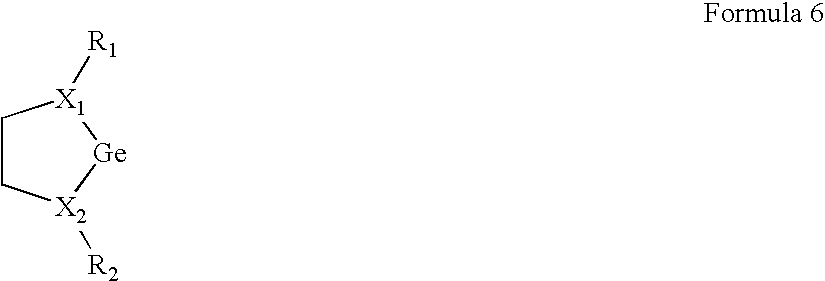
wherein X1and X2are each independently N or P, and wherein R1and R2are each independently one selected from the group consisting of a hydrogen atom, a C1-C10alkyl group, a C2-C12olefinic group, a C2-C13acetylenic group and an allenic group;
wherein X1, X2, X3and X4are each independently N or P, and wherein R1, R2, R3, R4, R5and R6are each independently one selected from the group consisting of a hydrogen atom, a C1-C10alkyl group, a C2-C12olefinic group, a C2-C13acetylenic group and an allenic group;
wherein X1and X2are each independently N or P, wherein Y1and Y2are each independently O or S, and wherein R1, R2, R3, R4, R5, R6, R7and R8are each independently one selected from the group consisting of a hydrogen atom, a C1-C10alkyl group, a C2-C12olefinic group, a C2-C13acetylenic group and an allenic group;
wherein X1, X2, X3and X4are each independently N or P, and wherein R1, R2, R3, R4, R5, R6, R7, R8, R9and R10are each independently one selected from the group consisting of a hydrogen atom, a C1-C10alkyl group, a C2-C12olefinic group, a C2-C13acetylenic group and an allenic group;
wherein X1, X2, X3and X4are each independently N or P, and wherein R1, R2, R3, R4, R5and R6are each independently one selected from the group consisting of a hydrogen atom, a C1-C10alkyl group, a C2-C12olefinic group, a C2-C13acetylenic group and an allenic group; and
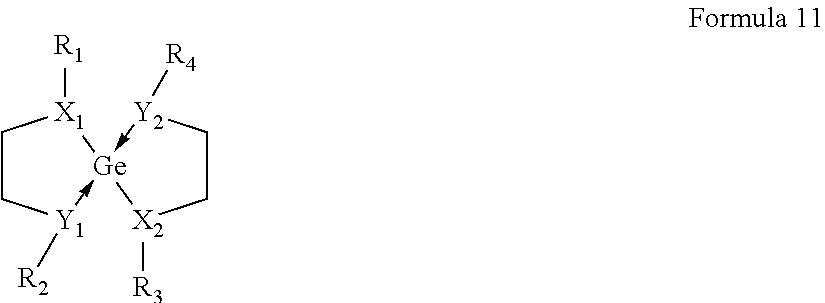
wherein X1and X2are each independently N or P, wherein Y1and Y2are each independently O or S, and wherein R1, R2, R3and R4are each independently one selected from the group consisting of a hydrogen atom, a C1-C10alkyl group, a C2-C12olefinic group, a C2-C13acetylenic group and an allenic group.
wherein Y1and Y2are each independently O or S, and wherein R1and R2are each independently one selected from the group consisting of a hydrogen atom, a C1-C10alkyl group, a C2-C12olefinic group, a C2-C13acetylenic group and an allenic group;
wherein X1and X2are each independently N or P, wherein Y1and Y2are each independently O or S, and wherein R1, R2, R3and R4are each independently selected from the group consisting of a hydrogen atom, a C1-C10alkyl group, a C2-C12olefinic group, a C2-C13acetylenic group and an allenic group; and
wherein Y1, Y2, Y3and Y4are each independently O or S, and wherein R1and R2are each independently one selected from the group consisting of a hydrogen atom, a C1-C10alkyl group, a C2-C12olefinic group, a C2-C13acetylenic group and an allenic group.
wherein X is N or P, wherein Y is O or S, and wherein R1, R2and R3are each independently one selected from the group consisting of a hydrogen atom, a C1-C10alkyl group, a C2-C12olefinic group, a C2-C13acetylenic group and an allenic group.
Experimental Example 1
Experimental Example 2
Experimental Example 3
Experimental Example 4
Experimental Example 5
Experimental Example 6
Experimental Example 7
Experimental Example 8
Experimental Example 9
Experimental Example 10
Experimental Example 11
Experimental Example 12
Experimental Example 13
Comparative Example 1
Comparative Example 2
Experimental Ge(II) NH3 320 12 Example 1 source of Experimental Formula 18 280 10 Example 2 Experimental 240 7 Example 3 Experimental 200 3 Example 4 Experimental Ge(II) 320 8 Example 5 source of Experimental Formula 19 280 4 Example 6 Experimental 240 2 Example 7 Comparative Ge(IV) 320 Deposited Example 1 source Comparative Ge(N(CH3)2)4 280 Not deposited Example 2 Experimental Ge(II) H2 320 4 Example 8 source of Experimental Formula 18 280 0.7 Example 9 Experimental 240 0.1 Example 10 Experimental Ge(II) 320 3 Example 11 source of Experimental Formula 19 280 0.8 Example 12 Experimental 240 0.1 Example 13